

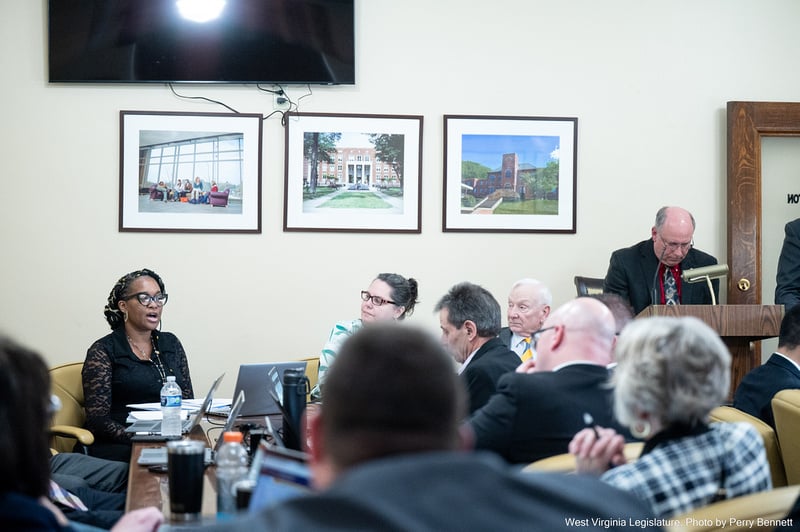
Members of the House Education Committee advanced a bill characterized as banning diversity, equity and inclusion practices in state government.
No one spoke in favor of the legislation, although there were some comments in opposition. The committee vote was 15-7 with three absences.
The bill is also assigned to the House Judiciary Committee for review.
Senate Bill 474 aims to eliminate initiatives related to diversity, equity, and inclusion from all departments, divisions, agencies, boards, public primary and secondary schools, and institutions of higher education.

Delegate Mike Pushkin, D-Kanawha, said diversity, equity and inclusion should not be considered societal negatives.
“Those are all good things, but this bill does it lumps all these words into one catch phrase, redefines three good words as something bad, as something we could pin problems on — and that’s at the very best,” Pushkin said.
He asked, “Why are we even doing it? What’s the problem? Is West Virginia too diverse?”
Ninety-three percent of West Virginia’s population is White and almost 4% of residents are Black, according to the U.S. Census. About 2% of state residents are Hispanic.
Gov. Patrick Morrisey has called for ending DEI initiatives across state government. The acronym stands for diversity, equity and inclusion.
It’s a set of policies in business, government and academia aimed at promoting the fair treatment and full participation of all people, particularly groups who have historically been underrepresented or subject to discrimination based on identity or disability.
Social conservatives have taken aim at the policies as a kind of reverse discrimination.
This bill includes the executive branch, primary and secondary schools, and higher education institutions.
The bill restricts the imposition of certain concepts related to race and gender on students and employees, and prevents employees from being compelled to use preferred pronouns that do not align with a student’s biological sex at birth.
It calls for official neutrality on associated terms such as unconscious or implicit bias, cultural appropriation, identity group allyship, micro aggressions, group marginalization, systemic oppression, social justice, intersectionality, neo-pronouns, racial privilege and critical race theory.
The bill forbids establishing or maintaining an office or division meant to promote diversity, equity and inclusion. And it prohibits directing an employee or contracted third party to promote diversity, equity and inclusion.
It would not allow requiring any person to provide a diversity, equity, and inclusion statement or give preferential consideration to any person based on the provision of a diversity, equity, and inclusion statement.
It would prohibit giving employment preference on the basis of diversity, equity, and inclusion, and it would disallow requiring as a condition of employment that an employee participate in diversity, equity, and inclusion training.

“So in West Virginia, are there any cases where people were hired and it wasn’t based on merit?” Delegate Anitra Hamilton, D-Monongalia, asked.
The answer from the committee’s counsel was no.
Hamilton later said of the bill, “I think this is a poor piece of legislation that is written to divide us.”