

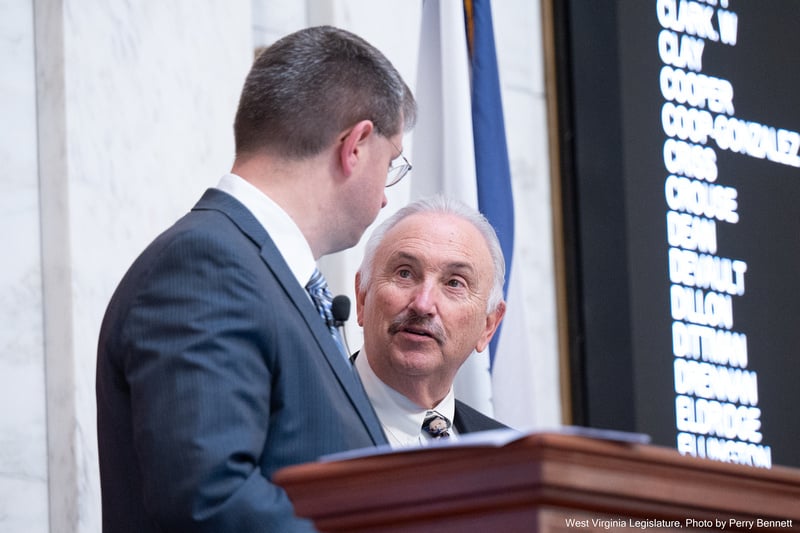
The full House of Delegates passed a $5.115 billion general revenue budget bill on Friday, kicking it to the Senate for the upcoming final week of the regular legislative session.
When the regular legislative session began, Gov. Patrick Morrisey and his representatives provided a revenue estimate for the coming fiscal year of $5.323 billion and proposed a general revenue budget that spent that same amount.
The House budget bill now goes to the state Senate, which rolled out its own version this week, proposing to spend just about a million dollars less than the governor’s version.
By the end, lawmakers aim to reach agreement on a final version.
“This is the first step that we do. It is our year to do it first. So the vessel that we have passed out today will be sent to the Senate,” House Finance Chairman Vernon Criss, R-Wood, said in an interview after the House floor session.
Monday will kick off final negotiations, with Criss anticipating that he and his finance staff will huddle alongside their Senate counterparts “to determine where the differences are and come to some kind of mutual agreement and before the end of next week, obviously, we will have a compromise budget that both the House and Senate will have.”
Criss did not describe any differences as major.
“It becomes a compromise at some point,” Criss said, “and that’s what you’ll end up having here by the end of next week.”
On the House floor, Criss fielded a series of questions about the specifics and intent.
“Did we leave any money on the table?” asked Delegate Kayla Young, D-Kanawha.
“Yes, we left a cushion,” said Criss, adding that amounts to $207 million in place for additional spending if the dollars remain available at the end of the fiscal year.
Young continued with her questions.
“At the beginning, you mentioned that unlike in previous years we did not go off of the governor’s budget. We went off last year’s budget. Why is that?” she asked.
“Because the governor’s budget was going to spend every dollar and did not have a reserve account,” Criss responded, adding that he also wanted to produce a bill with more specific line items than the one the administration initially provided.
Young followed up by asking about Gov. Patrick Morrisey’s pre-session conclusion that the state faced a $400 million budget gap: “I remember that earlier this year, he mentioned we were going to be about $400 million under. Is that the case in this budget?”
“It’s not,” Criss said. “Never was.”
“Oh!” Young said. “OK!”
The House budget bill passed on Friday by an 80-17 margin with three absences.
Delegate John Williams, D-Monongalia, was one of the delegates who voted against the bill.
“We’re not funding essential programs enough,” Williams said after the floor session. “We took roughly $32 million from waiver programs, which are under Medicaid. We took $15 million away from West Virginia University. We’re not prioritizing things like childcare.
“At the end of the day the services that West Virginians are getting are subpar compared to what they used to get, and it’s all in the name of flat budgeting, but all that we’re doing is we’re cutting services to our people and you can see out in our communities that it’s hurting actual West Virginians.”