

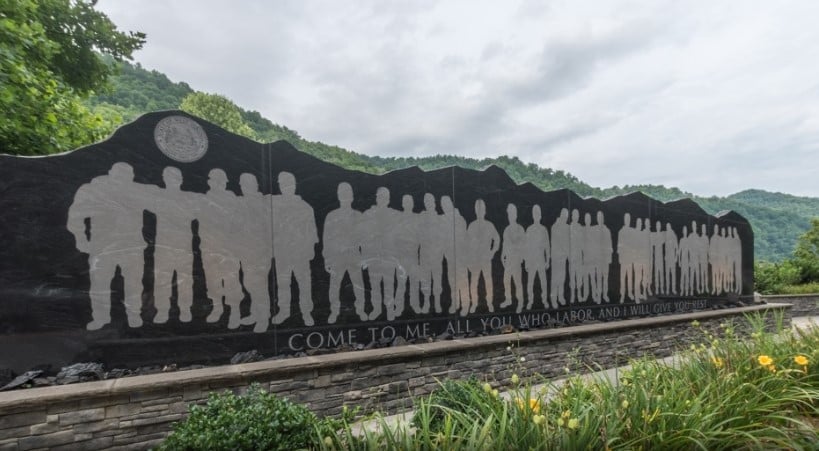
MONTCOAL, W.Va. — A granite marker in the town of Whitesville serves as the constant reminder of what happened on April 5, 2010 only a few miles away. The black monument features the silhouettes of 29 men, grouped together and forever remembered as victims of the worst mine disaster in West Virginia since the 1968 Farmington mine explosion.
The workers were engaged in a shift change at the Upper Big Branch Mine operated by Massey Energy. The evening shift was going in and the day shift would soon be leaving. During the process, federal investigators said a spark created an ignition near the longwall face. The ignition sent a massive fireball rushing through the extensive network of entries of the sprawling underground operation.
Initially six miners were confirmed dead and 23 were unaccounted for. During the early morning hours of April 6th, the West Virginia office of Miner’s Health, Safety, and Training along with MSHA confirmed 25 miners were dead and only four remained missing.
There was ardent hope the remaining men may have somehow survived the blast and made their way to a rescue chamber positioned inside the mine.
Mine rescue teams spent several days carefully working through the twisted metal and debris and contaminated air trying to find the missing men. The rescue chamber was reached and found to be empty. In the early morning hours of April 9th after a four-day search, MSHA officials and Governor Joe Manchin addressed reporters in a 2 a.m. media briefing. They announced the final four miners had been located and none had survived.
An investigation would determine poor ventilation and a buildup of coal dust in the air of the mine led to the explosion. Mine owner Massey Energy would eventually be sold because of the liability of the explosion. CEO Don Blankenship would eventually be convicted of misdemeanor federal charges of violating mine safety laws and spend a year in prison.
Blankenship has continued to deny he or his company had any responsibility for conditions leading to the explosion. He maintained the blame lay with MSHA for not approving an adequate ventilation plan. He said the ignition was a result of a pocket of natural gas which was released in the mining process.
The United Mine Workers of America released a statement on the occasion of the 15th Anniversary saying the disaster spotlights the need to strengthen, not weaken, mine safety standards and the staff to enforce those.
“The Upper Big Branch disaster was not an unavoidable accident, it was a preventable catastrophe caused by a failure to prioritize safety over profit. Investigations revealed a pattern of willful safety violations, highlighting the importance of strong enforcement by the Mine Safety and Health Administration (MSHA),” read a UMWA release.
“Yet today, the very agency tasked with protecting America’s miners faces an existential threat. The looming closure of MSHA offices across the country would roll back decades of progress in mine safety and health. Without MSHA’s presence in the field, violations will go unchecked, hazards will grow, and the risk of another disaster like Upper Big Branch will increase.”
Pam Napper lost her son, Josh, along with her brother and nephew in the explosion. She said Josh was 25 years old at the time.
Napper said a hole her son leaves behind and the weight of his absence is just the same for her as it was 15 years ago, but she tries to keep his memory alive the best she can.
“I miss him, like I always did, and it has been a long time, 15 years has been a long time, but we try to keep Josh in our hearts and we talk about him all of the time,” Napper said. “We just try to remember all of our good memories.”
She said this time of year is particularly hard for her and her family, who try to keep Josh’s memory alive as well as Napper’s brother and nephew, and all of the rest who tragically lost their lives that day.
Napper said they visit the cemetery where they’re buried as well as return to the former mine location in remembrance of them.
“I take a pretty plaque, it has something good on it, I always take 29 yellow roses for all of the guys there at the memorial, and I try to take just anything I can,” she said.
Napper said Josh had left a note behind saying that he didn’t feel right about the ventilation issues in the mine after leaving work early on that Friday. The explosion occurred the following Monday.
She said she has a picture she took over that weekend of him standing with his daughter, who is now 16 but was just a little girl at time, and in that picture, Napper said something just seemed off about him.
“He had that real far away look in his face, I could tell he was troubled by something, and we all went to church that Easter Sunday, he even rededicated his life because he knew something was wrong,” she said.
Napper said she comes from a family of coal miners, and she believes people do not understand just how treacherous the work truly is.
“You know, it’s just a dangerous job, and people should appreciate coal miners just as much as any service person, because it’s just a very dangerous job, but without the coal miners, we wouldn’t have a lot of things,” Napper said.
Today, the sprawling infrastructure on the outside of the mine along Route 3 in Raleigh County is all removed. Passers by the mine site, unless they knew, would never suspect where the giant mine was once located.
The UBB victims and their ages:
– Carl Acord, 52.
– Jason Atkins, 25.
– Christopher Bell, 33.
– Gregory Steven Brock, 47.
– Kenneth Allan Chapman, 53.
– Robert Clark, 41.
– Charles Timothy Davis, 51.
– Cory Davis, 20.
– Michael Lee Elswick, 56.
– William I. Griffith, 54.
– Steven Harrah, 40.
– Edward Dean Jones, 50.
– Richard K. Lane, 45.
– William Lynch, 59.
-Nicholas Darrell McCroskey, 26.
– Joe Marcum, 57.
– Ronald Lee Maynor, 31.
– James E. Mooney, 50.
– Adam Keith Morgan, 21.
– Rex L. Mullins, 50.
– Joshua S. Napper, 25.
– Howard D. Payne, 53.
– Dillard Earl Persinger, 32.
– Joel R. Price, 55.
– Deward Scott, 58.
– Gary Quarles, 33.
– Grover Dale Skeens, 57.
– Benny Willingham, 61.
– Ricky Workman, 50.