

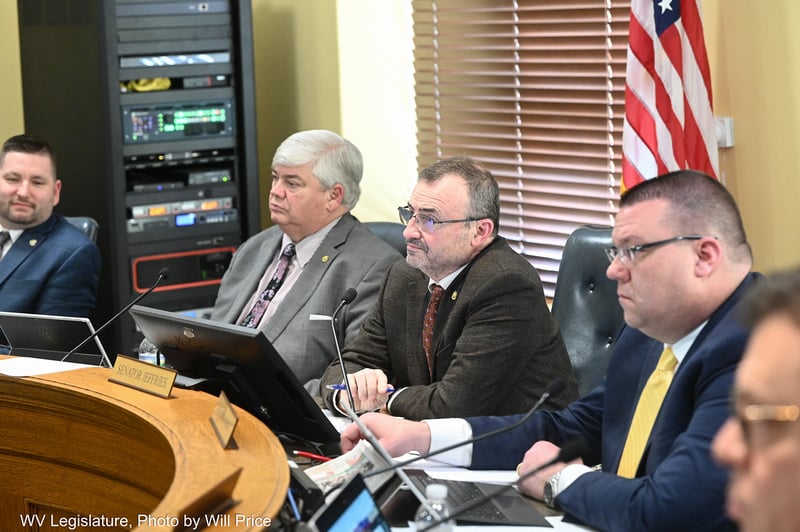
After a three-hour discussion, the state Senate’s economic development committee advanced a bill intended to encourage economic development involving data centers by providing greater latitude to let them harness their own power sources.
The legislation now goes to the full Senate during the final days of the regular legislative session.
Moving the bill was no certainty. The legislation, which has been promoted by Gov. Patrick Morrisey’s administration, was the subject of backroom discussions throughout the day until it finally got the long committee scrutiny.
One focus of discussion was how the bill might affect counties, which rely on the financial support of property taxes. The bill directs associated tax revenue to state funds, including one meant to help West Virginia reduce its personal income tax rates.
Several officials from West Virginia counties spoke before the Senate Economic Development Committee to say they need their fair share if data centers set root in their communities.

“It’s probably one of the most overreaching pieces of legislation that I’ve ever seen when the state can come in and take all of your tax dollars and not leave them left in the county,” Eddie Gochenour, a Berkeley County commissioner, told the committee.
The bill, HB 2014, which passed the House of Delegates by a wide margin a week ago, introduces a Certified Microgrid Program and a High Impact Data Center Program for West Virginia, aiming to attract and support these industries.
Much of the legislation is focused on data centers, the physical facilities that house computer structures like servers and storage.
“Data centers represent a significant and growing sector of the economy, generating substantial economic activity, including jobs, infrastructure investments, and technological innovation,” the bill states.
Data centers are enormous energy users, and that is only expected to grow as artificial intelligence and other computing innovations gain traction.
They are prolific in states like neighboring Virginia, but they are also controversial among residents because of their aesthetics and noise. They are not major employers but can contribute significantly to local property taxes.
The bill offers a possibility for data center developers who might want their own energy framework, the microgrids in the bill’s name.
The legislation establishes a framework for the special valuation and taxation of high impact data centers , including a specialized tax distribution formula benefiting various state funds.
Under the formula for the tax on property calculated based on its assessed value and the applicable levy rates:
55% would go to a Personal Income Tax Reduction Fund
15% to an Electric Grid Stabilization and Security Fund, which the Department of Commerce is supposed to use to provide support for electric grid stabilization for regulated utilities and grid security
10% to an Economic Development Closing and Promotion Fund
10% to the state general revenue
5% to the Economic Enhancement Grant Fund administered by the Water Development Authority
and 5% to the Low Income Energy Assistance Program administered by the Department of Human Services
Speaking on MetroNews’ “Talkline” earlier Tuesday, Gochenour said the state would be redirecting the financial foundation that usually would benefit the counties.
“That cripples us,” Gochenour said on statewide radio.
“The way the current law is, we would get 99% of that, and that’s what’s very disheartening. You try to go and do economic development things in your county, and what would prevent them from the next time something else good comes from the county being able to come in and take those tax dollars?”
He noted that local governments are generally prohibited from placing limits any certified microgrid district or certified high impact data center project — like zoning, horticultural, noise, viewshed, lighting, development, or land use restrictions.
“They want to exclude any land right uses. So, for example, the City of Martinsburg has zoning. The entire county of Jefferson has zoning. And none of these things apply. None of our building codes apply. None of our planning commission rules would apply, and that’s not how we do business,” Gochenour said.
Additional officials from local governments around West Virginia spoke before the Senate Economic Development Committee.

“I’m concerned that this bill, as presented, will ultimately discourage local counties and municipalities from attracting data centers to their community. Data centers utilize a lot of infrastructure, a lot of land, and create minimal jobs in relation,” said Greenbrier County Commissioner Tammy Tincher.
“The incredible impact and desire for local community to land one is the tax benefit. Will the local development authorities and county leaders want a data center if there is no input or oversight by local officials who have boots on the ground daily?”
She continued, “It’s essential to ensure that counties receive a fair share of tax revenues generated from economic activities. As written, that will not occur for a significant time.”