

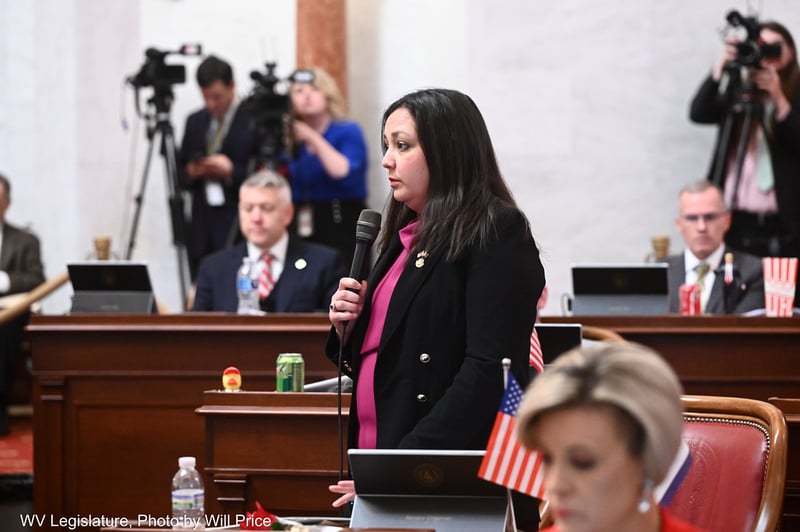
Senators backed off inserting the provisions of a vaccine exemptions bill into another bill about a different health policy.
Senator Joey Garcia, D-Marion, sought clarification: “I just want to make sure there’s nothing in this bill related to the immunization bill we had earlier this year.”
“That is correct,” responded Senate Health Chairwoman Laura Wakim Chapman, R-Ohio.
That was a roundabout after a majority of the Senate Health Committee led by Chapman on Monday voted to insert the provisions of the vaccination exemptions bill into different legislation requiring the Department of Health to report positive alpha-gal tests to the CDC.
The bills have very little to do with one another. Alpha-gal syndrome is a type of food allergy. The condition usually begins with the bite of the Lone Star tick, which transfers a sugar molecule called alpha-gal into the body.
Chapman ruled during the health committee meeting that the move to combine one bill into the other was germane, saying they’re in the same general area of state code covering public health. She reiterated that conclusion in public comments as this week continued.
Today on the Senate floor, Chapman reversed course, dropping the vaccination exemptions provisions that had been inserted.
The bill about alpha-gal syndrome, HB 2776, then passed unanimously.
In an evening floor session, Chapman elaborated on her position, saying the financial interests of big drug companies had fought against the bill.

“Now to the reason why the vaccine bill was pulled — big medicine didn’t want the bill and successfully killed it. It’s as simple as that,” she said on the floor, sounding emotional. “It’s as simple as that. There was a lot of misinformation out there about this bill. In every single version of this bill, the mandates remained.
“If the bill had passed, children enrolling in school would still be mandated to have vaccinations, all 37 doses of them. The bill as written would have simply allowed for meaningful medical exemptions and permit a very tight religious exemption, just like 45 other states.”
The vaccination exemptions bill was voted down 42-56 in the House of Delegates on March 24, so this had been a way to bring it back.
The vaccines bill was introduced on behalf of Gov. Patrick Morrisey, who called for legislation allowing West Virginia families to declare religious and philosophical exemptions to the state’s school vaccination requirements.
Almost all states except California, Mississippi, and West Virginia allow religious or philosophical exemptions for school vaccines, granting parents the ability to opt their children out of vaccinations based on sincerely held beliefs.
Right now, West Virginia students entering school for the first time must show proof of immunization against diphtheria, pertussis, tetanus, polio, measles, mumps, rubella, varicella, and hepatitis B unless properly medically exempted.
“Make no mistake, this issue is not going away, and I’m not going to give up. There are more like me in the Legislature who are not going to give up on this issue,” Chapman said on the Senate floor.
“We want our children to receive an education. We want our we want religious liberty, and we want our young families to remain in the greatest state of the nation. We fight for the children of West Virginia, not big health care’s bottom line.”