

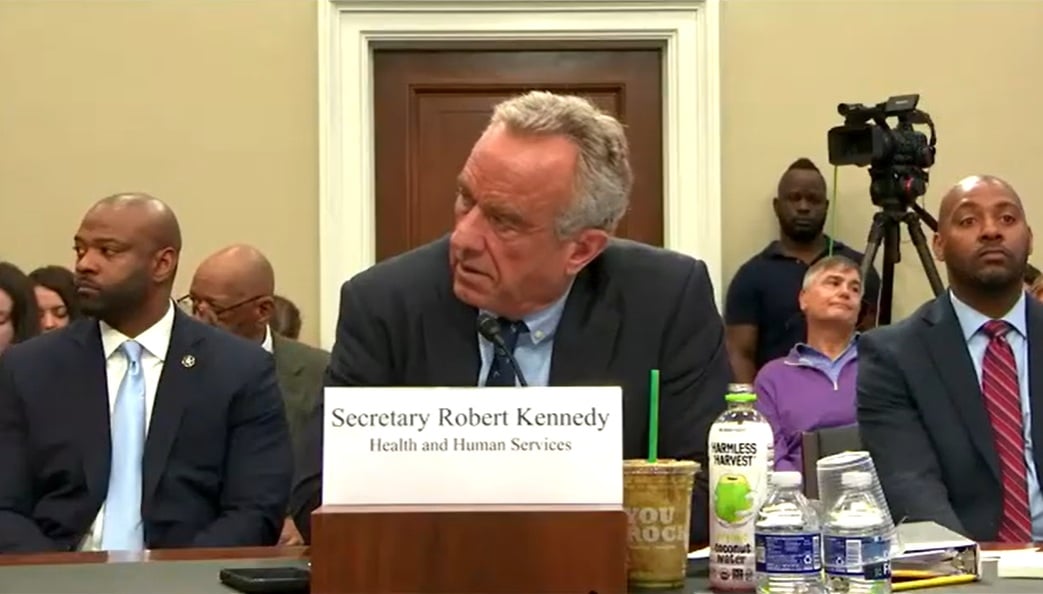
Under questioning by Congressman Riley Moore during a budget hearing in Washington, D.C., Health and Human Services Secretary Robert F. Kennedy Jr. confirmed the return of some jobs to the National Institute of Occupational Safety and Health in Morgantown.
It’s still not entirely clear what percentage of the jobs at NIOSH are coming back or what roles they represent.
“Mr. Secretary, my understanding is that the 111 employees at NIOSH in Morgantown were reinstated earlier this week. Is that correct?” asked Moore, R-W.Va.

Kennedy, who was appearing at a budget hearing before the House Appropriations Committee, responded that 328 employees were reinstated at NIOSH facilities in Morgantown and Cincinnati, and he seemed to make reference to the World Trade Center Health Registry.
About a third of those being called back are in Morgantown, Kennedy said.
Hundreds of workers at the Morgantown NIOSH facility were informed earlier this year that they would lose their jobs. The facility conducts research and makes recommendations about preventing work-related injuries and illnesses.
The Respiratory Health Division focuses on preventing work-related respiratory diseases and improving worker health. The Coal Workers Health Surveillance Program studies respiratory disease in miners and provides health screenings and information, particularly about black lung.
The work on black lung screening, which is required by federal law, has been a focus of public discourse. U.S. District Judge Irene Berger on Tuesday granted a preliminary injunction that would reverse federally ordered job cuts to that program over coal miners sued over it being halted.
In Congress, Moore said to the health secretary, “And the black lung screening program and the Coal Workers Health Surveillance Program are particularly important to West Virginia. My understanding is that the Coal Workers Health Surveillance Program at NIOSH will be fully reinstated. Is that correct?”
Kennedy responded, “Yes, the program will be will continue to function with continuity.
Moore continued, “And Mr. Secretary, it’s my understanding that the programs for occupational safety and testing, like the respirator testing programs will also be fully operational again. Is that accurate?”
“Yes, that’s accurate,” Kennedy responded.
Kennedy’s Health and Human Services agency announced on March 27 a restructuring in line with the administration’s Department of Government Efficiency initiatives.
West Virginia’s congressional delegation has described pushing the Trump administration, particularly Kennedy, for the return of jobs at NIOSH. Many of the reduction in force notifications have been set to become final at the start of next month.
“I talked to Secretary Kennedy even before he was confirmed and then several times, saying these jobs cannot go away. The functions that these great scientists have been performing in Morgantown for years now are irreplaceable,” said Senator Shelley Moore Capito, speaking today on MetroNews Talkline.
“They’re not being done anywhere else, and they’re helping to protect our coal miners, our firefighters, some of our first responders, because of the respiratory research that they do.”
Capito said she spoke to Kennedy on Tuesday, and that’s when it became apparent that 110 workers would return to the Morgantown facility.
The senator said the returning jobs are in a range of areas: respiratory health, safety research, personal protective technology and other roles.
“Now, of course, there’s still a lot that are under that reduction in force, but we are slowly getting back,” she said. “One thing he told me is that the functions of the office will still be there — in other words, the protections of our workers, our coal miners and others that NIOSH does such a good job with.
“So this was just a pressure campaign that we all put on the president to re-look at this, and he did.”
Senator Jim Justice, R-W.Va., said on Talkline that he trusted President Trump all along to preserve the black lung screening program for coal miners.
“We’ve all pushed and pushed and pushed and pushed, but at the end of the day, I really think that President Trump is going to do the right thing,” Justice said. “You know, he’s my buddy, and I really believe that we’ve got to do the right thing, especially for coal miners.”
The federal court ruling that came down this week will also affect work on respiratory health and black lung screening.
A Kanawha County coal miner named Harry Wiley filed federal suit on April 7 on behalf of himself and others potentially affected by the loss of the Coal Workers Health Surveillance Program. Wiley is represented by attorneys from organizations like Mountain State Justice and Appalachian Mountain Advocates.
The lawsuit noted that the federal mine safety statutes since 1969 have afforded American coal miners a medical screening and epidemiological surveillance program, along with a unique right to transfer to a non-dusty job if they begin developing early signs of occupational lung disease.
That work has been taking place at NIOSH in Morgantown.

“As far as I was concerned, failure in saving these programs was just not an option,” said Sam Petsonk, an attorney who represented Wiley.
“One way or another, these programs had to be saved, and I’m just prayerful and grateful that the district court saw fit to credit our arguments and enjoin the closure of these miners health programs.”
The judge ordered that the secretary for Health and Human Services, Kennedy, submit written certification to the court within 20 days of the order that compliance is complete.