

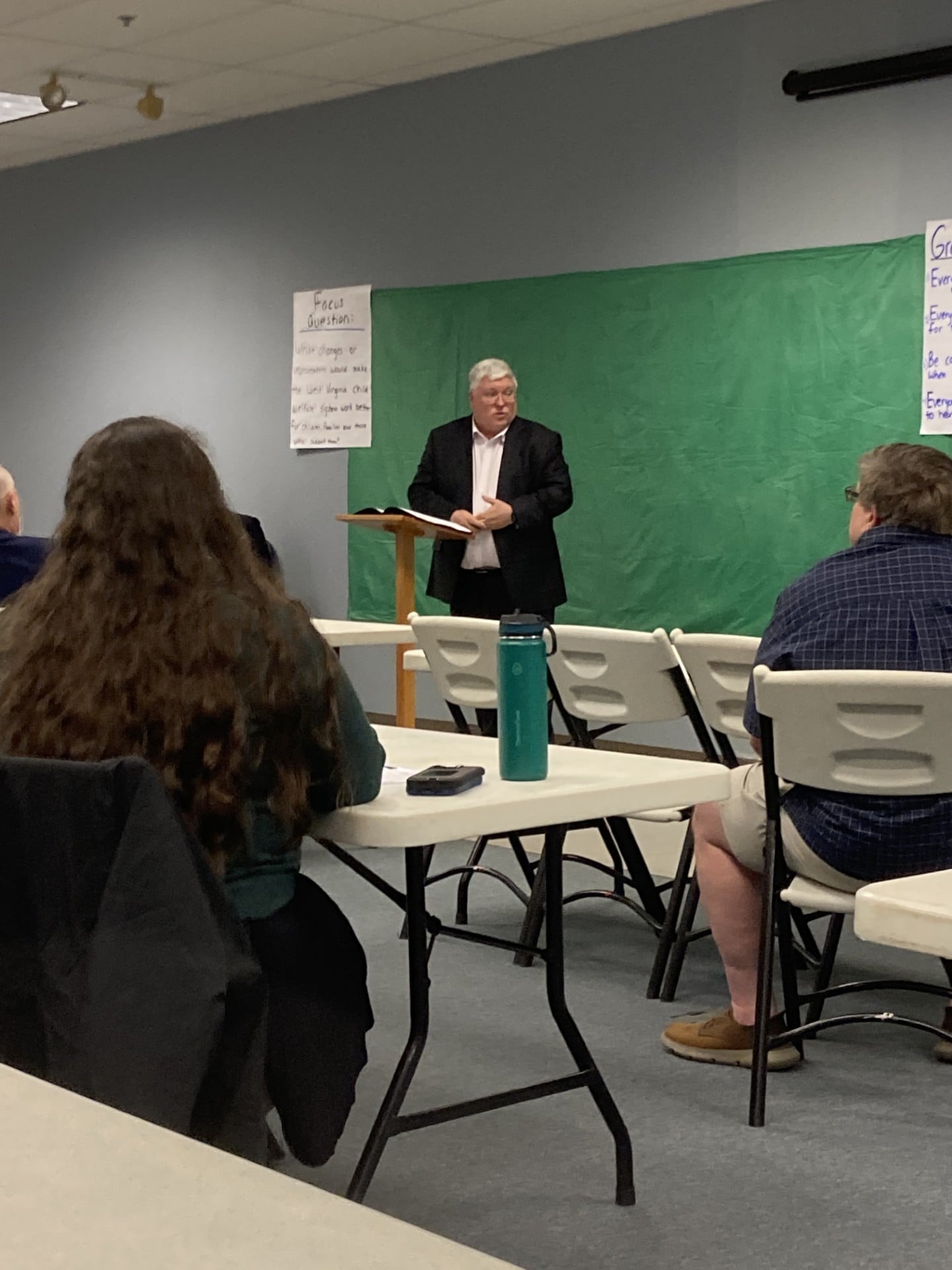
MARTINSBURG, W.Va. — Words like broken, fragmented, siloed, exhausting, and low priority were among those coming out of a work session to tackle issues with the child welfare system as the 7th of 8 listening tours was held in Martinsburg Wednesday night.

Gov. Patrick Morrisey sat in on the sessions. He said he inherited a mess when he came into office related to child welfare in the state.
“I’m a big believer in aligning the incentives and improving communications. I talk a lot about communication flow. A lot of that came up tonight, that there was not adequate communication between all the different people. Folks were in silos,” Morrisey said. “That has to change. There has to be a better communication system.”
DoHS Secretary Alex Mayer started the listening sessions last week. The 8th and final session is scheduled for Thursday evening in Morgantown.
Mayer said each area is unique. In the Eastern Panhandle, one of the top concerns was the lack of providers who can conduct mental health evaluations. Multiple speakers talked about the delays and difficulties in getting resolution when the available provider for mental evaluations may be as far as Romney.
“Recently we’ve learned a little bit more about how those psychological evaluations are occurring up here,” Secretary Mayer said. “That’s part of what I’m trying to do with these listening sessions is really trying to learn the system before we start putting things in place. We’ve already begun to have conversations about that issue in the Eastern Panhandle.”
Another big issue was turnover, fueled by competition from wealthier states that are a quick drive out of the Eastern Panhandle.
“I’ve always said we need to be more competitive with the states that we touch,” Morrisey said. “We have to do it across the board. We’ve talked about it in the context of first responders, teachers. It’s a prevailing problem.”
As for solutions to the pay disparities, “It’s going to take a bit of time,” the governor said. “It’s not easy because a lot of people may not fully appreciate the differences in costs that you see all across West Virginia. So we’re going to keep working on that. We’re going to do something that is fair to everyone.
In attendance were case workers, kinship grandparents, and families who have experienced the revocation of parental rights. Many who spoke decried the red tape that makes it difficult for foster or kinship parents to make plans with their charges. Other issues included lack of cooperation among neighboring jurisdictions and unclear formulas for when parental rights should be terminated.
Doug Anderson, who has worked in the healthcare space and now is a consultant. He said he does not put blame on the hard working employees of Child Protective Services, but he says many are constrained by bureaucracy from doing what they think needs to be done to fix the problem.
Anderson said the time to address the issues in the child welfare system is now, before the children are grown.
“We don’t see the back end of not taking care of the problem,” Anderson said. “A child that’s dysfunctional, a foster kid that has mental health and substance abuse issues, there’s a cost to that. And we pay that, in terms of quality of life, lost productivity, lack of employability.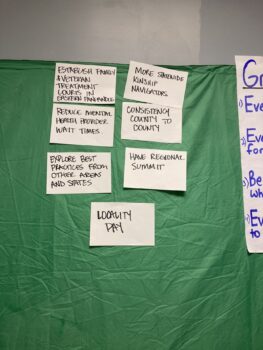
Among those in attendance were a social worker who works closely with a police department, a representative from Jobs & Hope, those who have worked in the child advocacy field, a CASA volunteer, kinship grandparents, and those who have had their parental rights revoked or had a family member go through the process. They were asked to identify a word they think of when they think about child welfare issues in the state.
One woman who had children removed from her home says she associates the child welfare system in the state to death.
“My kids are my life, and when they left, — I wonder if they’re safe,” adding she would rather be dead than not with them. “But you wish for the best every day.”
A grandmother who is fostering her grandchildren says the word she would use is “hostage,” because in the years she has had her grandchildren, “someone else has been running my life,” explaining that if she wants to take them to visit a relative she has to get permission to travel with them.
A social worker described the system as broken. “If we have protocols, why are certain workers following them one way and others following them another way?”
She said there is confusion regarding what constitutes grounds for removal.
Anderson said another frustration is non-disclosure agreements that “disincentivize departments from cooperating with each other.”
Asked why there are poor outcomes, the answers varied among the respondents. Lack of staff, lack of trained staff, talented staff leaving to go to Virginia or Maryland were among the reasons listed.
Another was mindsets, described by one social worker as the idea by some colleagues that, “Once a kid is in the system they always come back. You can’t put them back (in their home) because they always come back.”
That theme was illustrated by the mother who had children removed. She said the providers looking at her file saw a report from CPS that determined they “already knew the family dynamic,” which she said skewed the evaluation.
Another participant who said she had worked for 14 years in the child welfare system said local CPS leadership is not empowered to make community responsive decisions because they have to go through someone in Charleston, adding, “Decisions can be made based purely on the liability to the department.”
Some of the speakers who have had to deal with cases that crossed state lines alleged some departments that should be cooperating with each other don’t because of “aversion to risk.”
There was a chance to list some ideas for improving outcomes. Among them, dedicated courts for family treatment and veterans issues, access to virtual and tele-mental health services, retention and proper training of employees, hiring more navigators, promoting consistency from county to county, locality pay, and looking at best practices in other states to glean ideas.
Among those in attendance were 15th District Senator Tom Willis and state delegates Lisa White (96-Berkeley ), Chris Anders ( 97-Berkeley ), Chuck Horst (95-Berkeley), and George Miller (90-Morgan)
A report will be issued following the sessions that will be released to those who sign up to receive it. It will be part of the work of an advisory committee that will be formed among caseworkers, youth, lawmakers and other stakeholders who intersect with child welfare in the state.