


The “One Big Beautiful Bill” that passed the U.S. House of Representatillves last week now goes for review by the U.S. Senate, where it could face changes.
“It’s time for our friends in the United States Senate to get to work, and send this Bill to my desk AS SOON AS POSSIBLE!” President Donald Trump wrote on his Truth Social service late last week.
The Senate is aiming to pass the reconciliation bill by the Fourth of July. Broadly, the bill extends Trump’s 2017 tax cuts, tightens eligibility for health and food benefits, rolls back green energy incentives, increases funding for border security and increases the national debt ceiling.
A comprehensive estimate from the nonpartisan Congressional Budget Office calculates it will add $3.8 trillion to the federal government’s $36.2 trillion in debt.
The Senate could have changes up ahead, including to Medicaid and to its overall spending level.
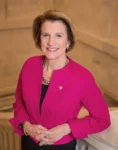
“I’m excited about what I see. Is it precisely what I would write? No, but I think that’s why we bring it to the Senate and we work it through our processes,” Shelley Moore Capito, the 4th highest-ranking Republican in the U.S. Senate, said in a briefing with West Virginia reporters.
Overall, Capito said she supports the bill.
“Yes, tax relief that was passed in 2017 needs to be extended,” said Capito, R-W.Va., in response to a question by reporter Steven Allen Adams of the Ogden Newspapers.
“We saw in 2018 and 2019, pre-covid, how these not just individual tax rates but also the business tax rates and individual pass-through tax rates as they were lowered really led to a lot of growth in the country — and we want to reinvigorate that, bring jobs back and manufacturing.”
A difference, Capito said, is senators are interested in making the tax cuts permanent rather than letting them expire after a few years. “So permanence is going to be critical for us.”
Medicaid changes
Capito said senators are also interested in “curbing the growth” of the federal government.
So Medicaid will remain in the spotlight.
“It’s a difficult issue because we have 28% of West Virginians are on Medicaid. I want to protect those benefits, and the president has said to protect those benefits,” Capito said. “So the House has some ideas; we’ll probably have some more ideas over here in the Senate.”
The proposals institute more rigorous requirements for Medicaid that are anticipated to cause millions of people to drop their Medicaid coverage.
One of the new provisions is “community engagement requirements” of at least 80 hours per month of work, education or service for able-bodied adults without dependents.
“This is only on able-bodied people without dependents, and so I think asking them to work several hours a week is well within reach,” Capito said in response to a question from reporter Anna Saunders of WCHS Television.

Critics have said the work requirement actually represents greater red tape for recipients who could forget to maintain their coverage, misunderstand steps or miss a key update.
“The bulk of the coverage losses are not removing ineligible people from Medicaid, but making fewer people eligible and implementing procedures that all evidence shows results in eligible people losing coverage,” said Kelly Allen, executive director of the West Virginia Center on Budget & Policy think tank.
People would also have to verify their eligibility to be in the program twice a year, rather than just once. And the bill adds a more rigorous income verification for those who enroll in the Affordable Care Act’s health care coverage.
The nonpartisan Congressional Budget Office estimates that 10.3 million people would lose their Medicaid coverage by 2034 under the GOP bill, about half of them because of the work requirement provision.
Capito said in response to a question by reporter Mike Tony of The Charleston Gazette-Mail that she wants “to see Medicaid be there for the people that it’s designed for, and that means that people that are ineligible should not be getting benefits and should be removed.
“That means people that are maybe here illegally are not entitled to benefits; should be removed. That means people that don’t have the paperwork and everything that shows they can work and receive a benefit then they should be asked to contribute by either work or going to school or looking for a job or any of a variety of things.
“And that saves money because if we save money in the program in a larger sense the 28% of West Virginians who are on it are going to get a better benefit, and they’re going to be able to keep those benefits.”
Allen of the West Virginia Center on Budget & Policy said that calculation doesn’t add up.
“That argument would only carry weight if the savings were being redirected to those who remain on Medicaid — but the truth is the savings are being used to offset extending tax cuts that are tilted towards the nation’s wealthiest households,” Allen said.
SNAP
The bill would reduce federal spending on the Supplemental Nutrition Assistance Program, known as SNAP, by roughly $286 billion over the next decade, according to the Congressional Budget Office analysis
A major aspect would expand the age range for work requirements.
The work requirements would mean 3.2 million people would lose food stamp benefits in an average month over the next decade, the Congressional Budget Office estimates.
Furthermore, the bill would require states to take on more of the costs of administering SNAP and limit future administrations’ ability to raise benefit amounts.
“The Senate is going to have something to say about SNAP benefits,” Capito said in response to a question from reporter Henry Culvyhouse of Mountain State Spotlight.
“I do think the point in SNAP is similar to the point in Medicaid. In order for it to work for people, to keep people from going hungry, to the neediest families and individuals that really cannot do and buy food and nutritious food at the same time without a SNAP benefit, we’ve got to preserve this.”
On the cost that could be passed on to states, Capito said, “I don’t know how it would impact the state of West Virginia if there was a match; I need to do my homework on that.”