


Governor Patrick Morrisey’s administration was undertaking a perceived license plate purge until a staffer said Tuesday “errors were made.” He now says most “Governor’s Plates” holders will keep their license plates.
The nature of the errors committed – were they political miscalculations – is an ongoing series of questions. Who made the errors? How did the errors come to be made? How many errors were made? When were the errors identified? Who discovered the errors? How should the errors be characterized? The list goes on.
First, the background…
License plates numbered 4 through 2000 are commonly known in West Virginia as “Governor’s Plates.” These low-number plates are typically reserved for individuals with close ties to state government. Not available to the general public, they are issued at the discretion of the sitting governor and are subject to annual renewal, again, solely at the governor’s discretion. The practice has been in place for decades, with low-number plates serving as a form of recognition and status.
While past governors have not always renewed all existing plates awarded previously, many holders have retained them through multiple administrations. This time around, however, the Morrisey administration appeared more aggressive. Buzz began building last week in state political circles over a perceived number of higher-than-usual non-renewals.
Among the most notable names associated with the undertaking is Willie Akers, a legendary figure in West Virginia basketball. Akers played at West Virginia University from 1958 to 1960, helping lead the Mountaineers to a national championship game appearance alongside teammate Jerry West. After a brief professional career, he returned home to become one of the state’s most successful high school basketball coaches, winning four state titles at Logan High School. His legacy as a player, coach, and educator earned him induction into multiple halls of fame.
His plate – 44, a nod to West – was slated for non-renewal. A source said Tuesday that decision was reversed, however confirmed Akers did receive a non-renewal letter prior to re-consideration. Governor Underwood granted Akers the plate.
After multiple unsuccessful outreaches last week, MetroNews, this time in the form of WAJR’s Mike Nolting, asked the Governor for comment Monday during a press event. Morrisey told Nolting regarding numbered plates, “Every administration goes through and deals with that. At the right time we’re happy to talk about that. We want to make sure today is a big focus on highways, on roads. I don’t try to focus too much on those issues; I focus on highways and bridges. That’s the priority.”
Additional outreach Tuesday to Morrisey Communications Director Alex Lanfranconi resulted in a text reply.
“Some errors were made when finalizing the annual list of plate recipients. As a result, some individuals received letters last week indicating that their plate would not be renewed. With very few exceptions, everyone who currently has a plate will continue to receive one. Letters to these individuals are being sent this week to inform them that they will continue to receive a plate,” Lanfranconi texted.
The text message, which offered no further details, came after a MetroNews FOIA request was issued Tuesday afternoon.
Sources familiar with the process, granted anonymity to provide details, indicated the number of original non-renewals landed in the hundreds. A few select names of note included:
- State Treasurer Larry Pack (R): A fellow member of the Board of Public Works.
- House Finance Chairman Vernon Criss (R): Publicly clashed with the Governor over budget matters.
- Delegate Scot Heckert (R): Known for his outspoken criticism of the Governor.
- Bill Cole (R): Former Senate President.
- Joanne Tomblin: Former WV First Lady.
- Susan Rogers: Widow of the late House Minority Leader and Senator Robert Burk Jr. *
Lanfranconi did not provide an exact number of original non-renewals, nor is it known if any of the above-mentioned plates will or will not be renewed.
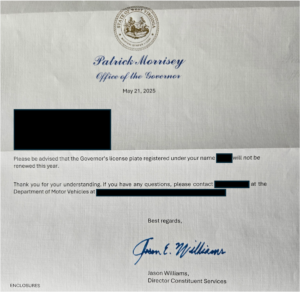
Finally, MetroNews obtained a copy of a form letter dated May 21 (below) from the Governor’s Director of Constituent Services, Jason Williams, notifying recipients of non-renewal.
Now, a few observations…
One: To be clear, Governor Morrisey is entirely within his rights to renew – or not renew – any plate at his discretion. That’s why they call them “Governor’s Plates.”
Although characterized as including errors, the exercise comes amid ongoing criticism of the Governor’s strained relationships with legislators. During the most recent session, he faced pushback for failing to build effective working relationships within the Capitol. Morrisey has since been perceived by some to employ a more collaborative, “carrot-not-stick” approach.
Did the move fuel political animosity? Judging by political murmurs, yes. Given the complex challenges ahead that will require collaboration between the Governor and the Legislature, one wonders why the Governor would poke the bear? Why take away any plates? How politicos will perceive the administration’s response (text) remains to be seen.
Two: More broadly, the optics aren’t ideal. Just days ago, the Governor held a press conference emphasizing the need for transparency in government, specifically promising improved information-sharing from agencies like Child Protective Services. That commitment is welcome and deserves recognition. But it raises a question: if transparency matters, why not apply it consistently and in a timely manner across government, including to the plate purge? It’s not as urgent as protecting vulnerable children certainly – but calling for open government while initially staying silent on this issue feels like a double standard. Credit for an eventual response, but this doesn’t seem like improved information sharing given the administration’s limited response Tuesday and the further questions it raises.
Three: Ultimately, the best course of action may go beyond selective non-renewals; it might be to eliminate the plates altogether. When a tradition, however valued, becomes so politicized as appears to be the case here, the most reasonable fix may be to modernize with the times. Retire the practice and move on. At minimum an understanding of how plates are renewed or not-renewed, issued or not-issued is prudent, good government.
All told, many questions remain. More answers are deserved and required to draw informed conclusions. Time will hopefully yield those answers.
*A previous version incorrectly noted Senator Roger Burk Jr., as opposed to Senator Robert Burk Jr.