

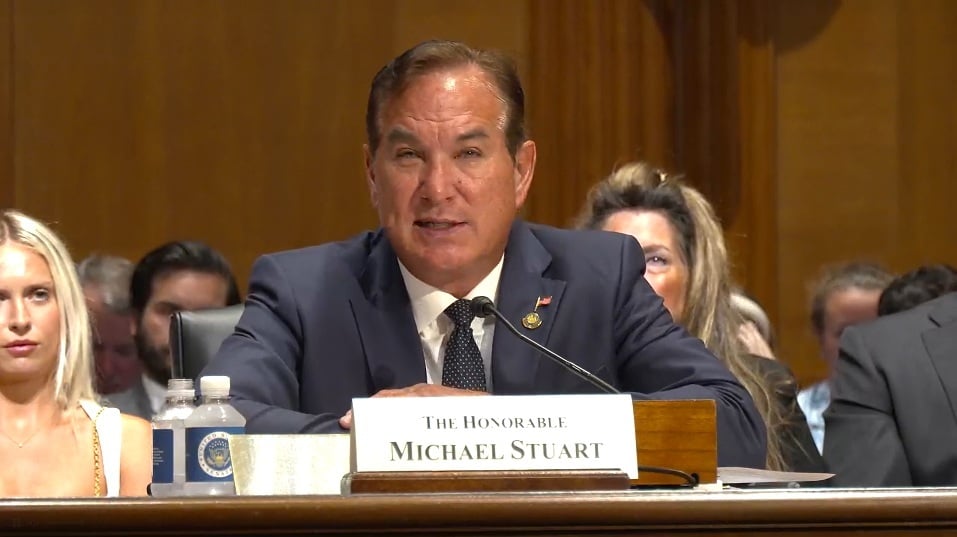
Longtime West Virginia political figure Mike Stuart, up for being the top attorney to U.S. Health Secretary Robert F. Kennedy Jr., was peppered with questions during a Senate confirmation hearing about his views on the opioid crisis and his commitment to adhering to the law.
Stuart appeared with several other nominees today for a two-hour hearing before the U.S. Senate Finance Committee. He is being considered to be the general counsel for the U.S. Department of Health and Human Services.
Mike Stuart’s experience prosecuting cases related to the opioid crisis and Medicaid fraud demonstrates a strong commitment to protect patients and root out waste and abuse in health care systems. This experience will make him an invaluable asset as @HHSgov General Counsel.
— Senator Mike Crapo (@MikeCrapo) July 31, 2025

Stuart, a Republican, has most recently served as chairman of the Judiciary Committee in West Virginia’s state Senate. He was previously a U.S. attorney for the Southern District of West Virginia and also has served as chairman of the state Republican Party.
He touched on that background in West Virginia during his opening remarks.
“As general counsel for the Department of Health and Human Services, I’ll bring the totality of my experiences, personal and professional, to the role to help President Trump and Secretary Kennedy do the work of the American people,” Stuart told members of the Senate committee.
If he is confirmed by the full Senate, Stuart will become the top legal adviser for the federal agency focused on protecting and promoting the health and well-being of Americans. Health and Human Services also administers key programs like Medicare and Medicaid.
Under Secretary Kennedy, the agency has been carrying out a Make America Healthy Again agenda.
Yet that has also resulted in controversies such as the initiation of mass layoffs and restructuring and debate over policies surrounding vaccines.
“I want you to have confidence in me and the department,” Stuart said in his opening remarks.
Senator Ben Ray Lujan, a Democrat from New Mexico, asked Stuart and the rest of the nominees under consideration, “Do you commit to follow the law?”
“Yes, sir,” Stuart replied.
Lujan went on to ask about Head Start, the early childhood education program that has had funding disruptions this year through Health and Human Services. He wanted to know, “Do you believe it’s against the law to delay or withhold Head Start funding that Congress has already appropriated?”
Stuart initially responded by saying that, as a lawyer, he likes to have all the facts and information at hand before making an assessment. “But I’m not at HHS right now I don’t know the facts and circumstances behind any of these decisions that were made,” Stuart said.
“So are you the best person for this job?” Lujan said. “So you are the expert then? You’re the best person for this job?”
“So am I an expert at every single subject?” Stuart replied. “No, but I bring a wide swath of experience, and I’m going to have a great team around me so that we can make sure on every subject we bring capable expertise to be able to provide the recommendations that are needed by Secretary Kennedy and the administration to make the right decision.”
Senator Maggie Hassan, a Democrat from New Hampshire, asked Stuart about his legislative record in West Virginia, including his sponsorship of a bill to ban methadone treatment.
“In his testimony before Congress, Secretary Kennedy said that medication assisted treatment is a critical tool for preventing overdose deaths. This is one area where Secretary Kennedy and I agree,” Hassan said.
“As a state senator, you introduced a bill that would have outlawed methadone clinics in your state, which would have effectively ended the use of methadone to treat opioid addiction in West Virginia, I understand that there are bad actors in the methadone clinic space, to be sure, but do you think Secretary Kennedy is wrong to support medication assisted treatment like methadone?”
After a couple of exchanges with Hassan on the issue, Stuart responded, “I’m going to support Secretary Kennedy on this issue. I agree with him on it, but keep in mind, there’s a difference between being a policymaker…” and at that point the senator cut him off and pivoted to another topic.
Senator Elizabeth Warren, D-Massachusetts, got into an exchange with Stuart about grants through the Substance Abuse and Mental Health Services Administration, which have been in line for major spending and staffing cuts.
Federal grants from the agency called SAMHSA can help states like West Virginia pay for life-saving naloxone.
Warren began by quoting from federal law to say such grants may be terminated only if “a state has materially failed to comply with the agreements or other conditions required for the receipt of the grant.”
Then the senator asked Stuart, “Can Secretary Kennedy wake up in a bad mood one morning and simply say to the worker who is running a suicide hotline, ‘I don’t like your face, I’m canceling your state’s grant money?'”
Stuart first responded by saying he looks forward to working with Warren and then he began to describe his approach to advising the health secretary.
Noting a time limit, Warren broke in and asked, “If Secretary Kennedy wakes up in a bad mood one morning, can he say to somebody, ‘I don’t like your face, so I’m canceling your state’s SAMHSA grant?'”
Stuart began to reply, “Well, what I’d like to do is review the code and all the code…”
Warren: “I just read you the code language. Did you have any problem understanding it? You can only do cancellation if a state has materially failed to comply with the agreements or other conditions required for receipt of the grant. That’s all it says.”
Stuart: “The key words, though, are the ‘agreements’ and the terms of those,” Stuart said.
Warren: “You think there’s an agreement out there that says that the secretary can cancel a grant because I don’t like your face?”
Stuart: “I don’t believe that’s been the case. I don’t believe that’s ever happened.”
After a few more exchanges about the legality of canceling federal grants over not liking someone’s face, Warren asked, “Can I just have a ‘Yeah, that would be illegal?'”
Stuart agreed, “You can’t cancel a contract, to my knowledge, because you don’t like somebody’s face.”
The senator turned to another variation, asking “What if Secretary Kennedy wakes up in a bad mood and he said, ‘I heard you’re a Republican, and it turns out I really don’t like Republicans, so I’m going to cancel your grant for your addiction treatment center. You think that would be legal?”
In a go-round about that question, Stuart responded, “We’ve got to meet the terms of the contract. If they’re outside the terms of the contract, it can be canceled.”
Warren: “OK, so, can he cancel because you’re a Republican?”
Stuart: “If it’s not included in the contract, no.”
Warren: “Bingo.”
The senator proceeded to a third situation where the secretary could announce, “Your work is no longer necessary. Your state’s grant is canceled. Let’s just say there’s nothing in the contract about whether the work is necessary. Would it be illegal to cancel the grant under those conditions?”
Stuart: “That’s not as easy a question as simply saying yes or no. Well, listen we’ve got to look in terms of the intent of these contracts as well.”
Warren again asked if the general counsel reads statutory language saying such a grant could only be canceled if a state has materially failed to comply with the agreements or other conditions, “Can you wake up and say, we decided we don’t need you anymore?”
Stuart: “My advice will always be to follow the terms and agreements.”
Warren concluded: “I really hope you do follow the terms and conditions in the agreement because that is exactly the letter that Secretary Kennedy sent canceling projects over this country, and the only grounds he gave were grounds that are not in the contract and clearly in violation of the law.
“So I hope, Mr. Stuart, based on what you said, you will deliver that message to Secretary Kennedy and give advice that is consistent with the law in the future.”