

A national advisory firm gave lawmakers an extensive list of choices that could improve the finances of the Public Employees Insurance Agency.
Those included possibilities like removing non-state employees from eligibility and bolstering fraud detection capabilities.
The result could be annual savings of about $55 million if the options were successfully implemented, the consultant said. That represents about 5% of PEIA’s total annual cost of about a billion dollars.
Gov. Patrick Morrisey has been talking about making changes to the agency. His administration anticipates the agency is likely to rack up about about $50 million in additional state expenses year over year.
Workers and retirees in the state insurance system are stinging from hefty increased premiums that recently went into effect. Yet the most recent financial numbers for the agency itself showed stability.
Lawmakers declined to go right into a special session while regular interim meetings are occurring this week.
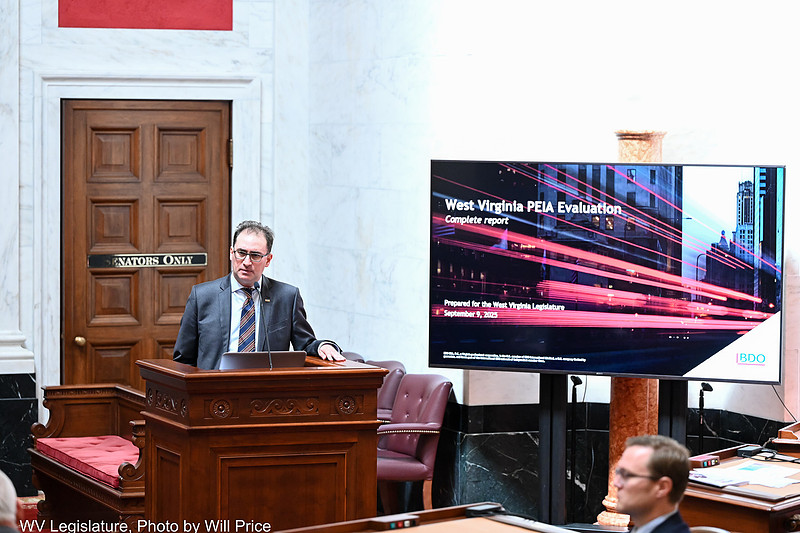
But members of the Joint Standing Committee on PEIA heard a detailed presentation prepared by the national advisory company BDO USA.
Ben Lewis, the company’s managing director of strategy and innovation, described the underpinnings of PEIA’s financial situation and then offered nine options that the state could undertake.
Overall, he said, plan participants appear to be satisfied with the benefits offered by the PEIA including the relatively low premiums and out of pocket maximums when compared to the private sector.
The report concluded that PEIA’s recent and anticipated annual premium increases of about 14% premium increases are justified given that costs were frozen for people in the program between 2018 and 2022.
From the perspective of state costs, BDO concluded those 14% premium increases will improve the financial condition for the state over time.
The top reason for increasing expenses is prescription drug coverage, Lewis said. That’s primarily driven by specialty drugs, especially G1Ps that are prescribed for diabetes and popular for weight loss.
A recent increase on reimbursement rates for healthcare providers to 110% of the Medicare rate is improving provider participation. But that also led to a spike in cost.
If the State of West Virginia wants to pursue possibilities to keep costs at bay, BDO offered nine options. Lawmakers just took them under advisement for now. Some could probably be instituted by the executive branch, if it chooses, without legislative action:
1. Reduce non-state employee memberships: BDO says this could trim a key ratio of money coming in through premiums versus medical claim costs while decreasing the number of policies by more than 15,000. It has an overall potential expense reduction of $189 million, netting a modest $1 million reduction after accounting for contract risks involving third party administrators.
2. Build up anti-fraud function: Implementing a robust anti-fraud team with dedicated personnel and software could help save $17 million to $27 million annually through fraud recoveries and the elimination of fraudulent practices, BDO says.
“Best case, you improve the financial results. Worst case, you try, you investigate and you declare success — that there is no fraud,” Lewis said. “So very little downside risk from this for the amount of investment.”
3. Disenrollment of participants with spousal surcharge: Removing policyholders whose spouses have employer-sponsored insurance but opt for PEIA coverage could result in an expense reduction of $15 million, the analysis suggested.
4. Better marketing of wellness programs: Doubling investment in wellness programs and targeting chronic conditions could lead to net savings of $1.7 million by increasing participation and reducing claims expenses, BDO suggested.
5. Specialty drug solutions: Hiring a dedicated staff member to focus on more efficiency for specialty prescription drug use through site-of-care management, promotion of biosimilars and annual market checks could save about $8 million a year.
6. Importing prescription drugs: The possibility of importing more drugs from Canada is estimated to generate $5.3 million in annual savings, offset by associated negotiation and operational expenses.
7. Supplemental drug coverage: Engaging with discount programs like GoodRx or Cost Plus Drugs could save PEIA between $1.1 million and $3.3 million a year by offering member discounts outside traditional coverage.
8. Encourage more use of High-Deductible Health Plans and Health Savings Accounts: Getting more people to make modest PEIA contributions for such accounts could save $0.6 million to $1.6 million annually by encouraging more consumer-driven healthcare choices.
9. Total family income rate tiering: Adjusting premium levels based on total household income (including income from outside PEIA employment) could increase premium revenue by an estimated $20 million, promoting fairer cost sharing.