


MORGANTOWN, W.Va. — For several reasons, the lead-up to Mark Kellogg’s third season as West Virginia’s women’s basketball coach differs greatly from each of the previous two years.
For starters, one of the most accomplished players in program history is no longer around as guard JJ Quinerly is now with the Dallas Wings of the WNBA.
Kellogg is also working with a smaller roster size than normal, one that features 11 players — five returnees and six newcomers.
“If you get two hurt, you’re down to nine and you can’t play against each other,” Kellogg said. “Thankfully, we do have a really good practice team this year that if we do have those, we can always play. It’s not like we get down to nine and we have to throw a coach in there. We do have a group of guys that are here every day and can help us. It is a give and take. We may get one more eligible. We’re still waiting on a NCAA decision on one and a VISA on one more, but for now, we’re rolling with 11 and that’s what we’ll go with.”
Guards Jordan Harrison and Sydney Shaw headline the group of returning players from last season’s 25-8 team, one that also includes significant contributors Sydney Woodley, Jordan Thomas and Celia Riviere.
Without Quinerly, a dynamic guard that ranks third in program history in points and steals, West Virginia tries to move forward minus one of the better players in the country in each of her two seasons under Kellogg.
Quinerly was consistently at the head of West Virginia’s full court pressure and highly successful at bothering ball-handlers and disrupting the opposition from comfortably getting into offense. That leaves a different look in the Mountaineers’ third year utilizing a system Kellogg has won with at various levels throughout his coaching career.
“We teach it the same way every year and then it takes on a life of its own based on the team we have,” Kellogg said. “We teach it a certain way every year and the personnel dictates what it’ll look like. I don’t think it’ll look a whole lot different. JJ is phenomenal obviously and [Big 12] Defensive Player of the Year, so that is hard to replace. But we have some other bodies that can fill in and we may have to do it with more bodies and more depth than just having a JJ that you can rely on for 30 straight minutes to play at that elite level.”
Kellogg considers Woodley elite defensively and believes a pair of transfers Gia Cooke (Houston) and Loghan Johnson (Texas Tech) are capable of getting to that status as well.
While compiling a 50-16 record over his first two seasons at WVU, Kellogg has proven his unique style can be successful at a power conference program. The Mountaineers have won one NCAA Tournament game in each of his first two seasons, with those campaigns ending as a result of road losses to Iowa in 2024 and North Carolina last March.
The team’s most glaring deficiency in its 58-47 season-ending setback to the Tar Heels was a lack of offensive execution. The Mountaineers finished that outing shooting 13 for 54 and scoring 12 or fewer points in three of four quarters, including nine in the second and fourth frames.
Kellogg, a believer in analytics who’s noted his desire for field-goal attempts to come from in the paint or beyond the three-point line, is hopeful WVU can become more efficient in its half court offense.
“We have to get better there,” Kellogg said. “If we don’t turn people over, what is it going to look like? We’ve made a few changes, some subtle changes to what we do. There are so many ball screens set and that’s what these kids operate out of. We’ve gone to a little bit more of that type of motion offense now. Until we play somebody else, we won’t really know, but we’ve spent quite a bit of time trying to get better in the half court.”
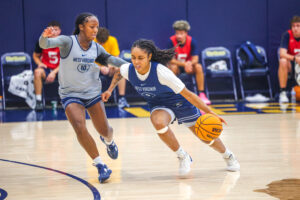
Harrison has been a double-figure scorer in each of her two seasons at West Virginia and Shaw was in the most recent campaign that marked her first with the Mountaineers.
That duo could assume a more featured role in the near future and Kellogg is stressing the importance of the next several weeks as an opportunity for other players to separate themselves and prove their worth.
“That’s on us as coaches to set them up at times not necessarily for failure, but for those opportunities to see how they respond,” he said. “We had a practice with all sorts of chaos going on. We were creating it. We haven’t done it a ton, but I’m trying to learn who can survive, who thrives in it, who wilts in the chaos, was it too much for some of them? It wasn’t. They did a pretty good job that day.
“But there’s times and drills that we’re trying to create it, whether it’s chaos or adversity. We’re trying to learn these kids and who will respond, who steps up in the big moments and who wants to take the big shot. We had a tie drill [Tuesday] and it came down to sudden death. Had to get a stop, had to get a score. Who wants that shot? That shot is a little different now when the game is on the line as opposed to who just fires up shots throughout practice when it doesn’t mean as much.”
Preseason practice officially began Monday — six weeks from the November 3 season opener against Purdue Fort Wayne. While the Mountaineers still have time to continue identifying roles and what may and may not work best for this particular group, Kellogg feels it’s imperative he and his staff identify lineup combinations before too long.
“We’re not quite there, but we’re getting a little it closer where roles are going to have to start getting defined,” Kellogg said. “I mix up the teams, too. Now I have to start putting some of the groups that we think may be on the floor together. That needs to start happening at a higher rate. Roles haven’t been overly defined. It’s been show me what you’re working with, show me what you got type mindset, but we have games coming up and need to start getting rotations figured out. We’ll start to do that sooner rather than later.”