

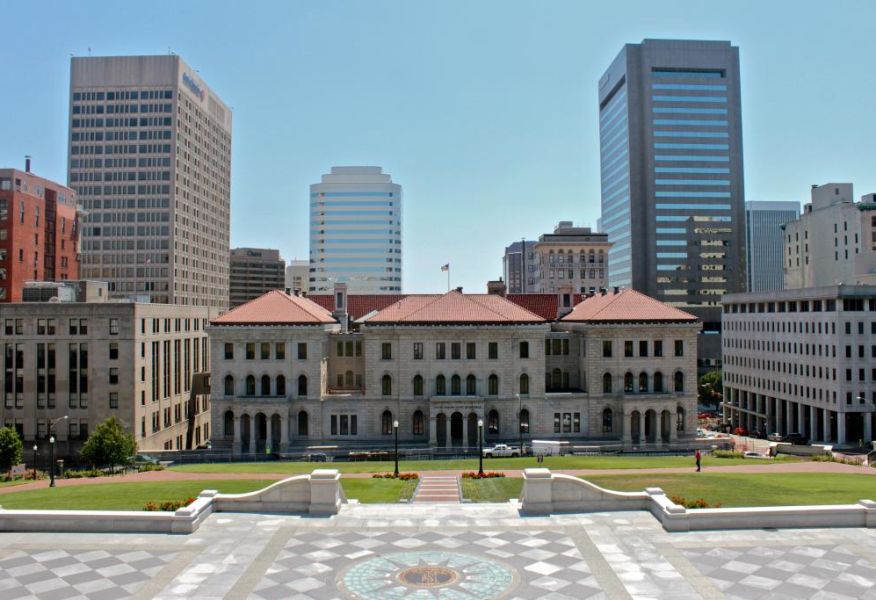
RICHMOND, Va. — A huge legal victory for the City of Huntington and Cabell County in their fight against the Big 3 drug distributors in the opioid epidemic.

The Fourth Circuit Court of Appeals handed down a ruling Tuesday that vacates U.S. District Judge David Faber’s June 2022 decision and remanded the case back to Faber to issue a new ruling based on the Fourth Circuit’s findings.
The decision, written by Senior Circuit Judge Barbara Keenan, says the Court disagrees with Faber’s analysis that the claims against AmeriSource Bergen, Cardinal Health and McKesson were not a public nuisance under West Virginia law.
“We hold that under West Virginia common law, the conditions resulting from the over-distribution of opioids can constitute a public nuisance,” the Fourth Circuit ruling said.
The Court also said Faber “misconstrued” the duties the Big 3 distributors had under the federal Controlled Substance Act.
“This error materially affected the court’s analysis of the distributors’ conduct,” the Fourt Circuit said.
The ruling keeps alive Cabell County and Huntington’s hopes of receiving $2.5 billion in abatement funds from the distributors. The money would be used in a 15-year abatement plan.

Lead plaintiffs’ attorney Paul Farrell told MetroNews Tuesday Faber will now have to make a decision on the case based on the correct interpretation of the state’s public nuisance law and the federal Controlled Substance Act.
“We still have a long journey ahead of us but we have a roadmap to success,” Farrell said.
Faber could ask for more legal briefs and arguments for his reconsideration of the facts.
“We have an affirmation from the Fourth Circuit that we can proceed but this by no means is a day to declare victory, this is just a day that we can resume the battle for civil justice,” Farrell said. “We have a new day in court.”
The Fourt Circuit’s opinion began with an acknowledgement that West Virgina was “ground zero” for the opioid epidemic in the United States and that Huntington and Cabell County were particularly hard hit with more than 10 percent of the nearly 150,000 people living there in 2017 addicted to opioids.
Farrell said the facts in West Virginia stand out.
“The critical issue is not whether or not there is an opioid epidemic and whether or not there were too many pills in West Virginia—it is who has legal responsibility for it,” Farrell said. “That’s where the primary fight in the Fourth Circuit circled around. The plaintiffs felt there was a strong duty under the Controlled Substances Act, the federal District Court (Faber) did not think so. The Fourth Circuit has now established precedent that there was in fact a duty to stop suspicious orders.”
Possible settlement ahead?
MetroNews asked Farrell if the favorable ruling could spur settlement talks between his clients and the Big 3.
“Absolutely. The door is always open for discussions related to how to resolve this civil dispute and so I would anticipate they’ll be discussions in the future to see if there would be interest in finding middle ground. As it stands right now, we are thankful we have another opportunity to go back before the federal court and present our case,” Farrell said.
Could ruling impact other opioid cases in West Virginia and other states?
Farrell said the short answer is yes. He said it’s a clear vindication of the public nuisance doctrine and could have a direct impact on cases against pharmacy benefit managers.