

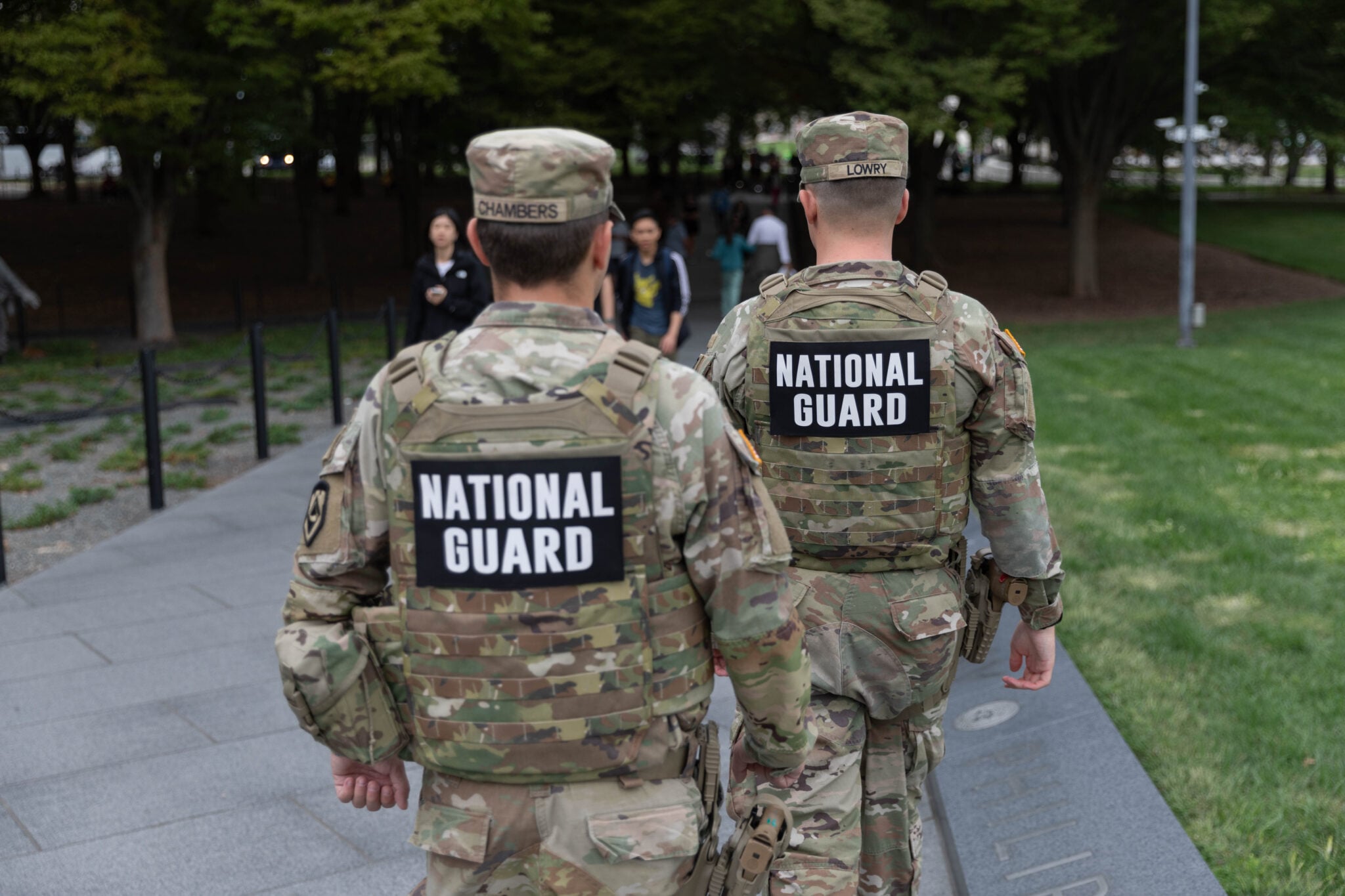
A judge again held off on determining whether Gov. Patrick Morrisey is operating within his authority to deploy the West Virginia National Guard to patrol Washington, D.C.
Kanawha Circuit Judge Richard Lindsay heard about two hours of testimony Monday morning, but delayed making a final ruling until another hearing that he set for 2 p.m. Nov. 10. The judge already heard about an hour of testimony Oct. 24.

“And believe me, this court usually does not do this. I want finality just as much as anybody else, but I want to make sure it’s right,” Lindsay said.
The court case in Kanawha County has challenged the governor’s power to deploy the West Virginia National Guard to the streets of America’s capital.
ACLU-West Virginia filed the lawsuit on behalf of West Virginia Citizen Action Group. Lawyers for the state Attorney General are defending the governor’s decision to deploy the Guard.
One of the lawyers for the state, Jace Goins, sought clarification of where the case is ultimately headed.
“If the court says that the deployment was legal, the case is over. If the court determines that the deployment was not legal, or that the governor or the president did not have authority, then we’re in a situation where we’re talking about, how do we enjoin this deployment,” Goins said. “Is that essentially where we’re at judge?”
Yes, the judge said.
On August 11, President Donald Trump declared a “crime emergency” for the District of Columbia, and five days later Gov. Patrick Morrisey deployed members of the West Virginia National Guard for support.
The West Virginia National Guard deployment remains active and could be in effect through the end of November or beyond.
The governor’s original announcement noted that the mission would be funded at the federal level. That’s a Title 32 order, typically for natural disasters, where the National Guard remains under the control of the state’s governor but receives pay and benefits from the federal government for federal missions.
“Although under Title 32 West Virginia National Guard troops have been sent to DC for a federal mission, that does not mean that they’ve been federalized,” said Christopher Etheredge, an attorney representing state government.
The 300 to 400 members of the West Virginia National Guard who have been deployed to Washington, D.C., have been operating under Joint Task Force-DC, which says the mission will continue “until law and order is restored.”
Such an arrangement strikes a middle ground, said Franklin Rosenblatt, a constitutional law professor at Mississippi College who testified in the West Virginia case.
“It’s really a Goldilocks type of approach with the state Guards,” he said.
“You can be that Goldilocks, in between, where you are performing under the command and control of the state governor, but you’re being funded by the U.S. government for a mission that was requested by the federal government.”
Because the call-up remains under the governor’s authority, a couple of sections of West Virginia law apply.
“Yes, that’s axiomatic, that they must follow their own laws,” Rosenblatt said of state militia units.
In West Virginia law, one key provision outlines the authority of the governor to order the organized militia to active state service, including the ability to order the militia to serve outside the state for training, parades or other duties.
Another describes the governor’s powers to call out the West Virginia National Guard “into the active service of the state” in events like war, insurrection, riot, invasion or public disaster.
ACLU-West Virginia has contended the deployment to D.C. meets none of those definitions.
“In this sleight of hand, the mixing of federal control and state control, the state is saying that the West Virginia National Guard is under the command and control of the defendants,” said Aubrey Sparks, attorney for ACLU-West Virginia, referring to state authorities.
“Under Title 32 that is the case. The state must be. And yet, when asked to defend their actions, to justify the deployment, they can only point to the authority of the federal government.”