


Gov. Patrick Morrisey said the state will continue supporting food banks financially and through the service of the National Guard while federal food assistance support is in flux, although the governor said the state is prepared to increase its level of support if the situation calls for it.

“I want to assure West Virginians that we have your back. We’re going to make sure that no one’s going hungry,” Morrisey said during an update today at Step by Step Family Support Center in Charleston.
Federal officials announced that benefits under the Supplemental Nutrition Assistance Program would not be available Nov. 1, this past Saturday, affecting 42 million Americans as the federal shutdown drags on.
At the end of last week, federal courts directed the Trump administration to use emergency contingency funds for SNAP.
In court filings on Monday, the Trump administration said that it would use all $4.65 billion available in contingency funds, which will cover about half of each eligible household’s benefits this month.
Today, in a social media post, Trump suggested that the United States will not pay any SNAP benefits during the government shutdown.
COMMENTARY BY T.J. MEADOWS: The Art of the Walk-back
The Republican majority in the U.S. Senate has called for stopgap funding for the federal government. Democrats have been holding out for a reversal of changes to Medicaid from the Big Beautiful Bill, an extension of Affordable Care Act subsidies and greater congressional leverage on executive branch financial decisions.
About 275,000 West Virginians — 16% of the state’s population — are supported by SNAP benefits. The total amount necessary to fund SNAP benefits in West Virginia for a month is about $47 million.
Governor Morrisey said he has been taking a judicious approach. Last week, he announced a donation drive with matching state funding of up to $13 million to help food banks while federal supplemental food benefits are halted. He also deployed the National Guard to help distribute food.
In all, Morrisey said, the state has pledged $14.1 million so far, with $8.6 million distributed to food banks and pantries.
Some other surrounding states have taken more direct steps to shore up SNAP funds for their residents.
In Virginia, Gov. Glenn Youngkin had already committed to using state dollars to pay for SNAP benefits through November. Maryland Gov. Wes Moore on Monday announced the state will pay for the portion of federal food stamp benefits not covered by the federal government this month.
West Virginia’s Morrisey has not taken such a step, but the governor did say his administration could do more as the situation evolves.
“So I’m going to continue to make sure that people have the food they need, and we’re going to accelerate the monies to get ahead of it,”
“If I determine that through after the 14 million we need more resources, I will call the Legislature back into session, and I will ensure that West Virginians don’t go hungry, period, full stop.”
Already, he said, the National Guard has delivered 6,653 boxes to food pantries and supplied another 3,936 boxes directly to citizens and pop up food pantries.
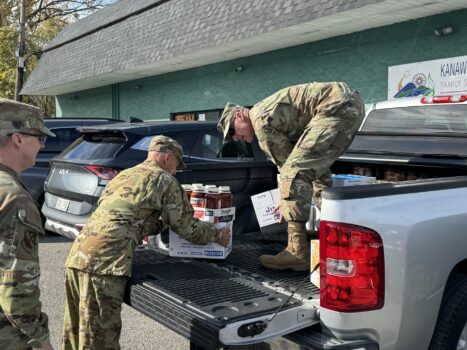

“The Guard is always ready and always there,” said Maj. Gen. James Seward, adjutant general of the West Virginia National Guard.
Representatives of West Virginia food banks and food pantries said they are grateful for the help.
“We didn’t think it would be this drastic immediately,” said Michael Farmer, pastor of Risen City Church and chief executive of Step by Step West Virginia, who spoke with reporters including Aaron Parker of MetroNews.
“Our goal here is to meet the need as much as possible.”
Tami Boling, who works with a food pantry in Lincoln County, said demand has been unusually busy in recent days. “Very busy,” she said, saying that the pantry was nearly out of supplies just a few days ago until the National Guard quickly helped resupply. “I just give them a call and tell them what we need and they’re there.”

Mountaineer Food Bank is the largest emergency food provider in the state of West Virginia serving families, children, seniors, veterans and individuals at risk of hunger. Each year, the food bank distributes more than 19 million meals to food-insecure neighbors in 48 of the 55 counties.
“A lot of families out there are struggling. So we are trying to be there, trying to be there for our partners, our food pantries, but it’s definitely been a challenge for the food banks in the state,” Chad Morrison, executive director of Mountaineer Food Bank, said on MetroNews Midday.
The New York Times podcast “The Daily” focused on food distribution efforts in Kermit, Mingo County, in the latest episode about the effects of the SNAP disruption.