


MOOREFIELD, W.Va. — Wednesday marked the 40th anniversary of the natural disaster which changed much of West Virginia’s landscape and a lot of West Virginia lives forever.
The remnants of Hurricane Juan in 1985 collided with a frontal system to produce rain which sat over West Virginia and poured for several days. The National Weather Service recorded 4 to 8 inches of rain on the region in a 48-hour period. The result was a raging torrent coming out of the West Virginia mountains and down into the valley areas below.
The Cheat River, Little Kanawha, West Fork, and South Branch of the Potomac all experienced high water that week, but it was Cheat and South Branch where the worst of the impact was realized.
“It started raining like early morning on the 4th, just constant rain non-stop. Of course it was raining in other towns above and it all came down on our town. When it hit it sounded like two rocks being slammed together,” said Gunby Delawder, a lifelong resident of Hardy County.
Delawder was nine years old and his family lived in an area called Caledonia Heights, a neighborhood on the mountain which overlooked the town of Moorefield. Their home wasn’t impacted, but their hometown was obliterated. Delawder, who still makes his home in Moorefield today, recalled the site as a youngster in speaking with MetroNews.
“It kind of looked like mud pouring down through the valley. It didn’t look like water, to me as a kid it looked like a chocolate milk shake just rolling down through the town,” he explained. “It took out houses, blew out the back of concrete buildings. You saw cars floating down the road,”
Delawder’s dad was a member of the Moorefield Volunteer Fire Department and spent days trying to help out. His own 1957 Chevrolet pickup truck was lost while he was on a call and the fire department parking lot flooded. Very little of the town was spared. Delawder and his family didn’t make it to town for five days.
“I remember wearing long rubber boots and walking with my dad through town. My boots were full of mud by the time we got where we were going. It was terrifying,” he said.
Chris Wetzel also lived in Hardy County and attended Moorefield Elementary. He was in 5th grade and remembered his teacher telling them as they dismissed early to take their reading book and complete an assignment, thinking they would be out maybe a day or two at the most.
“That was the only book I had left a month later when we returned to school,” Wetzel said.
Today Wetzel of the local Ford dealership.
“I was telling our general manager yesterday we would actually be standing under about 13 feet of water 40 years ago where we’re located,” he said.
Wetzel’s dad worked in Richmond, Virginia and was out of town when the flood water hit. He recalled his dad calling them and telling him to get the camping tent out of storage and if the water broke over into the yard to lead his mother and siblings up the mountain behind the house to an area where they often hunted. His dad then found through washed out roads, road blocks, mudslides from Richmond all the way to Moorefield. He found the entire South Branch valley covered in water and the road to his home washed out.
“He and a couple locals borrowed a canoe and he literally canoed across the raging river where it washed out the road in the pitch black dark and then walked several miles until he could get someone to give him a ride to our house. Still gives me cold chills thinking about it,” Wetzel explained.
It would be two weeks before Wetzel and his family could make it back into town.
“When we got there, I remember teachers covered in mud from head to toe shoveling out the school and throwing away a bunch of stuff,” he said.
Amazingly, in 1985, there were no FEMA trailers the school was hosed out, washed down, and kids returned to school at Moorefield Elementary five weeks after the high water. According to Wetzel they were served cold lunches on paper plates for a long time in the cafeteria, but they were still in their old school.
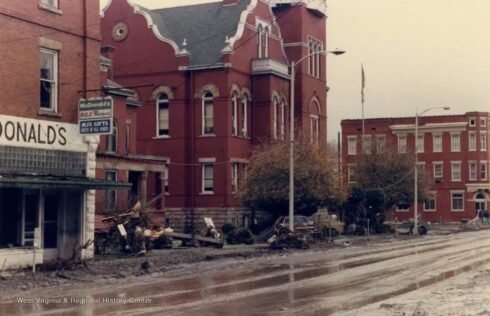
It was a deadly event for much of West Virginia. Forty-seven people were killed. Delawder knew of ten victims who drowned or were swept away by the raging water. Wetzel’s dad helped in the recovery of one of them in a canoe.
Nearby Petersburg took an equally devastating blow from the 1985 flood. The river’s path was reshaped in some areas, bridges were washed out and even today, the remnants of old cars and some debris can still be found along the banks of the South Branch. On the other side of the Allegheny’s the devastation was equally tragic. Parsons and several homes and communities along the Cheat River in Tucker County were destroyed. Downstream, the town of Rowlesburg in Preston County was largely under water for days. Marlinton along the Greenbrier River experienced high water along with parts of Summers County downstream.
A marker at the Hardy County Courthouse today pays tribute to the 47 lives lost in the 1985 flood. The toll was beyond catastrophic with 10,000 homes damaged or destroyed, more than 700 businesses were destroyed, and damage estimates topped $700 Million.