


Bluestone Coal, a company owned by Senator Jim Justice’s family, has had more than $3 million in liens filed against it for unpaid severance and special reclamation taxes over the past few years, according to public records on file in McDowell County.
The liens were filed by the West Virginia Tax Division between 2023, when Justice was still governor, and this past summer.
Bluestone Coal is run by members of the Justice family, including siblings Jay and Jill Justice, plus close associates, according to incorporation records with the Secretary of State’s Office.
Bluestone representatives did not respond to an email inviting comment on the liens in McDowell County.

Jim Justice, a Republican who was sworn in as a U.S. senator earlier this year, lists a $5 million to $25 million stake in Bluestone Coal Investment as one of his many assets on his annual financial disclosure.
Justice continues to be one of West Virginia’s most popular political figures with 61% of respondents in the most recent MetroNews West Virginia Poll viewing Justice favorably.
Several financial strains have again surfaced for Justice, who at one point was a billionaire considered West Virginia’s richest man.
The national news outlet Politico first reported last month that the U.S. Internal Revenue Service filed liens against Justice and his wife Cathy over more than $8 million in unpaid income taxes dating back to 2009. The liens were filed by the IRS Oct. 2 with the Greenbrier County Clerk.
Meanwhile, the West Virginia Tax Division also filed liens on The Greenbrier Hotel and Greenbrier Sporting Club, both owned by the Justice family, over $1.36 million in sales taxes collected but not remitted.
“Just let it be and see how it all plays out,” Justice said of the IRS claims during a briefing with West Virginia reporters last month.
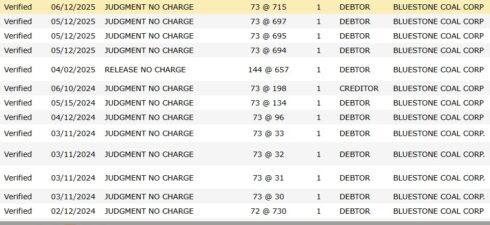
The court record in McDowell County shows liens filed against Bluestone Coal by the state tax division starting at the beginning of 2023. Over the next few years, 35 filings add up, listed as immediately due and payable.
Only one of the liens mounting over that time, one in the amount of $43,387, has been withdrawn, according to county records.
The liens continued to be issued with interest and penalties through this past June.
The nonpayment of the coal taxes affects both state and county finances, said Evan Hansen, a state delegate who founded Downstream Strategies, an environmental and economic development consulting firm.

“A portion of severance taxes go into the General Revenue Fund, but the rest is returned to coal-producing counties and to other counties and municipalities according to a formula. The counties and municipalities use the funds for local priorities,” said Hansen, a Democrat from Monongalia County.
He continued, “The special reclamation tax is used to fund reclamation at coal mines at which the operator walks away and fails to perform the required reclamation. This can include land reclamation and water reclamation.
“Coal mine reclamation is particularly important in parts of the state, like McDowell County, where coal production has decreased, and where people are looking for ways to diversify their local economies. Mine reclamation itself creates local jobs, and properly reclaimed mines help a county be a more attractive place to grow an outdoor recreation industry.”
McDowell County’s finances have significant challenges, including per capita income of about $35,000 and a poverty rate higher than 30 percent. Through August, McDowell County’s unemployment rate was 10.6 percent. The county’s population has decreased significantly, leading to a smaller tax base.
McDowell County was hit hard by flooding earlier this year.