

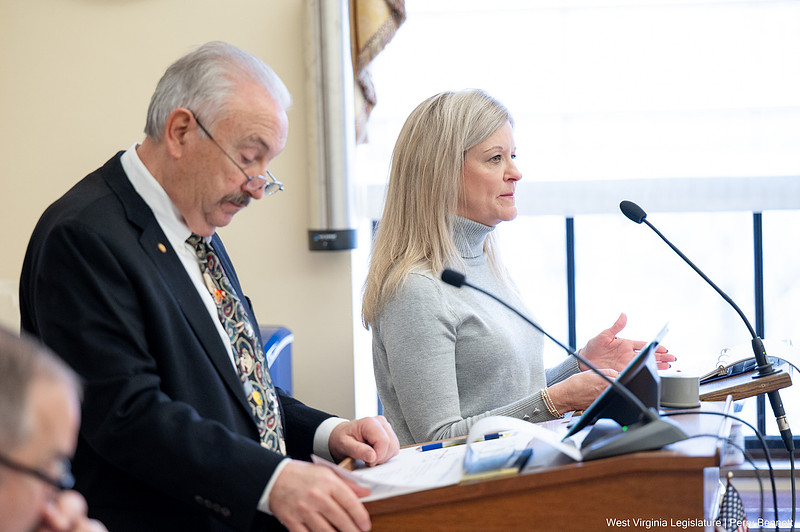
The state superintendent told lawmakers that West Virginia’s school aid formula, which is largely based on student population, deserves examination — as illustrated by the number of consolidations and closures of community schools.
In December, the state school board approved consolidations and closures of more than a dozen schools across six counties. The state also experienced a wave of school consolidations last year.

As the funding formula stands now, counties face difficult decisions. But sometimes it’s more difficult than it might seem to make cuts, state Superintendent Michele Blatt told lawmakers during a budget discussion before the House Finance Committee.
“When a funding formula is based on the number of students you serve, we run into the issue that I might lose 20 kids countywide, but they’re at five different schools — which means I can’t cut a teacher, or I still have to run that bus for the 10 that are left on that road,” Blatt said.
“And so tying everything to that enrollment number, when you spread it across to county, they’re not able to make the cuts that if you just look at numbers on paper: ‘Well, they lost 50 kids, they should cut two teachers; they should cut two bus drivers.’ And that’s just not, in reality, how it works when we’re spread out across the counties.”
Blatt thanked lawmakers for their consideration of issues surrounding the school aid formula and asked for continued focus “because we know it’s a very complicated formula, and there’s a lot of moving pieces.”
She suggested one area, in particular, to examine is financial support for special education students.
That population is growing, she said. Three years ago, special education students made up 18% of the student population, and now it’s 21 percent.
Generally, Blatt said, the available financial support for special education students compared to what’s needed is about half.
“A lot of that comes in, again, to personnel because so many of our high need special education students need nurses; they need a one on one aid, and these different resources. And so all of those things impact and pull from the other services our counties are able to provide,” Blatt said.
COMMENTARY by T.J. MEADOWS: Special education need exceeds funding
Blatt said the special education students in West Virginia receive the educational support that they need — but those resources are often made available by diverting funding from where it might otherwise go. General education gets squeezed, she said.

Delegate John Paul Hott, R-Grant, followed up by asking how that balance is usually achieved: “How are the school systems able to do this? They’re just basically making cuts and in other areas, and they’re they’re losing services there?”
“Yes,” Blatt responded, “The cuts are having to be made to a lot of the general education programs, a lot of additional supports and things that are provided to after school programs, summer school programs, different things that would be available for all students so that we can assure that we, you know, are meeting the needs of those special needs students.
“And so we’ve really looked at, you know, if we would weight our special education students like even 1.5 it would go a long way to ensuring that not only are their needs met, but the needs of all students in the system are being met.”
In comments to reporters after the legislative meeting, Blatt elaborated by saying one focused way of adjusting the state school aid formula would be to adjust the way it accounts for special education students.
“If we could weight those special education students so that our counties receive additional funding to provide for some of those personnel and services they need, we think would be one quick step that wouldn’t complicate the formula,” Blatt said.
“We think that’s one piece and a priority right now that would help with our counties across the state, as we start continuing to look at the different pieces.”
Superintendents from several West Virginia counties attended the budget hearing. Speaking later on MetroNews Talkline, Superintendent Will Hosaflook of Jackson County, said current trends mean that county is in line to lose more than $1 million in state aid.
“A million dollars basically equals 13 teachers,” he said.
Asked about special education costs, Hosaflook said Jackson County runs a $2.8 million deficit and has to pull from other resources.
“So we’re pulling $2.8 million out of our unrestricted assets each year through our levy, or our excess levy, and then we have to kind of make cuts based on that,” he said.
“Those programs that could be cut, those are programs that keep kids in school a lot of times, such as your CTE programs such as your welding, your carpentry, your HVAC, your foods program. All those programs mean so much to our students, and those the programs that are not required in state law.”