


Members of the Marshall University swimming and diving team asked the House Education Committee to push ahead legislation to create permanent endowment funds intended to support women’s sports.
Marshall announced last month it would cut the women’s swimming and diving program to add a STUNT program, citing financial sustainability.
Madison Bowen, a freshman member of the Marshall swim team, addressed the House Finance Committee on Tuesday afternoon.
Bowen and teammates Allison Dodd, Charlotte Thompson and Lauren Ramsey have been at the Capitol over the past week to rally support for The Women’s Collegiate Sports Protection Act, SB 502.
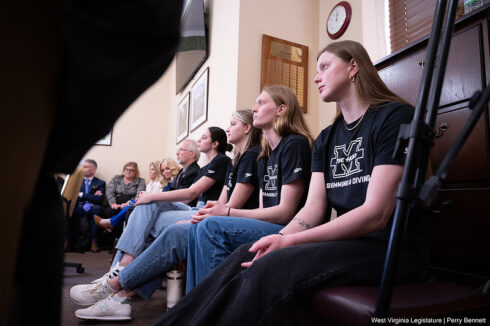
Bowen asked the committee to prioritize investments in women’s sports programs, especially those that have recently lost teams.

“While evaluating this bill, please think of not only us, but of the little girls you pass kicking a soccer ball on your way home from work each day. Think of the young ladies cheering on the sidelines from your district’s football games,” Bowen told lawmakers.
“Think of your daughters and the opportunities which you hope will be provided to them.”
Members of the House Education Committee responded in a couple of ways to try to ensure momentum in the final week of the regular legislative session.
First, House committees have had a system of exploring bills one day and voting on them a different day. In this case, Delegate Mike Pushkin, D-Kanawha, asked for the committee to move the vote to today. The committee agreed to do so.
Second, the bill has also been assigned for consideration by a separate committee, House Finance. That would be a quick turnaround for the possibility of passage by the full House of Delegates because the final day of the session is Saturday.
So some members of the committee asked for the second committee reference to be dropped, potentially bypassing that step. Where that stands is, the chairmen of the education and finance committees will talk about it and reach a recommendation about what to do.

Pushkin noted the bill is about allowing schools to raise their own money, not spending state funds. “It sets up funds where they can raise money on their own or the institution may do it. It’s not necessarily taking public funds,” he said.
Overall, the bill aims to shield collegiate women’s sports from market volatility and shifting funding priorities through a blend of private investment and whatever might be available through administrative savings.
The bill proposes the creation of permanent endowment funds where the principal remains untouched, ensuring a consistent revenue stream for scholarships, coaching, and facilities.
Earnings from a women’s athletics endowment may be used only for scholarships, coaching and training staff, equipment, facilities, travel, and other expenses directly related to women’s collegiate Olympic sports programs.
At one point, the bill had a mechanism where the state would offer tax credits to private donors to build the funds, but that was removed from the legislation earlier in the process to ensure it’s revenue neutral for the state.
The bill passed the Senate earlier this month. The lead sponsor is Senator Jay Taylor, R-Taylor, who is a softball enthusiast.
West Virginia University’s athletic department communicated early on with Taylor and, generally, says the legislation would be helpful. Travis Mollohan, WVU’s associate vice president of government relations, told the House Education Committee that the bill is modeled on measures already adopted in about 10 other states.
Mollohan said the Legislature has already passed several bills to help with name, image and likeness and revenue-sharing. WVU is currently relying mainly on a nonprofit athletics entity, Gold and Blue Enterprises, created last year.
“While this is a really good idea and would be another tool in the toolbox, I think right now WVU would focus more on direct investment to its athletics program and using our nonprofit athletics to deal with some of those issues,” Mollohan said.
Tony Stroud, vice president for strategic initiatives at Marshall University, testified in support of the bill and discussed Marshall’s funding challenges, Title IX proportionality and the operational costs of women’s sports, including swimming and diving.
“We are fully supportive of any funding that comes in that could be used to support women’s college athletics,” Stroud told delegates.
Stroud, questioned by delegates, addressed the situation with the swimming and dive team. He said cutting swimming and diving was a difficult financial and Title IX–driven decision.
“We looked at several things when we made this decision. And as you can imagine, making a decision like this is not easy. We looked at Title IX and what we could do going forward. As you may have heard, we are adding a program called STUNT, which will initially start with the roster of 30 and pick up to 65,” he said.
“We also look at the long-term sustainability with respect to allocation of resources,” he continued, “and just look at the long term sustainability with respect to resources going forward. And can we properly field a Division I competitive team based on the resources that we have?”