

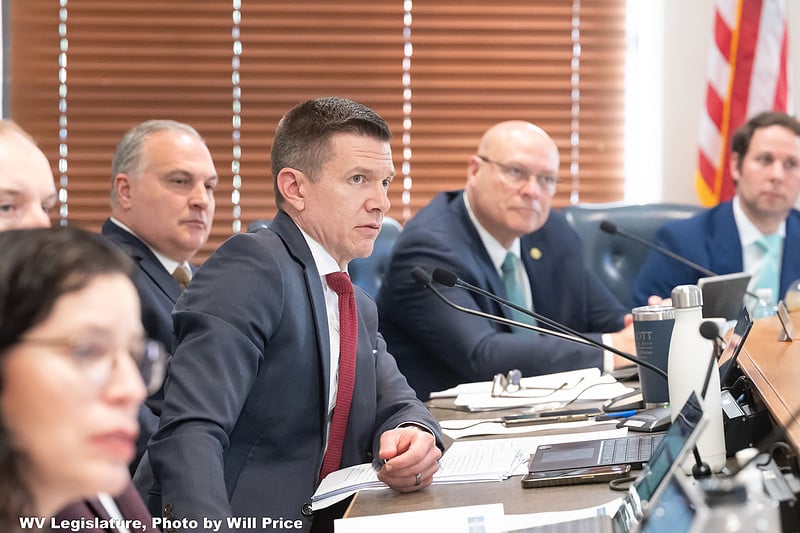
Senators are trying for a quick and extensive rebuild of legislation to have West Virginia business owners confirm a new hire’s eligibility to work in the United States.
The Senate Judiciary Committee debated the legislation for almost two hours Tuesday afternoon, with several expressing strong doubts about whether the current version of the bill represents burdensome regulation on small businesses — or whether it’s workable at all.

At one point early on, Senator Eric Tarr asked to table the bill but the majority of the committee did not agree.
“I’m a small business owner, there’s small business owners on this committee. I would argue the intent piece — because when I read this bill, I feel like the intent is to entrap businesses. That’s what this feels like when I read it as a business owner,” Tarr said.
After coming back from a recess, Senate Judiciary Chairman Tom Willis said the bill would need to be set aside for work. He assigned a subcommittee led by Senator Patricia Rucker, R-Jefferson, and gave the group a deadline of 2 p.m. Wednesday for improvements.
Subcommittees are regularly assigned — and sometimes they get the job done — but this one is on a particularly short timeframe with the regular legislative session ending Saturday.

“I say that we’re not putting this into subcommittee with an intent to kill this bill. We’re putting this into subcommittee with the intent to clean it up so we have a good product that is good for West Virginia,” said Willis, R-Berkeley.
Willis provided a list of tasks: resolve code conflicts, fix circular or inconsistent definitions, define the term “seeks to employ” and ensure the bill doesn’t inadvertently make people have to report casual hires like babysitters and lawn cutters.
House Bill 4198, also known as the E-Verify Safe Harbor Act, mandates that all employers in the state use the federal E-Verify system to confirm the legal work authorization of new employees.
Under the bill, all employers, including private businesses, state agencies and political subdivisions, would have to register and create an E-Verify account. Employers are required to verify a new employee’s authorization to work after hiring.
The early version of the bill defines “employer” broadly to include any individual, person, or business entity that “employs or seeks to employ an individual or individuals,” which senators viewed as overly broad.
The bill establishes a tiered system of penalties for employers who knowingly employ unauthorized workers, ranging from a formal warning to a civil action to permanently revoke the employer’s business license.
Each day of non-compliance and each individual employee’s missing record constitutes a separate offense, resulting in rolling fines.
Last month, the House of Delegates had a marathon debate over the E-Verify bill before narrowly passing it, 48 to 46, with some members of the Republican supermajority accusing others of being soft on illegal immigration.
Willis said that is not the case with the Senate.
“There’s no question that this committee is a committee dedicated to legal immigration and against illegal immigration,” he said.
But members of the committee did express strong reservations about how the requirements — and potential punishments — in the bill would work with small employers.
Tarr, R-Putnam, asked questions about how the loose definitions and requirements might apply to very, very small employers.
First, he asked staff counsel if he would qualify as a “person” under the bill. Yes was the answer.
Next, he asked if he would be considered an individual. Again, the answer was yes.
“Now, if I’m offering to pay somebody to watch my kid. Me my wife are going to go out on a date tonight. I need somebody for a few hours. Am I employing them?” Tarr asked.
Broadly, as the bill originally came through, yes.
So the conclusion was that the individual person who hired the babysitter might be subject to the legislation’s reporting requirements.
Tarr suggested a different scenario: “I’ve got an elderly parent, and I need a little help. I can’t get them out of bed. I need somebody who’s going to come in and help me transfer my parents to get up, to eat, go to the restroom. And I’m going to say ‘I need you in here a couple days a week from 2 to 3.’ Am I employing them?”
If the person in that situation would fail to meet the requirements, Tarr asked, “Am I subject to a $500 per day per incident for every day that I don’t comply?”

Senator Joey Garcia, D-Marion, also described a possible situation: In this case, a small business owner employs one person. That person has the background to work, but the small business owner fails to use the system to report.
“Let’s say it’s like Susan B. Anthony‘s great, great, great, great, great granddaughter — been here since the beginning of time in the United States of America, absolutely American citizen,” he said.
“That doesn’t matter if I don’t use the E-Verify process in this bill, correct? I still get a penalty: $500 per day, per person.”

Delegate Elias Coop-Gonzalez, the lead sponsor of the bill in the House, testified before the Senate Committee and acknowledged the bill wasn’t perfectly drafted.
“Is it written completely beautifully? Is there any bill that’s completely perfect? I don’t think so. A lot of people have a say in the legislative process through multiple committees and the House floor,” said Coop-Gonzalez, R-Randolph.

Senator Ryan Weld, R-Hancock, took issue with that, saying the punishment for small employers could be quite serious.
“At the outset of your testimony, you said, in respect to the bill, you said maybe it wasn’t structured 100% perfect, and that is my problem with this piece of legislation,” Weld said.
“We are dealing with legislation that could result in significant fines for people that could have their business taken away from them for not complying with something that, in your mind, wasn’t structured 100% perfect — in my mind is unbelievably poorly drafted.”