

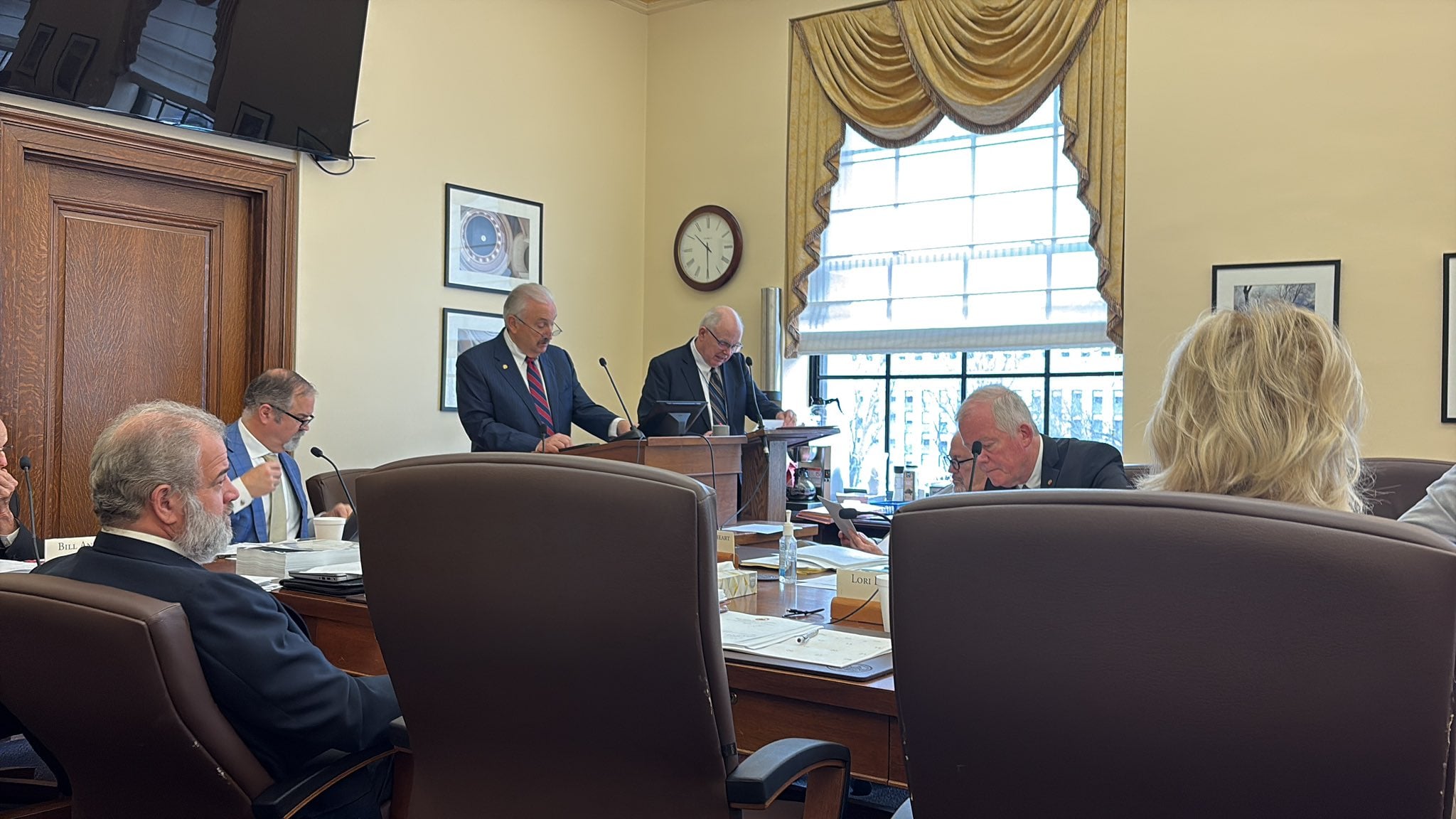
The House Finance Committee advanced legislation to cut personal income taxes by 5% while also increasing taxes on vape products.
The full House of Delegates will now need to make a collective decision on the tax cut. What the House would do has been one of the lingering questions of this regular legislative session, which ends Saturday.
Gov. Patrick Morrisey has repeatedly said his administration has done the hard work of identifying ways to account for the 5% cut, but he has consistently expressed a wish for 10 percent.
State officials under the prior Justice administration established a trigger system to cut income taxes when the state reaches particular measurements for economic growth, but this tax cut would occur outside that framework.
The 5% tax cut is estimated to amount to about $125 million in state revenue. A 10% tax cut would be about $250 million.
The vape tax increase is an estimated $16 million more in state revenue.
This year’s overall general revenue budget is roughly $5.5 billion.
The governor’s revenue estimate essentially lowered spending levels to give space for the 5% tax cut amount in the budget.

During nearly an hour and a half of discussion of the tax cut bill in the House Finance Committee, Delegate William Anderson asked what would have to be done if the effects of the cut are a slice too deep.
“If you get a worst case scenario, governors in the past have had to issue spending cuts to reduce their spending. Is that correct?” asked Anderson, R-Wood.
The answer was yes.

After the meeting, Finance Chairman Vernon Criss said he is personally comfortable with the 5% cut, at least mostly.
“I think so. I don’t like the idea that we’re not using the formula that we implemented — that we get the growth and if our growth is above the inflation rate then we’re able to do the reduction. And I think that part is where I still think we need to be. We’ve accelerated the last two tax cuts prior to knowing what our economy is doing,” he said.
“And now we’re not allowing the economy to catch up to where our tax cuts are to where we can make sure we’re maintaining cash flow to pay our bills.”
Criss, in a hallway interview with reporters, said he was not comfortable with the 10% proposal.
“The 5% is what he introduced. That’s what he proposed. That’s what he had baked in his revenue estimate,” Criss said of the governor. “He had no reason to ask for a 10% cut without providing the legislation or the vessel to be able to do that. So the 5% is what he’s going to get.”

Delegate Sean Hornbuckle, D-Cabell, proposed a series of amendments to the tax cut bill. One would have adjusted tax tiers to give more tax relief for lower income residents.
“We’re going to shift the brunt of those dollars to the West Virginians making the least in our state,” Hornbuckle said.
Members of the Republican majority on the committee argued against it, saying the change would amount to class warfare. “”I think we need to put it back into all West Virginians’ pockets,” said Delegate Clay Riley, R-Harrison.
Hornbuckle managed to get an on-the-record vote on the amendment. It failed 2-18, but the vote could wind up in political messaging later.
Another Hornbuckle proposal would have changed the tax cut to a child tax credit of $350 per child. That one was ruled not germane.
And a third Hornbuckle amendment would have repealed the earlier section of code that established the trigger on cutting the income tax. “If we’re going to go around the law, I’d just suggest we do away with it,” he said. That proposal failed too.
Afterward, in the hallway, Hornbuckle said the income tax cut is a case of misplaced priorities.
“This is bad fiscal policy,” he said. “The question is, with $125 million at stake, how many potholes could that fill in the state of West Virginia. How many roads and bridges could that $125 million fix. We see PEIA premiums are up. Could it help that? We could put more money into childcare,” he said.
“We have schools that are shutting their doors right now. How many schools could that keep open? It’s irresponsible the way we’re spending money.”