

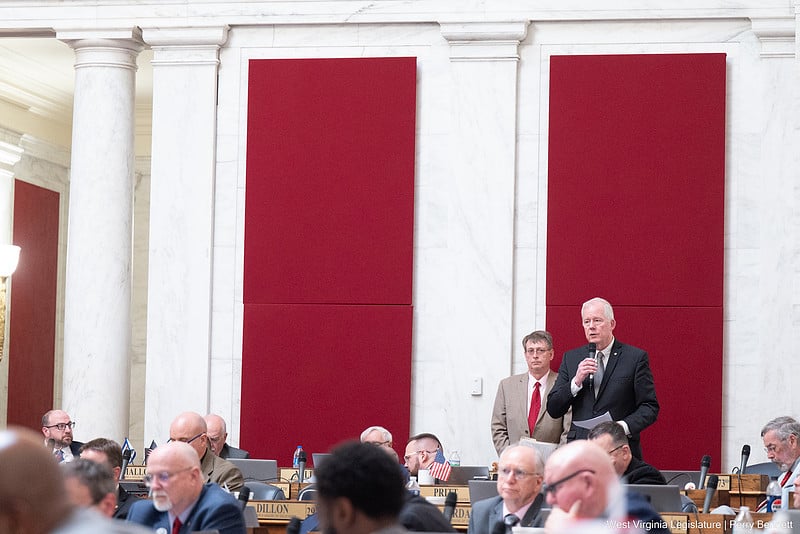
Most delegates voted for legislation representing a partial rollback of policies that were passed a decade ago after contamination of the drinking water supply in the Kanawha Valley.
The House of Delegates took legislation passed earlier by the Senate that made more significant changes and, you know, watered it down.

“The Aboveground Storage Tank Act was passed in 2014 and since then, we have seen every year efforts to repeal it,” said Delegate Kayla Young, D-Kanawha.
“I do think this version is a lot better than than the original version that we had in the energy committee. So I’m glad that it’s less bad, but that doesn’t make it good,”
Delegates passed SB 641, relating generally to aboveground storage tanks, on a 58-34 vote today.
In a chamber where there’s a 91-9 split between Republicans and Democrats, that’s a pretty close vote.
The bill passed the Senate on March 4. The House has amended it, so it now goes back to the Senate to approve or reject those changes. The regular session ends Saturday.
On Jan. 9, 2014, a storage tank at Freedom Industries in Charleston leaked about 10,000 gallons of MCHM, a chemical used for coal processing, into the Elk River. The contamination affected the water supply for nine counties, leaving about 300,000 residents without potable water for days.
Right after that, state lawmakers voted the West Virginia Aboveground Storage Tank Act into law. It created a regulatory program for tank registration, inspection and spill prevention, especially in “zones of critical concern.”
Legislation under consideration now expands exemptions for smaller tanks used in hydrocarbon production and for certain tanks within mining permit boundaries, as long as they are outside zones of critical concern.
It reclassifies some brine tanks (10,000 gallons or less, used in connection with hydrocarbon production and storage) from stricter level one regulation to level two when they’re located outside the most sensitive areas.
The bill gives tank owners nine months to upgrade when new zones of critical or peripheral concern are created before a tank’s regulatory status can be changed.

“The tanks, some of which will be moved from a level one to a level two, are still subject to aboveground storage tank regulations. All tanks are subject to other regulations, both at a federal and state level,” said Delegate Bob Fehrenbacher, R-Wood, who explained the bill in today’s floor session.
“I believe the actions proposed in this bill are prudent and supportive of continuing to protect our water supply.”

Delegate “Happy” Joe Parsons, R-Jackson, said the bill does not go far enough to loosen restrictions for operators.
“I don’t like this bill because I don’t think it helps our small producers enough. However, correct me, if I’m wrong: We’re regulating the the tanks that have brine only,” Parsons said.
The bill came over from the Senate proposing bigger changes — aiming to loosen regulations for tanks up to 50,000 gallons. The House Energy Committee discussed the policies for hours earlier this week and refined the bill.
During the earlier committee discussions, Scott Mandirola, former West Virginia Department of Environmental Protection official, testified that he was involved in the original writing of the Aboveground Storage Tank Act. Mandirola is now technical advisor on water policy and regulations for West Virginia Rivers.
“What we put in place,” he told delegates, “has substantially reduced the risk to drinking water and the risk of another Freedom Industries incident. I think lessening of those regulations is very concerning to me, and should be to all people in West Virginia.”
Mandirola told delegates that the state now regulates 4,500 tanks out of about 42,000 tanks in the state — concluding that equates to regulation of about 11% of the existing aboveground storage tanks in the state. “It’s basically 89% have been deregulated since the inception of the act,” he said.
Overall, he said, “I would prefer the bill doesn’t proceed forward.”
Jeff Eisner, an oil and gas owner based in Ripley, Jackson County, also testified before the energy committee about the the costs of fees and third‑party inspections, how often his tanks are inspected and how many tanks the bill would affect. He was among several people who spoke in favor of the bill.
“It is a big impact to us, the level one regulations that we are under,” Eisner told delegates.
“You know, you have an operator like myself that has roughly 50 tanks – it’s real money for us. And level one tanks are, I believe, in the 40‑some dollar range.”
Eisner told delegates that although he supports loosening the state’s regulations, he remembers the 2014 water crisis too.
“I don’t want to make light of what was said today,” Eisner said in a Monday committee meeting.
“I lived in Elkview when the spill happened. I have a 12‑year‑old son who was born the week of the chemical spill at Women’s and Children’s Hospital, so I understand the fear that was there, but I’m happy to report he’s at baseball practice tonight and doing just fine.”