

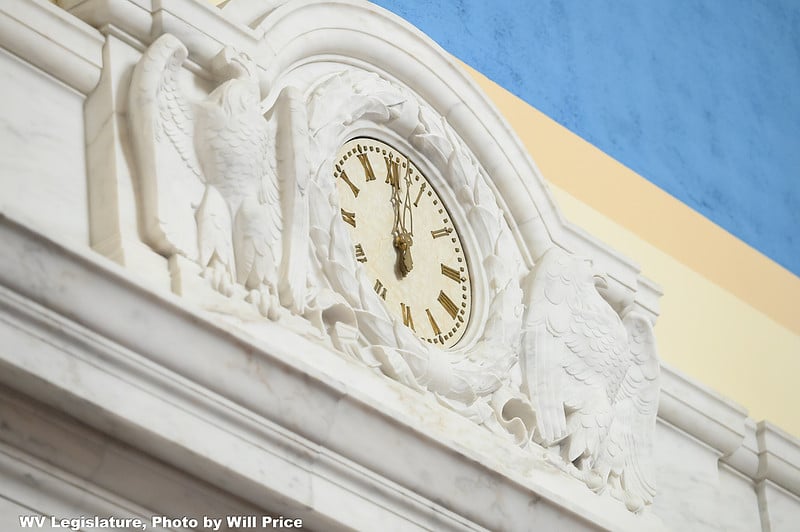
At 11 minutes to midnight, senators passed a 3% pay raise bill for teachers and State Police, laying aside an attempt to mix in higher pay rates for some areas of the state.
That was the last action taken by the Senate on the final night of the regular session.
A separate bill that would have provided additional financial support for special education students in public schools fell victim to the legislative clock. That bill did not reach agreement before midnight on the final night of the regular legislative session.

Senate Finance Chairman Jason Barrett, R-Berkeley, blamed the loss of the locality pay provision as well as the failure to pass enhanced special education funding on the House of Delegates.
“It’s unfortunate,” Barrett said in an interview after the session ended. “I want to commend the members of the Senate for recognizing a problem we have in some areas of this state as it relates to cost of living and completely disappointed in the House of Delegates again.”
House Bill 4765 — Teacher, School Personnel, and State Police Pay Raise — was completed just in the nick of time, fulfilling a pay raise promise from the governor and legislators.
State law requires lawmakers to pass bills for pay raises for those three groups of workers because their salary schedules are in state code. Other state workers are in line to receive average 3% pay raises through the general revenue budget.
In the final week of the legislative session, Barrett led an effort to add a formula that adjusts base pay based on the cost of living in certain areas. Economic competition in the Eastern Panhandle, where he lives, is particularly acute with many residents finding better wages across the state line.
The version of the bill that Barrett preferred kept the across‑the‑board pay raise but added a “market pay enhancement” that varies by county based on cost of living.
On Saturday morning, the House of Delegates voted to reject the changes that the Senate had made. The Senate then had to decide whether to stand firm, which might have risked losing the pay raise bill entirely, or back off of the market pay provision. In the end, senators chose the second option.
That concept has often been a dividing line among delegates who are from communities all around the state and on the ballot every two years.
“I’m disappointed that they failed to recognize that different areas of the state have different needs and concerns. In the Senate we pass a lot of bills that help certain areas but don’t help other areas because it’s the right thing to do for our state. Unfortunately, there are too many members of the House of Delegates who just don’t see that,” Barrett said.
School funding bill
As the session ended, legislation that would have addressed special education costs in public schools fell between the cracks.
Financial support for West Virginia’s public schools was a recurring theme of this year’s legislative session, but nothing wound up getting through.
A major aspect of financial pressure on local school systems is the cost of special education because some students need extra help like one-on-one instruction or nurses.
In a bill that was changed repeatedly over the past few weeks, senators this week rolled in new provisions that would add additional weighting for level two and level three special education students.
With the additional weighting. Level two, special education students count as 1.2 students. Level three, special education students count as 1.3 students.
That would not occur in the coming fiscal year. Lawmakers passed a budget bill last week. So the financial change in the school funding bill that is still running would would take effect starting July 1, 2027.
A final version of that bill passed the Senate on Saturday. But because HB 5453 had changed so many times, the most recent version still needed to be approved or rejected by the House of Delegates.
The House got embroiled in the last hour of the session with a bill about halting students from transferring to homeschool status if there’s an active child protective services investigation. So delegates never managed to circle back to the special education funding bill.
“This is what we see out of the House every 60th day. In the evening, late at night, a controversial bill rolls out and it gets filibustered. And there are a lot of smart people in leadership over there, and I’m never going to be convinced that’s not orchestrated. They know exactly what they’re doing, and they run the time out on good legislation,” Barrett said.
Education chair’s reaction

Senate Education Chairwoman Amy Nichole Grady, R-Mason, had worked on both the pay raise bill and the school funding support bill.
On the pay raise bill, Grady said she understood the economics that led to the market pay push. “We wanted to try to make things fair for people in higher cost of living areas, sending it over there knowing they probably wouldn’t concur,” she said.
Grady said most senators were willing to recede from the market pay position to get the overall pay raise through.
“I’d like to work towards that locality pay just to help those teachers who are in those areas, but that’s hard. It’s a hard sell, and I understand that.”
On the school support bill, Grady had spoken all session about passing such a bill as a top priority. In this case, it didn’t happen.
“The only thing that saves me about that is that it didn’t go into effect this year,” she said. “It wasn’t to go in effect until ’27, ’28, so we can still take care of that next session.”
School calendar changes
On the final evening, Senators also agreed to changes to school calendars from days to hours.
Senate Bill 890 would change the minimum public school 180 instructional day requirement into a minimum 954 instructional hour requirement.
Earlier, the mark was at 900 hours when first passed in the Senate.

Senator Mike Oliverio, R-Monongalia, has argued the change will shortchange student learning.
“I want to renew my opposition to this bill,” Oliverio told senators on Saturday afternoon. “This is the bill that reduces high school attendance by 23 days. The House attempted to make an amendment to our bill to reduce it by 14 days. Either way, I think it ‘s a step in the wrong direction.”