

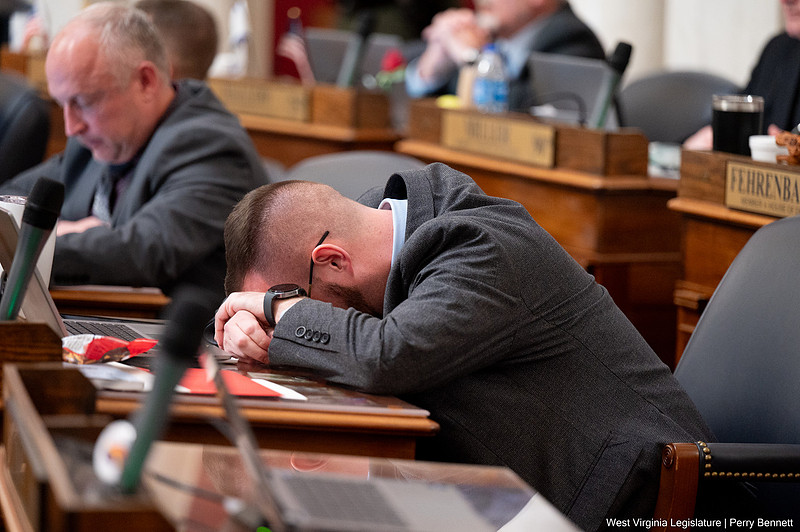
Late on the last night of the legislative session, Delegate Elliott Pritt laid his head on his desk, his hands folded above. The body language was forlorn.

“I think in that moment, I just realized what was going to happen and the ramifications of that for some kids in our state, what could potentially happen while we have to wait another year to try to do something,” Pritt, R-Fayette, recalled on MetroNews Talkline.
“I think that just hit me in that moment.”
Pritt had been advocating for “Raylee’s Law,” a proposal to place a hold on removing students from public schools if there is a pending child abuse or neglect investigation.
The bill is named for 8-year-old Raylee Browning, who died of abuse and neglect in 2018 after she was withdrawn from school, eliminating contact with educators under mandatory reporting requirements. That bill has been introduced since 2019, but has never passed.
This year, the proposal ebbed in and out of legislative discussion. The House Education committee advanced a version early this month, but then the bill did not meet a crossover day deadline to be passed to the Senate.
Then, a day before the regular session concluded, a group of senators successfully pushed to amend “Raylee’s Law” into a separate bill about education policy. To get that done, a majority of senators overrode the president’s ruling that the overall result was not germane.
So that left the House of Delegates with a big decision on legislative day 60. Delegates could agree to what the Senate did and pass the bill, they could reject what the Senate did or they could make further changes to the bill.
The final day is both a rush and a slog with these kinds of final decisions being made on dozens of policies and also with an extraordinary amount of waiting around.
The House was scheduled to convene at 9 a.m. on the final day, actually did so relatively shortly after that — and more than 12 hours later still had not gotten to “Raylee’s Law.”
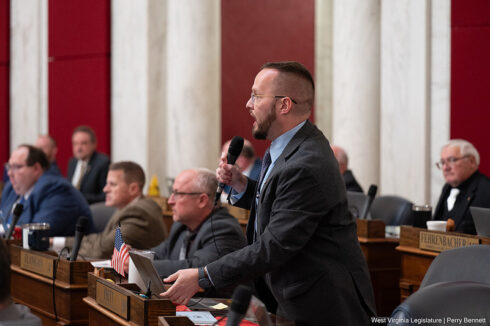
Pritt: ‘Do something to protect children’
Pritt was well aware of all of that and wanted to give “Raylee’s Law” a chance. So at 10:35 p.m., Pritt made a motion to bring “Raylee’s Law” directly to consideration. His motion failed in a narrow vote, 47-49.
The House eventually brought “Raylee’s Law” up at 11:12 p.m.
That allowed just 48 minutes, or less, to weigh the bill.
There were half a dozen further amendments being offered to the policy. Without a time crunch, the amendments could have been thoughtfully considered and further shaped the bill. But with time short, any change would have to go back to the Senate with virtually no time left.
Delegates who supported the policy made a motion to limit debate on amendments to 90 seconds. That was voted down. Then they made a motion to limit debate on amendments to 5 minutes. That passed. Delegates repeatedly made motions to move the previous question or table the amendments, moves to try to push ahead.
Pritt, a social studies teacher, pleaded.
“We have an opportunity here tonight to do something to protect children. We have tried this for four years. If we amend this bill, change it in any way, this bill dies tonight, which I do think is probably the outcome that some in this room want,” he said.
A few minutes later, the bill ran out of time as the clock hit midnight and the legislative session ended, sine die.
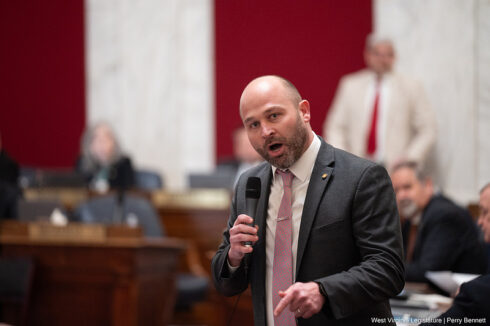
Burkhammer: ‘It didn’t pass because it’s bad law’
On the other side of the debate was Delegate Adam Burkhammer, who believed that as written, “Raylee’s Law” was a flawed policy.
“If we really want to protect kids, maybe we should write good law, because the law before you is not going to protect one single child,” said Delegate Adam Burkhammer, R-Lewis.
“And I don’t care what time it is, our job is to write good law. And we need to write good law, and we need to protect kids. And this garbage of kicking this same bill around for the last four years — it didn’t pass because it’s bad law.”
Burkhammer was one of the delegates offering amendments. His would mandate that county superintendents must directly notify the Department of Human Services if they suspect a student is being harmed when a parent or guardian attempts to withdraw the child from school.
The amendment also would have required an official investigation to begin within a 24-hour window. Additionally, the amendment mandated that all local school boards implement policies requiring teachers and staff to inform their superintendent whenever they report suspected abuse.
“And so there we were late, late in the day, but I had filed my amendment earlier in the day,” Burkhammer said on MetroNews Midday. “I really wanted to get to the crux of the problem and want to force our CPS workers in those really dire times to get out there see the kids, to make sure we’re protecting all kids.”
His amendment wound up being approved by a majority of delegates, 69-26.
“It ultimately passed. I hated how it wasn’t able to make it over the Senate, kind of the last-hours things there, but I still think that was our best attempt at truly protecting kids,” he said.
Burkhammer said he intends to focus on the issue when the next legislative session convenes, Jan. 13, 2027.
“So we’re going to roll out day one with with this piece of legislation. I’m going to work in a bipartisan manner, and we’re going to get this rolling right away,” he said on Midday.
“I think us kicking this around and everybody being frustrated with each other at the end of the day just doesn’t need to happen. We can get something on the books day one. And we’ve got a lot of other CPS work that we can do as well, that we have been doing and so I think it’s going to be a priority.”
Pritt, his Republican colleague, agreed that’s a start. But he said the resulting bill needs to be broader than what the amendment envisioned.
“I think that his amendment is a good start. I do think that there are some things that need change,” Pritt said.
“I do think it’s a little too restrictive. I think it needs to be more people able to file — any mandated reporter, things like that, or a couple other designees in the county, not just the superintendent.”
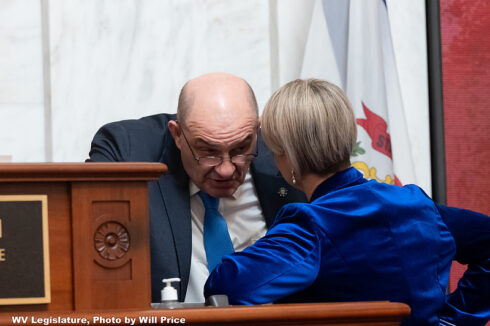
Grady: ‘I am 100%. determined to get that bill out’
Senate Education Chairwoman Amy Nichole Grady was one of the biggest advocates for “Raylee’s Law” in that chamber.
About 9:15 on the final night of the session, when she heard the bill was stalled, she went with Senator Ryan Weld to meet House counterparts, deputy speakers Matthew Rohrbach and Joe Ellington. With set faces, they trucked across the House floor while delegates chatted and waited around for anything to happen.
“Senator Weld and I had to go over to talk to House leadership to get that actually put on the floor. I’m happy they decided to take a vote on that,” Grady said right after the session ended.

Grady, a fourth grade teacher, believed strongly that the policy could offer protections for vulnerable children.
“In my situation as a classroom teacher, I’ve had seen students in investigations for child abuse and neglect and then (the family) pulled their child and moved out of state and CPS has lost contact with them,” Grady said on Talkline.
“You can’t find them — find them anywhere, you know. And those are the kind of things that we’re trying to prevent from happening.”
Grady continued, “You know, we’re not talking about traditional homeschooling families here. We are talking about people who are using homeschool or transferring of schools as a curtain or a shield to abuse their kids, and those are the people we’re going after, not not people that homeschool in general.”
The Senate Education chairwoman said she remains focused on the policy for next year.
“I am 100% determined to get that bill out in a way that we can get support in both chambers next year, and I will work hard on it.
“And so, yes, I will run it next year. We will, we will have to vote on the floor regardless. However, we have to get that out. That’s my plan.”