

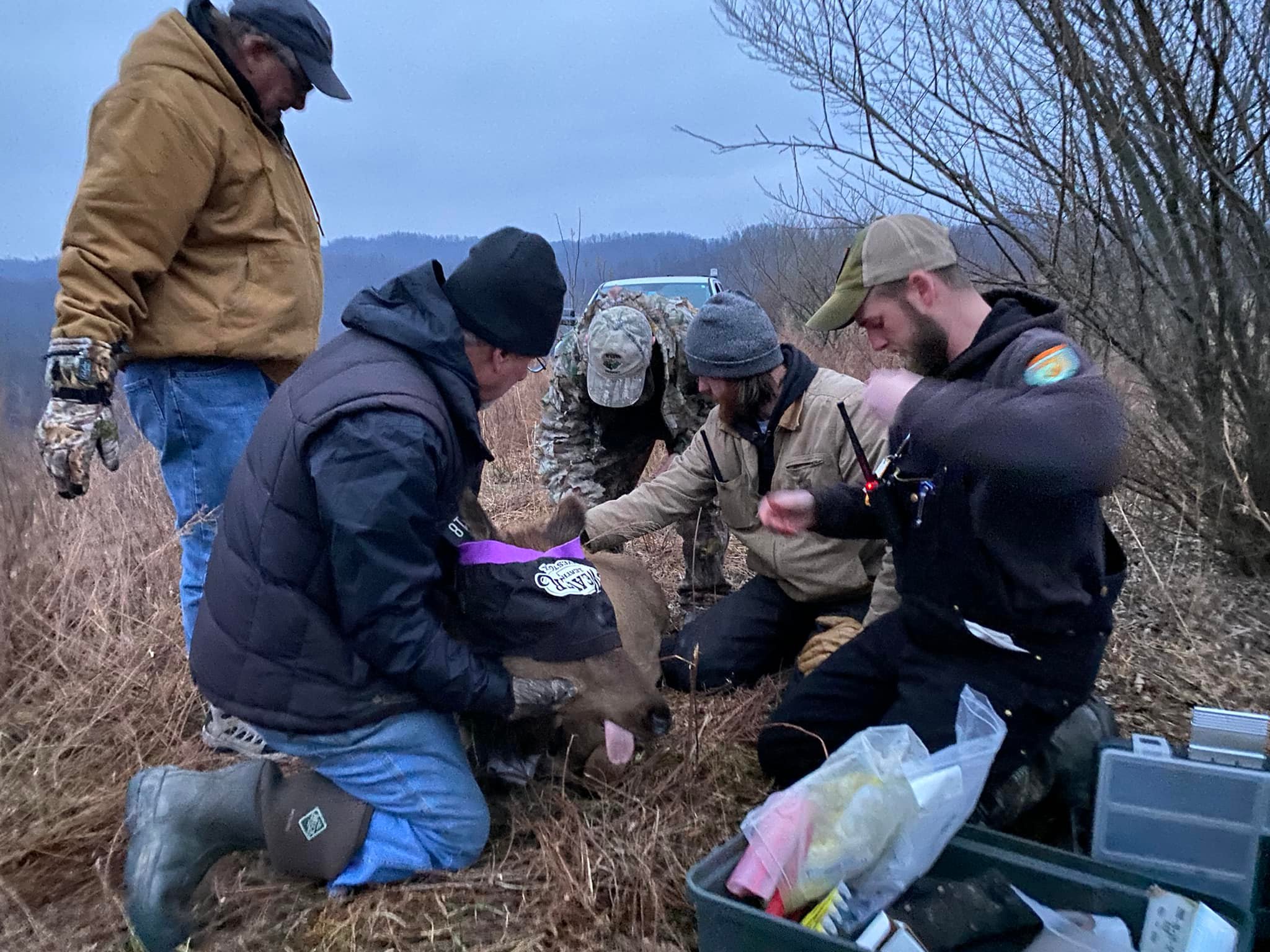
HOLDEN, W.Va. — The leader of the elk project for the West Virginia Division of Natural Resources indicated this year’s off season checks were a stark contrast to the work in past years.
“It’s been kind of a unique year and I really wouldn’t want to make a whole lot of flat out statements about whether we had better or worse reproduction because we really struggled to catch this year in comparison to previous years because of the acorn crop down here,” said Randy Kelley.
Much like whitetail deer this past fall, the elk feasted through the winter on the abundant acorns from last fall. They were much more content to hide out in the dense wood lots surrounding the reclaimed strip mining property on the Tomblin Wildlife Management area.
“They’re staying a whole lot more in the woods because they’ve learned to eat acorns, ” he said.
Kelley believed the numbers were down slightly because of how much they struggled to catch the animals, but still wasn’t sure how far down. Kelley and his team always try to catch the newborn calves each year, or at least as many of them as they can. They are fitted with a GPS tracking collar, ear tags, and biologists collect DNA and blood samples from each elk.
“We also take elk where we’ve had collar malfunctions or have lost a collar or maybe they were caught when they were young and the collar appears to be tight. We’ll dart those and expand those as well so we don’t lose any data,” said Kelley.
The elk Kelley was able to bring down for an examination were healthy. The heard continues to grow, just at a slow rate. Although difficult to have an exact number he estimated the elk numbers are likely in the 130-140 range now. The ratio of cows to bulls among the calves is right at 50/50 every year.
“It’s half and half. It’s amazing how just about every year it tops out at 50/50. Mother Nature is a crazy thing,” he said.
The herd needs females to expand, so Kelley hoped there might be few more of those and a few less bulls, but it doesn’t work out that way. He did note in their capture numbers they had one more cow than bull.
The first calves of 2026 are expected to begin arriving in the latter half of May and peak out in the first couple of weeks of June.
“It kind of peaks the first week or two in June. It’s a lot like deer fawning, that first week or two in June is the peak,” Kelley said.