

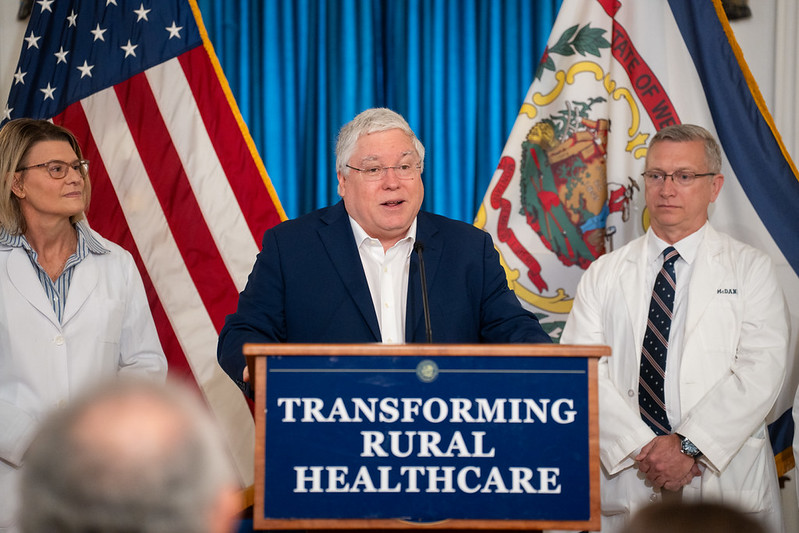
Gov. Patrick Morrisey announced the first $28.56 million availability for bolstering West Virginia’s rural healthcare infrastructure and professional workforce.
The initial funding, which is part of a larger federal grant, is aimed at initiatives called the Mountain State Care Force, HealthTech Appalachia and the Connected Care Grid.
The three programs are meant to work together to expand workforce capacity, drive better health outcomes, foster health technology innovation and enhance connectivity across rural and underserved communities.
By strengthening the medical labor market, the state hopes to improve public health outcomes and encourage more citizens to enter the workforce.
Eligible organizations can now apply for the funding opportunities through the state’s procurement and grants management system at wvOASIS.gov.
“We did the work to bring this program to West Virginia, and now these resources are available to the organizations on the ground that can put them to use,” Morrisey said in the announcement.
“As these resources are deployed, we’ll see more West Virginians back on the job and stronger, healthier communities across the state.”
The funding is administered through the state Department of Health.
“This is a major step forward in our work to improve health outcomes and transform the workforce across West Virginia,” said state Health Secretary Arvin Singh.
“By investing in long-term, system-level solutions through initiatives like the Mountain State Care Force, HealthTech Appalachia, and the Connected Care Grid, we are making meaningful, lasting investments in our healthcare workforce and ensuring communities across the state — especially those in rural areas — have access to high-quality care now and for the future.”
In late December, officials announced that West Virginia has secured $199 million this year from the federal Rural Health Transformation Fund. The award almost doubled the guaranteed minimum for the first year.
Of the full amount, $25 billion is being evenly divided among the 50 states, and discretionary dollars are being allocated to states based on each state’s application, the state’s rural nature and other policies. Allocation to each state is based on a competitive application process and guided by the quality of state-proposed strategies.
Nationally, disbursements for states are between $145 million and $281 million for the year.
This is through The Rural Health Transformation Program, created under the “One Big Beautiful Bill Act” to distribute $50 billion over five years across all 50 states to strengthen rural health care.
The program to support rural health grew out of concerns that changes to Medicaid under the “One Big Beautiful Bill Act” would undercut already fragile rural health systems.