


CHARLESTON, W.Va. — Students from all across the state gathered in the Charleston Coliseum and Convention Center Tuesday for the 2026 West Virginia Social Studies Fair.
The state Department of Education-operated event featured over 500 students from 44 counties this year. There were three divisions of students — third-through-fifth grade, middle school, and high school — with ten categories in each division.
Topics from students included economics, psychology, anthropology, and even a special category to commemorate America’s 250th birthday. Students could present individually or with a group.
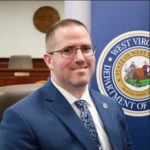
State Department of Education Secondary Social Studies Coordinator Matt Kelly said the all-day event brought students of different ages together.
“You’ll see a project with a third grader, and then down the row is a senior in high school, and they’re all here for the same reason,” Kelly said. “They got to pursue their passion and something they care a lot about, learn something along the way and have some fun.”
Kelly said West Virginia has one of the largest social studies fairs in the country that’s run by a Department of Education.
Students who presented at the state Social Studies Fair had worked their way through several levels to get there. Kelly said students began at the individual school level, followed by county and regional levels, then the state level on Tuesday.
Kelly said students took their presentations very seriously. He said it’s refreshing to see social studies mean so much, as he noted it often takes a backseat to other academic subjects.
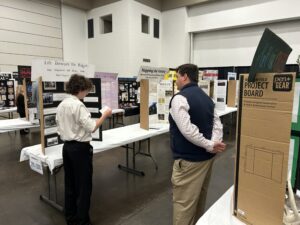
Berkeley Springs High School ninth-grade student Joshua Lucas said his project was about West Virginia geography. He said he discovered how mountains impacted coal mining in the state throughout history.
“We couldn’t really mine coal in West Virginia until after the Civil War, because that’s when they started making railroads, and we couldn’t move any of the coal out of there,” Lucas said. “But once the railroads were made, that allowed travel through the region to flow better because roads in some spots, they just couldn’t be made, because the mountains were too dense, too high.”
Kelly said that students prepared an abstract, a research-driven paper, prior to making it to the fair. During the fair itself, students orally presented their projects to a panel of judges.
The judging panel was a combination of community volunteers, retired teachers, and active teachers. Kelly said all of the judges had some type of background in social studies.
West Virginia Department of Education English-Language Arts Grades 6-12 Coordinator Susie Garrison was on the panel of judges. Garrison said she and her fellow judges learned a lot as they observed presentations.
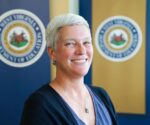
“We are listening to our students and understanding what their impact is on our society based on their research, which is powerful,” Garrison said. “Because sometimes we worry that they’re not engaged.”
Judges went around the room to observe presentations, then marked their scores on a sheet. Once all the presentations were complete, the panel got together to sort out their results.
There’s a lot of interest in social studies in West Virginia right now, Kelly noted.
“When teachers present these options to their students, students get excited, parents get excited, and it winds up being a really fun process for everyone involved,” Kelly said.
Kelly said that other states look at West Virginia as an example of how social studies fairs should be run.
“If you Google Georgia and their social studies fair, a picture from West Virginia’s social studies fair is on the Georgia social studies fair website,” Kelly said. “Which I think is interesting, but it also shows that they look at us as sort of the model of what it can be when they’re building their own programs.”
“So, [it’s] really fascinating that not only are these students able to be really good scholars throughout the year,” Kelly continued. “They’re not only representing at a state level, but kind of at a national level, in a sense, because nobody else does it like us.”
There were a wide variety of topics covered by students in their presentations. Garrison said she was struck by the diversity.
“We’ve seen an awful lot of impactful projects and very thoughtful research,” Garrison said. “Our West Virginia students are absolutely amazing.”