

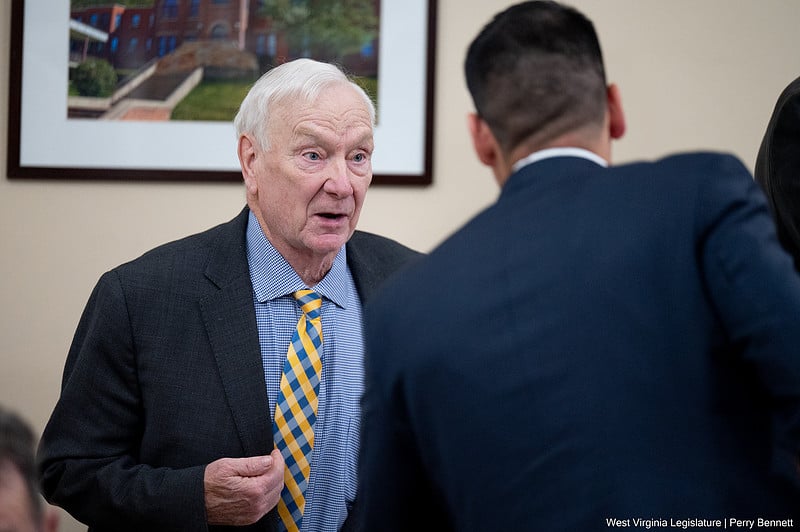
MORGANTOWN, W.Va. — The chairman of the House of Delegates Education Committee continues to emphasize the need for more state funding to address rising costs to provide special education.

Chairman Joe Statler, R-Monongalia, said the state needs to address approximately $170 million shortfall in special education spending over several years.
“We have to meet these mandates that are put out there under this section of law,” Statler said last week on MetroNews “Talkline”. “What Uriah Cummings (of the State DOE) gave was the estimate that it’s about $170 million on all three tiers, Tier One, Two, and Three.”
According to Statler, the need for the state to find ways to directly supplement levels of special education funding for county school systems stems from both rising costs and promised allocations on a state and federal level that were not met. Among those in focus, is a promise of federal allocations that covers 40 percent of total costs per pupil across three tiers of priority as part of the Disabilities Education Act passed back in 1990 and reauthorized in 2004. With less than half of that being accounted for over several decades, Statler emphasized how much the state needs to account for in special education spending.
“You look at this and where (you see) that, not only is the state underfunding, but also the federal (government) has really underfunded the promises that they made into this area,” Statler said.
On a state level, Statler noted that avenues are being explored to tackle portions of the funding deficit, particularly for increasingly individualized programs. This includes a potential $18 million that could be allocated towards Tier Two and Tier Three students, which are focused on small-group support and one-on-one personalized services. While it’s not expected to fully solve funding problems on a state level for special education, it is an area where the state can immediately address student needs.
“We do have to find what I estimate to be $18 million, we’re trying to get that figure a little closer down for Tier Two and Tier Three,” said Statler. “Those are the most critical, most needy areas, and I do believe that we need to find that money now, just as we did in session.”
If funding is not found through the state or federal level, Statler feels that several county school systems will not be able to sustain any supplemental funding that would need to be provided locally. This would be particularly concerning for several county school systems that are in the middle of contracting without accounting for potentially needing to cover millions of dollars for special education. With the situation already dire for school systems around the state, Statler emphasized the need for a state solution to a long-term issue.
“The bigger counties can probably absorb and eat this for a while, not forever, but we’re going to start seeing more smaller counties that are going to go under,” said Statler. “And that just means we’re going to have to step into the state and do more.”