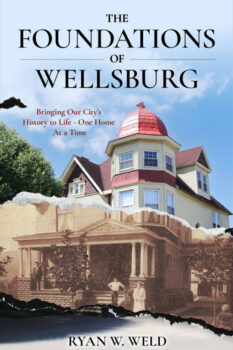
State Senator Ryan Weld learned a lot while writing his book, “The Foundations of Wellsburg,” not least of which was just how hard it is to write a book.

“Every time I complained about it, my wife would tell me to shut up, because it’s like I volunteered to write the world’s worst term paper, and so that was on me,” Weld said on MetroNews Talkline.
Nevertheless, he completed the history of his hometown, Wellsburg, through the lens of its architecture and the ordinary citizens who shaped the town. The book’s release was just in time for West Virginia Day.
The book chronicles the rise of the community as an industrial and river port hub, highlighting the local pride invested in its civic infrastructure. The book is a tribute to the interconnected lives of families and the enduring physical foundations of their small American town.
Weld, who serves in the Senate as a Republican from Brooke County, said his mother and stepfather moved into the house he grew up in in 1986. The home was built in the 1900s.
One day, he recounted, his mother commented, “You know, as long as we’ve lived here, I don’t know anything about the house, when it was built, who built it, who lived here, what those people did, anything.”
That piqued Weld’s curiosity so he began nibbling away at some research. He learned that the original builder of the home “was a pretty prominent guy in town, an entrepreneur, a capitalist, if you will, and it really got to read about their successes, you know, their tragedies, all that happened at the house.”
Then he started asking himself, “What other untold histories were behind the many other homes in town? I thought, well, maybe there’s enough to fill a book, and as I found out, I was correct.”
At the center of the book is the work of architect Pillaid Wells, who designed several landmark structures, including the Classical Revival home at 1298 Main Street and the monumental Wellsburg City Building.
That is set off by the tragedy of the 1939 fire that destroyed the City Building, which mobilized the community and marked the end of an architectural era.
Weld’s journey of writing the book began in the summer of 2014 and took about nine years to complete. By late 2019, Weld was actively writing the book. He had anticipated being finished by late 2020, but the research proved to be more time-consuming than initially expected.
The result has a forward from revered Wheeling newspaper editor Mike Myer, who died in early 2021. The forward originally appeared as a newspaper column, just a couple of weeks before Myer’s death, expressing admiration for the ordinary people who built America. “That’s why I can’t wait to read Ryan Weld’s book,” Myer wrote.
Myer continued with a tongue-in-cheek description of Weld as a guy hooked on history.
“I consider Weld a friend, so it pains me to know he’s about to become an addict, if that hasn’t already happened. At some point, folks during research become hooked on the real people of history,” Myer wrote. “Their stories become intoxicating. Learning more about them develops into an obsession.”
Weld had a book launch this past week at one of the homes that’s featured. Meanwhile, Weld is already thinking about a second book.
“This one took quite a while, but I kind of have a rhythm down, and so I don’t think the second one would take a while because I didn’t even touch some of the really older homes that were built in the 1800s that really have histories, because I wasn’t looking to write something longer than the Old Testament,” Weld said in the radio interview.
“So a volume two, I think, will probably come about someday. But I’ve already started to kind of to work on it, yes.”