

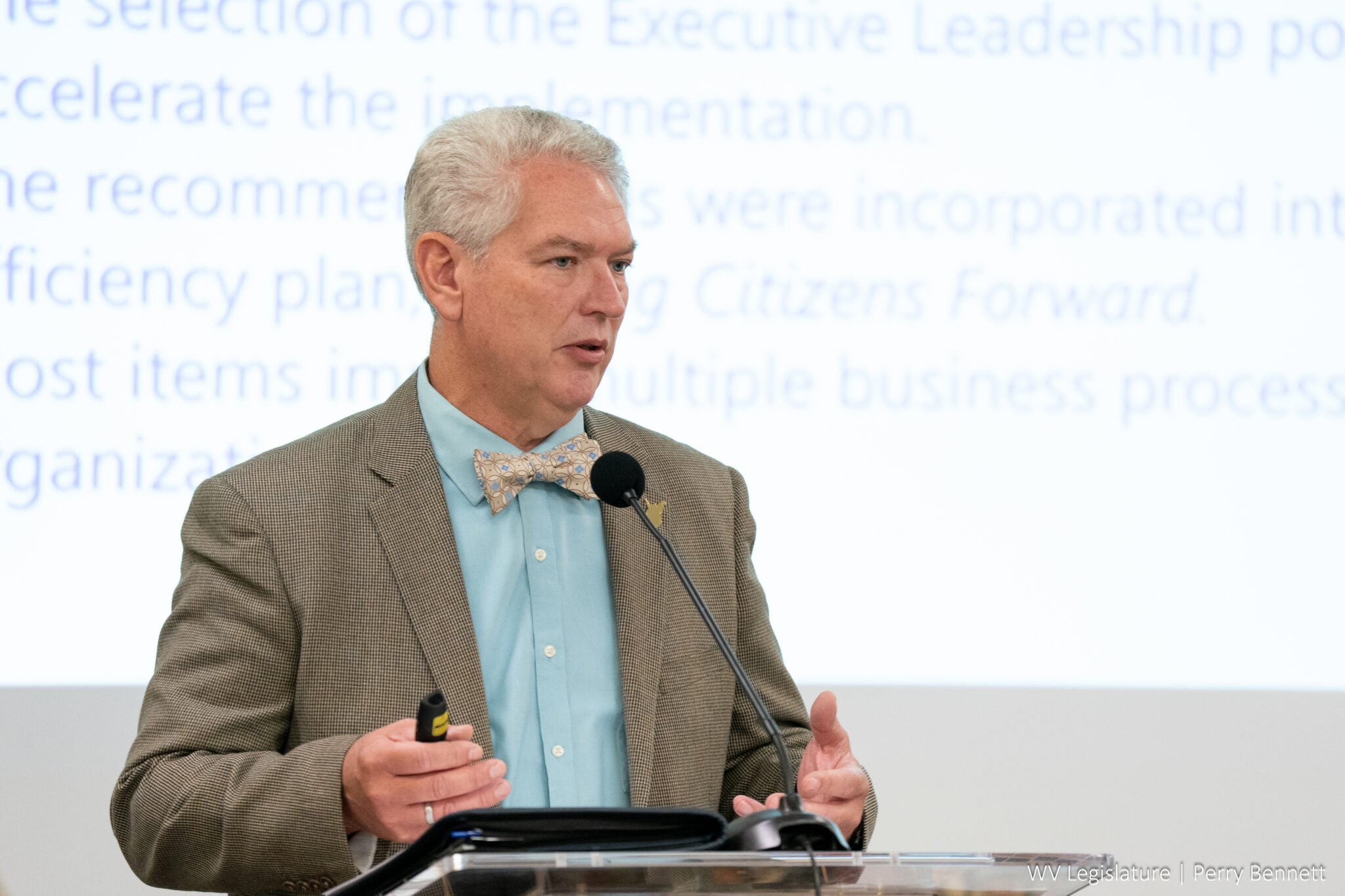
CANAAN VALLEY, W.Va. — The West Virginia Department of Transportation is implementing suggestions from the consulting firm BDO’s audit that identified over $50 million in potential savings.
State Transportation Secretary Stephen Todd Rumbaugh updated the Joint Standing Committee on Finance about DOT operations during last week’s interim meetings at the Canaan Valley Resort State Park.
Gov. Patrick Morrisey announced $50.6 million in potential savings within the DOT during a news conference last month. The DOT savings were part of $168 million in potential savings among three state agencies: the DOT, the Department of Homeland Security, and Department of Human Services.
Rumbaugh said the DOT has already gotten to work after receiving the BDO audit earlier this year.
“Most everything that they have on there is in some type of initial phase,” Rumbaugh said. “There are a few things that we’ve completed, there are others that are further along.”
The BDO audit happened concurrently with an internal efficiency audit that Rumbaugh called “Moving Citizens Forward.”
“When I first came into office, we knew there were a lot of things that we were not doing very efficiently,” Rumbaugh said. “So, we put together folks from out in the districts, folks from central office, and we started our own program internally, letting them analyze things, and look at things, and come up with an efficiency plan.”
Rumbaugh said the two audits have resulted in similar findings. The BDO audit came back quickly, he said. The firm came in during October 2025 and had a draft done by this January.
DOT officials have been working ever since then to implement those suggestions, Rumbaugh explained. He reported the DOT can never truly have savings, as money not spent on a project will be moved over to address other needs. He said the goal is to never “leave money on the table.”
A focus of the audit was related to contractor oversight and accountability. Rumbaugh said permitting for any type of work on highways, driveways, and more have endured many hindrances. He said they’re moving permitting processes online. He cited the biggest savings could come from within the DOT’s own construction contracts.
Rumbaugh called out some “dirty permits,” which he said cause significant delays because of improper securitization of contracts. Rumbaugh said this ends up costing the agency $30-to-50 million a year.
The solution is to stop allowing bids on contracts until permits are secure, Rumbaugh said. While it caused a delay in the interim, he said it will save millions of dollars in the long run.
Rumbaugh identified $10.1 million in savings with DOT computer systems. He said the agency brought in the Timmons Group to do IT work. Rumbaugh said this work was done before the BDO reported its final findings. The problems with computer systems stem from bringing more systems online, he said.
When operations transitioned to a more online medium, Rumbaugh said, lots of overlap took place and multiple systems ended up tracking the same thing. Rumbaugh said the Timmons Group was tasked with figuring out which system takes precedence. He reported that the group found 18 needs across four tiers.
Some of those suggestions are set to be implemented next year, but Rumbaugh said the process in its totality will take a while.
Rumbaugh said the DOT documents its work, and all residents can stay informed on the DOT website.
“We have a map out there that shows all the projects that have been completed since this administration (came) to office,” Rumbaugh said. “We also have a map showing any active construction projects that are out there, since this administration came, and we have another map that shows the planned construction projects out there.”
Another finding in the BDO audit was the costly nature of outside consultants. Rambaugh said the audit called for an elimination of those outside consultant positions and instead bring those operations in-house. Rumbaugh said the DOT has increased its recruitment efforts with officials attending job fairs.
Rumbaugh also said he’s gone to capstone projects at Mountain State universities — for projects that would ordinarily be given to paid consultants. Instead, Rumbaugh explained, the students do the work and gain valuable real-world experience. Rumbaugh said the students can do bridge designs during their capstone — then the DOT uses those ideas.
It’s been met with positive feedback, Rumbaugh reported. He said students have told him it’s one of the best classes they’ve taken in college. Rumbaugh said WVU students informed him that until they took that class, they couldn’t tie everything together from the classroom to the real world. The class bridged that gap for them.
Rumbaugh said the DOT is taking on more interns in engineering, accounting, and legal departments as well — he said if people are willing and there’s a position available; they’re brought in for summer internships.
The Division of Motor Vehicles (DMV) operational costs could decrease by $1.75 million. Rumbaugh said the DOT has been considering ways to make the DMV process easier for West Virginians. With that, DMV operations are moving more online and may decrease traffic in physical DMV buildings. Rumbaugh said the DOT will measure transactions at the DMV and compare it with expenses for workers.
The current wait time at most DMV buildings is 20 to 30 minutes, Rumbaugh said. There are plans in motion to address those wait times and cut into them.
Rumbaugh reported the DOT wants to develop a mobile DMV office. He called it a “Bookmobile-type office” that would show up in certain locations at scheduled times. Rumbaugh said the mobile DMV office would offer in-person interaction for West Virginia residents who want that.
He says the DOT is working to get a mobile office, potentially even by the end of the year. Rumbaugh said the mobile DMV rollout would take place in locations with excessive wait times, such as Kanawha City. Rumbaugh cited the current wait time there as 30-to-40 minutes. By utilizing a mobile office in those troublesome locations, it would reduce wait times and also allow the DMV to explore any challenges the mobile office would face — and address those for the future.
Potholes
Despite an announcement from Morrisey in late April that indicated all potholes in West Virginia would be paved by the end of May, Rumbaugh laid out a more extensive timeline.
“As always, as I stand here, I know everyone hates potholes; I do too,” Rumbaugh said. “The only way to get rid of potholes is to get our roads on an eight year or less paving cycle. To get us on an eight-year-or-less paving cycle, I need a billion (dollars). And that’s with a “b,” a billion dollars a year. And in eight years, we would eliminate potholes.”
Rumbaugh said the DOT appreciates the funding from the legislature — $125 million — and that the agency will use all of that money for this work. However, Rumbaugh said the $1 billion annual number is what he believes is needed. He reported the work would take place on secondary roads in West Virginia and would take eight years to complete.