


MARTINSBURG, W.Va. — Berkeley County is experiencing more rabies cases than it has in recent memory. This week, the Berkeley County Health Department issued a rabies alert after a rabid skunk was found in the Gregory Drive area of Martinsburg.
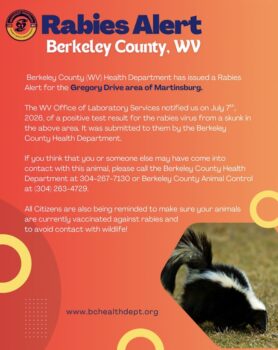
The West Virginia Office of Laboratory Services notified Berkeley County Health Department officials July 7th of a positive test result for the rabies virus in the skunk.
On Panhandle Live Thursday, Berkeley County Health Department Director Cara Harding talked about the cases.
“This case is actually the sixth case of a rabid animal here in Berkeley County,” Harding said. “We’ve definitely seen an increase this year.”
Of the Gregory Drive case, Harding said, “This case in particular was a skunk that was aggressive and attacked two dogs.”
By comparison to the six identified rabies cases so far this year, Berkeley County had just three documented cases last year.
Epidemiologist Robert Deener with the Berkeley County Health Department talked about how the disease is transmitted.
“It’s transmitted via saliva. An animal that has rabies can only transmit the rabies the last ten days of its life,” Deener said, adding it is important to be vigilant.
“We get about 700 animal encounters per year. It could be from wildlife, it could be your own pet, or someone could be out walking a dog and get bit. It’s all reportable to the health department,” said Deener, adding “For domestic dogs, cats, and ferrets, there’s a 10-day observation period. So we know that if that animal was healthy 10 days after you were exposed to it, you’re safe.”
Both stressed the importance of having rabies vaccinations up to date for animals in your care.
While some people who may encounter animals as part of their jobs may get vaccinated against rabies, most human beings do not. There are protocols to follow when bitten by an animal suspected of carrying the disease, including seeking treatments from area hospitals such as War Memorial Hospital in Berkeley Springs or Berkeley Medical Center in Martinsburg.
Both agreed that If a human becomes symptomatic, it is already too late.
According to the World Health Organization, once clinical symptoms appear, rabies is virtually 100% fatal.
The Berkeley County Health Department advises anyone who thinks they or someone else may have come into contact with the rabid skunk to call the Berkeley County Health Department at 304-267-7130 or Berkeley County Animal Control at (304) 263-4729.