

CHARLESTON, W.Va. — A long, detailed defense of how Gov. Patrick Morrisey is handling a key state welfare program says Morrisey is doing the responsible thing.
The defense was released Monday in the form of a statement from Morrisey’s Communications Director Lars Dalseide. It follows criticism from state Treasurer Larry Pack and a number of state lawmakers after Morrisey’s state Department of Human Services stopped the application period for the school children clothing voucher program after a week saying the program had run out of money.

Monday’s statement said there are several things broken with the Temporary Assistance for Needy Families (TANF) program, which the clothing voucher program falls under, things the statement said Morrisey has been trying to fix since he took office.
“When this Administration began reviewing West Virginia’s TANF-funded programs, the first data we received described a program in crisis. The state was spending far more each year than the federal grant provides, and the savings that had covered the difference were nearly gone,” the statement said.
State Revenue Secretary Eric Nelson agreed during an appearance Monday on MetroNews “Talkline.” He said the state has been spending from a TANF savings account that’s now down to $41 million and shrinking.
“An excess cash balance has been utilized over the last seven to eight years and it’s starting to dwindle and that’s a concern our governor looked at,” Nelson said.
Communications Director Lars Dalseide released the following statement on Temporary Assistance for Needy Families (TANF) funding and the Administration’s ongoing review of TANF-funded programs:
When this Administration began reviewing West Virginia’s TANF-funded programs, the… pic.twitter.com/QTXVR0UYMN
— Governor Patrick Morrisey (@wvgovernor) August 3, 2026
The statement addressed the TANF savings account in more detail:
“Every dollar still in it is already committed to child care for working parents, cash assistance, family support centers, and the other programs paid for out of this same grant, so money spent on any one of them is money taken from the others. When those savings are exhausted, all of these programs are in jeopardy – and the West Virginians who rely on them are the most vulnerable people in our state.”
Some of the problems were discovered through an audit that Morrisey ordered for state agencies after taking office.
Monday’s statement also takes aim at Pack who was acting revenue secretary under then Gov. Jim Justice.
“The prior administration committed West Virginia to permanent, long-term obligations using one-time, temporary federal money in the savings account the state was only ever going to have once,” the statement said. “Larry Pack was that administration’s acting revenue chief when those commitments were made. He kicked the can down the road, and it landed on these children.”
Pack fired back with his own statement Monday.
“The Governor can cast all the stones he wants to put blame elsewhere, but at the end of the day, this is his administration. As Governor, he has the opportunity to make needy children a priority. So do it,” Pack said. “We will never stop fighting for supporting children and families who need it most,” Pack said. “We look forward to continue dialogue with state leaders to better serve West Virginia’s most vulnerable families.”
Monday’s statement said Morrisey will ask the legislature to supplement TANF with $15 million out of surplus funds to keep the programs going at their current spending levels through this fiscal year. Nelson said that will come along with talks about the future of TANF funding.
“I fully expect the governor is going to have some discussions with his team here as well as the legislature and how we can become much more transparent with this and close that negative spending gap,” Nelson predicted.
State Senator Joey Garcia, D-Marion, said it’s good to get some financial numbers from the Morrisey administration but those released Monday have created more questions.
“It seems like they aren’t adding up,” Garcia said Monday on MetroNews Midday.
Voucher program

The Morrisey administration also defended its decision to stop the clothing voucher program last week.
“Last year the School Clothing Allowance spent roughly $11.4 million and assisted approximately 57,000 children. Applications for this year are still being processed and verified, and we expect this year’s program to match or exceed last year’s level of support,” the statement said.
The administration also said West Virginia’s program allows more kids to be eligible than other states and spends more than other states that more-population and stronger economies.
Garcia said it’s the values of West Virginians, including Democrat and Republican lawmakers, who have decided over the years, under many governors, the state should have a strong school clothing voucher program. He said what other states do shouldn’t make a difference.
“We’re West Virginians,” Garcia said. “And the governor coming at this and not allowing many families the notice that they are only going to have a week to apply for this program is pretty unconscionable.”
Full statement from Morrisey administration:
Communications Director Lars Dalseide released the following statement on Temporary Assistance for Needy Families (TANF) funding and the Administration’s ongoing review of TANF-funded programs:
When this Administration began reviewing West Virginia’s TANF-funded programs, the first data we received described a program in crisis. The state was spending far more each year than the federal grant provides, and the savings that had covered the difference were nearly gone.
Compounding the problem, the eligibility system the state depends on – a system that has cost West Virginia nearly $400 million and still does not work properly – cannot tell us reliably what is being spent while it is being spent. A state cannot manage what it cannot measure. That is why the Governor ordered a comprehensive review: not to reduce support for families, but to establish what West Virginia actually spends, what it actually receives, and what it can sustain.
Where we go from here
The Governor has directed the Department of Human Services to maintain spending levels for all TANF programs through the end of the current fiscal year, so those programs can continue to provide services to West Virginia families. The Governor will also seek a supplemental appropriation of $10 to $15 million from surplus funds to ensure adequate resources last through June 30, 2027, because some of the federal funds now being drawn down for these programs will be nearly exhausted by then.
School clothing this year
Our goal was to keep support consistent with last year while making sure the state’s capped federal TANF funding can still cover the other programs that depend on it. Last year the School Clothing Allowance spent roughly $11.4 million and assisted approximately 57,000 children. Applications for this year are still being processed and verified, and we expect this year’s program to match or exceed last year’s level of support.
How West Virginia compares
West Virginia is one of only a handful of states in the country that runs a statewide school clothing program, and it is the only state in the region where every eligible child, in every county, qualifies on the same terms. In the states that border West Virginia, this kind of help is generally limited to children in foster care, left to each county to offer or not, or not offered at all. Among the states that do run a program, West Virginia’s investment is among the most generous in the nation. Michigan – with more than five times our population and an economy more than six times the size of ours – appropriates about $10 million a year, while West Virginia invested about $11.4 million last year. The chart below sets out the comparison.
No money for TANF is sitting unused
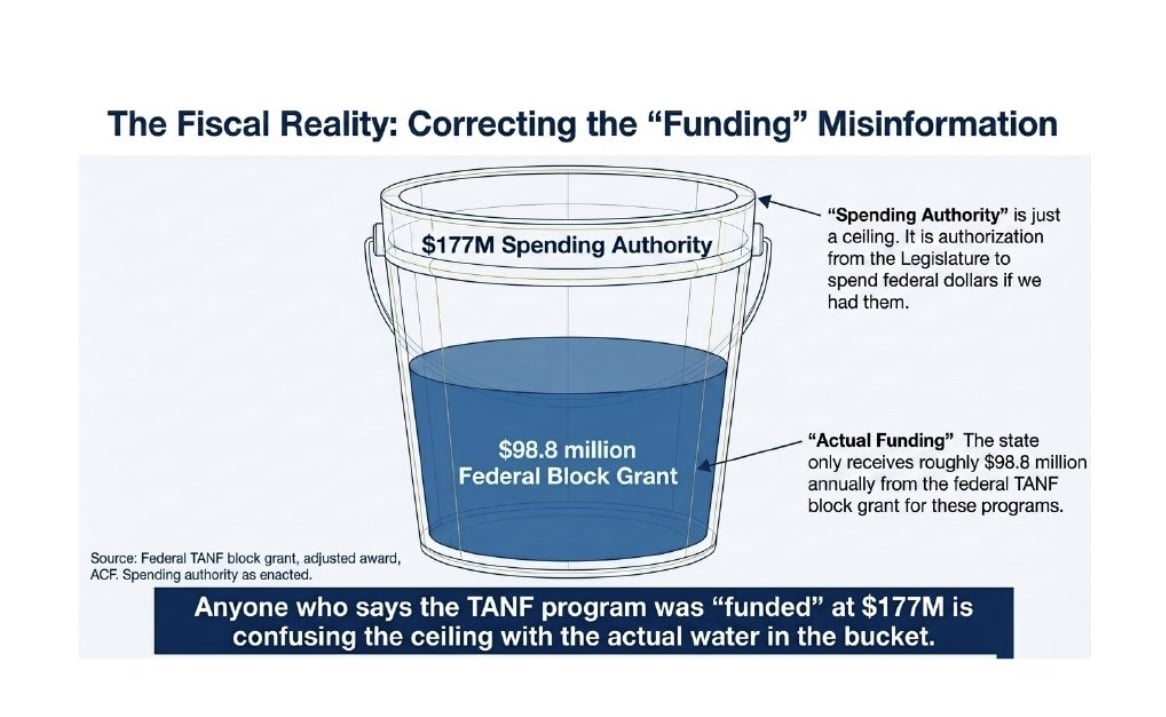
Two different figures are being mistaken for money the state is free to spend.
The first is West Virginia’s spending authority. That is a ceiling the Legislature sets – the most the state would be allowed to spend if it had the money in hand. It is not money. The federal block grant actually provides about $98.8 million a year, and we are spending almost $137 million.
The second is the balance in the state’s TANF savings account, and it is not a surplus either. That gap – about $38 million a year – has to come from somewhere, and it has been coming from those savings. The account has fallen from roughly $141 million three years ago to about $41 million today. It is almost gone. Every dollar still in it is already committed to child care for working parents, cash assistance, family support centers, and the other programs paid for out of this same grant, so money spent on any one of them is money taken from the others. When those savings are exhausted, all of these programs are in jeopardy – and the West Virginians who rely on them are the most vulnerable people in our state.
How the state got here
The prior administration committed West Virginia to permanent, long-term obligations using one-time, temporary federal money in the savings account the state was only ever going to have once. Larry Pack was that administration’s acting revenue chief when those commitments were made. He kicked the can down the road, and it landed on these children.
Moving forward
Governor Morrisey is doing the responsible thing – determining how West Virginia can live within its capped federal allocation and support every program that helps vulnerable families, not only this year but over the long term. The Governor has also directed agencies to continue identifying reforms that strengthen accountability, improve transparency, and preserve these programs for future generations of West Virginians. In addition, the Governor will work with the Legislature to develop a permanent solution – one that does not depend on the one-time COVID-era money the state once relied on to paper over the gap – and to put safeguards in place that make sure every dollar in these programs reaches the children and families it is meant to serve.
Governor Patrick Morrisey’s policies will always put kids first. He fights for kids, and he is working to make sure they have the benefit of these programs for the long term – funded through sustainable revenue sources.