

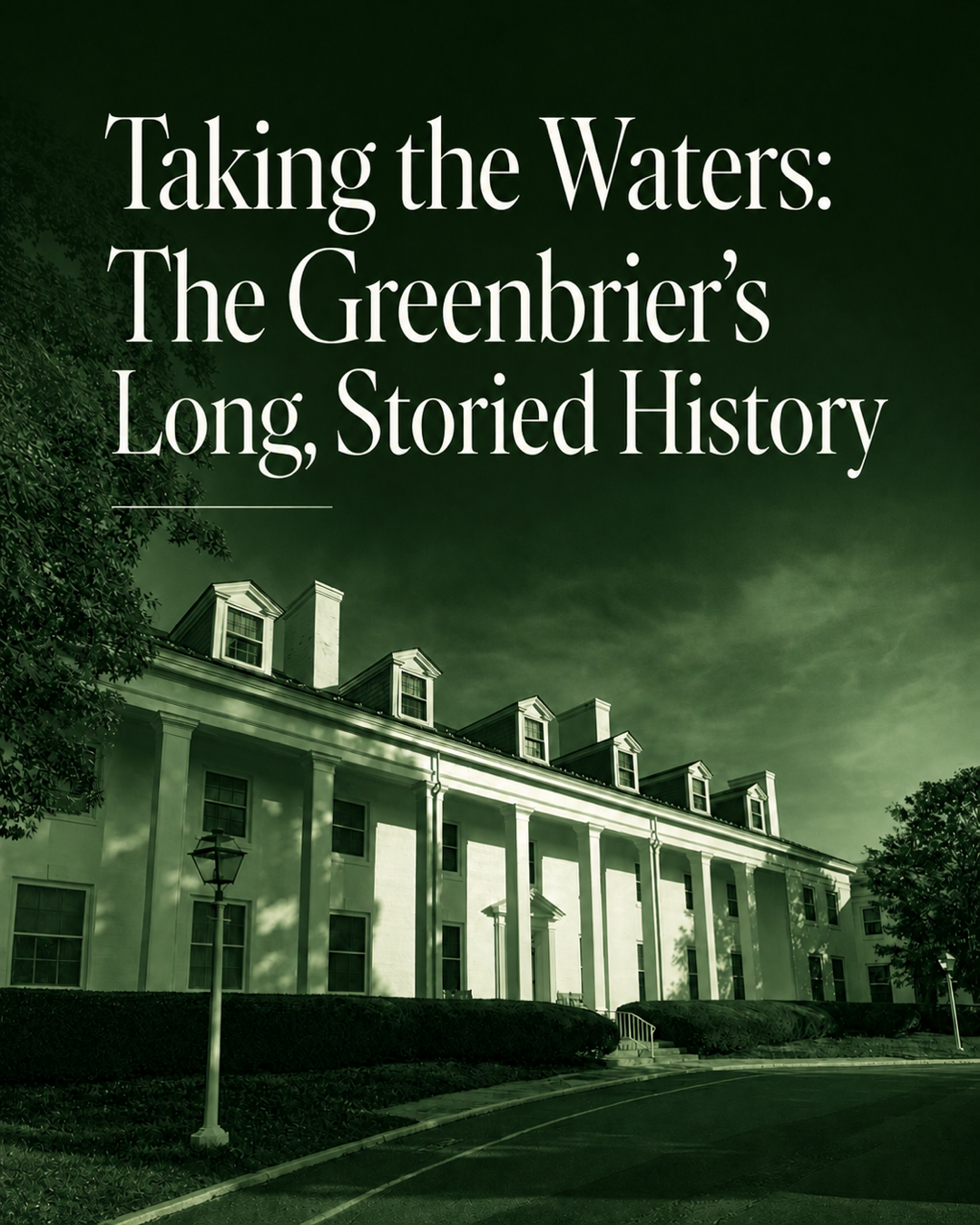
Listen to “Taking the Waters: The Greenbrier’s Long, Storied History” on Spreaker.
Sometimes we talk so much about what is happening today that we forget to pause and consider the history of the place we’re discussing.
The Greenbrier has a long and remarkable history — a chapter of West Virginia’s story worth retelling from time to time, if for no other reason than to ensure younger West Virginians know it, learn from it and pass it along to the generations that follow.
It all began with the water around 1778.
Believers in its mysterious powers said it could cure headaches, arthritis, mental disorders and more. A woman known as Mrs. Anderson reportedly used the water to ease her rheumatism. Word spread. Stories like hers helped draw society’s elite to the Allegheny Mountains from Virginia, North Carolina and other parts of the country — and, eventually, the world.
“It cures ugliness itself, causes sailors to forget and lawyers to confess the truth,” narrator Richard Thomas said, quoting an unnamed observer in “West Virginia: A Film History.”
Curing ugliness? We all probably know a few people we’d like to have “take the waters” today. A few might even want to send us there for the same reason.
Cottages of distinction and elegance emerged at White Sulphur Springs, the most famous of the mountain retreats built around sulfurous waters.
West Virginia Governor William A. MacCorkle quoted an 1837 visitor as saying, “If you are happy enough to be a bachelor, get into Alabama row; if your state is a happy duplicity, Paradise Row is your befitting asylum.… On the other side of the road are Compulsion Row and Wolf Row; the latter of which avoid, unless you be young and foolish — fond of noise and nonsense, frolic and fun, wine and wassail, sleepless nights and days of headache; Mercury and Nimrod have taken up their abode there, and Macbeth like; nightly murder sleep.”
The White, formally known as the Grand Central Hotel, stood near the cottages on the site of the present-day hotel. At 400 feet long, it contained 228 rooms and a dining room capable of seating 1,200 guests.
The resort’s early history was not unlike that of the country itself; not without dark, inhuman, and deeply regrettable times. Enslaved people often accompanied guests and worked in the hotel’s dining room on behalf of those who claimed ownership of them. The White also provided enslaved workers to serve its guests.
“If you have no servant, you must bribe one of those attached to the place, or you run the risk of getting little or nothing,” John H.B. Latrobe reportedly said as quoted in “West Virginia: A Film History.” “Bribe high and you live high, avoid bribery and you starve.”
During the Civil War, the resort fell into both Union and Confederate hands, changing sides several times as the conflict unfolded. In 1864, retreating Union soldiers nearly burned The White and its cottages. The property was spared after a Union officer convinced his commanding officer the hotel might serve as barracks later on. Some say that officer also frequented The White and didn’t want to see it completely destroyed.
Robert E. Lee spent portions of several summers there, including after the war.
28 U.S. presidents have walked the grounds, as has the Duke and Duchess of Windsor, among other royalty and numerous celebrities.
Rail service reached the resort in July 1869.
The Chesapeake and Ohio Railway purchased the property in 1910, added a golf course in 1911 and opened the central portion of today’s Greenbrier in 1913. The new hotel offered 250 guest rooms and operated year-round by 1914. The Old White and its wooden frame was demolished in 1922 after failing a fire inspection.
Shortly after the attack on Pearl Harbor, the U.S. State Department leased The Greenbrier to hold German, Japanese and Italian diplomats.
In September 1942, the U.S. Army purchased the hotel and much of its grounds, transforming the resort into Ashford General Hospital.
The railroad bought the property back in 1946, making way for the later Dorothy Draper redesign, The Greenbrier Clinic and the new West Virginia Wing. That addition helped conceal a secret congressional bunker built under codename Project Greek Island, later declassified in the 1990s.
The resort also hosted the 1979 Ryder Cup on a golf course redesigned by Jack Nicklaus.
Too much history, too few column inches.
Coal and agriculture magnate Jim Justice, not yet a governor or U.S. senator, would buy the resort out of bankruptcy in 2009 from CSX Corporation; who came to own the hotel through a merger of Chessie System and other rail companies. Justice would see his share of successes and challenges in his time as the resort’s sole owner.
Now enters Kennedy Lewis alongside Justice in what is reported as a joint venture with a board controlled by Kennedy Lewis and promises of restorative capital investment.
The point is that The Greenbrier’s history is long, storied and not without triumphs and disappointments, spread over a few centuries and multiple owners. Its present and future will likely look much the same when viewed from a few hundred years down the road.
But, most importantly, people will look back — and this West Virginia gem will have a solid chance at still being around when they do.