

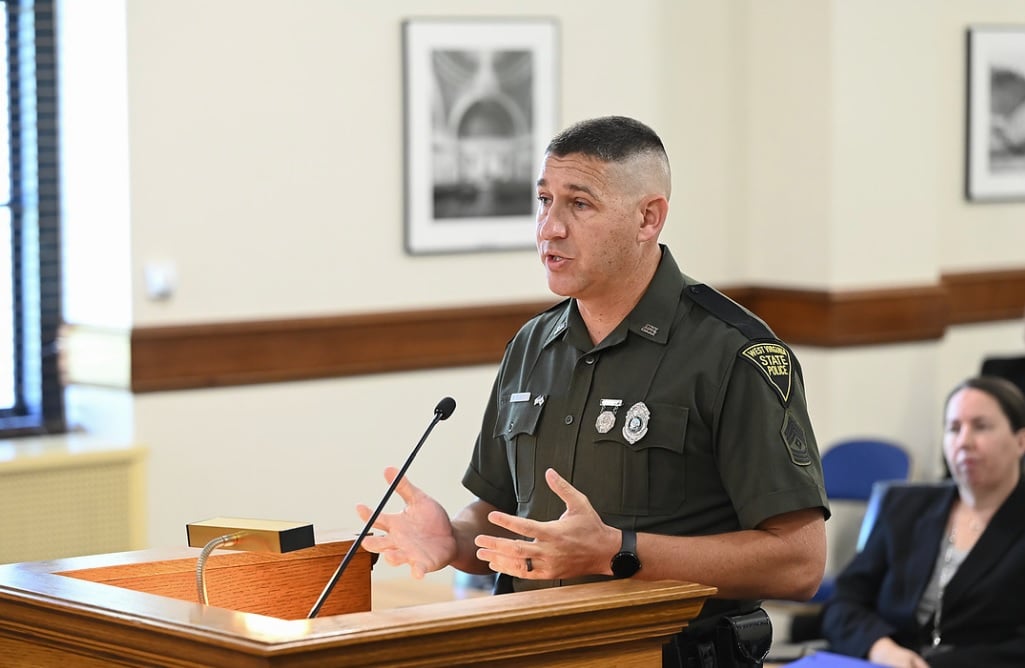
CHARLESTON, W.Va. — A decision from State Police Superintendent Col. Jim Mitchell three years ago to appoint a staff member to concentrate solely on recruitment is beginning to pay off.

State Police Recruiting Coordinator First Sgt. Scott Allen told state lawmakers Tuesday they’ve changed the way they gather applicants for testing.
“We’ve always gotten a large volume of applicants but they just sat there and when testing came along, whoever showed up, is who we tested and who we hired,” Allen said. “I’ve made it a point to reach out to every person and be more military-style in my recruiting.”
Allen has had some pretty big numbers to choose from in the latest testing classes.
“We had 473 (applicants) for the previous two classes we enlisted this year plus 300 now for the class we are currently testing for,” Allen said.
Six State Police Academy classes have taken place since Allen has been in his role. They started with 172 cadets in training and have graduated 135.
He said the number-1 recruitment tool has been social media.
“We go to a lot of (recruiting) events, but we get more (response) back from putting a post up that we were at an event than actually being there,” Allen said.
Allen said they are getting a lot of recruits from other police agencies in West Virginia. He said they won’t turn them down.
“I get a lot of calls every day from county and city agents wanting to come to the state police,” Allen said. “We’re never going to tell somebody they can’t advance their career in the way they want to.”
State police have also trimmed the number of weeks of State Police Academy training time from 30 to 22. It’s been even less, 16 weeks, for officers who have previously been certified and are coming from municipal police departments or sheriff’s offices.

Grant County Delegate John Paul Hott expressed some concern about the accelerated schedule for some.
“I do just pause a little bit with concerns,” Hott said.
Allen said the weeks of training may be less but the quality has not been compromised.
“We have shortened it and made tweaks but I can honestly say the training has not been lowered,” Allen said.
Academy training used to include a program through Marshall University but that degree training went away and that has reduced the time cadets need to be at the academy. Allen said other changes allow for some online work. He maintained State Police have not reduced hands-on training.
Allen said the biggest challenge in keeping state police numbers where they need to be is retirement. He said when experienced get to 20 or 25 years they are ready to retire.
A starting state trooper makes just more than $63,000 a year. There are currently 571 troopers. Allen said he hopes the next class gets them to 620-630 troopers.