

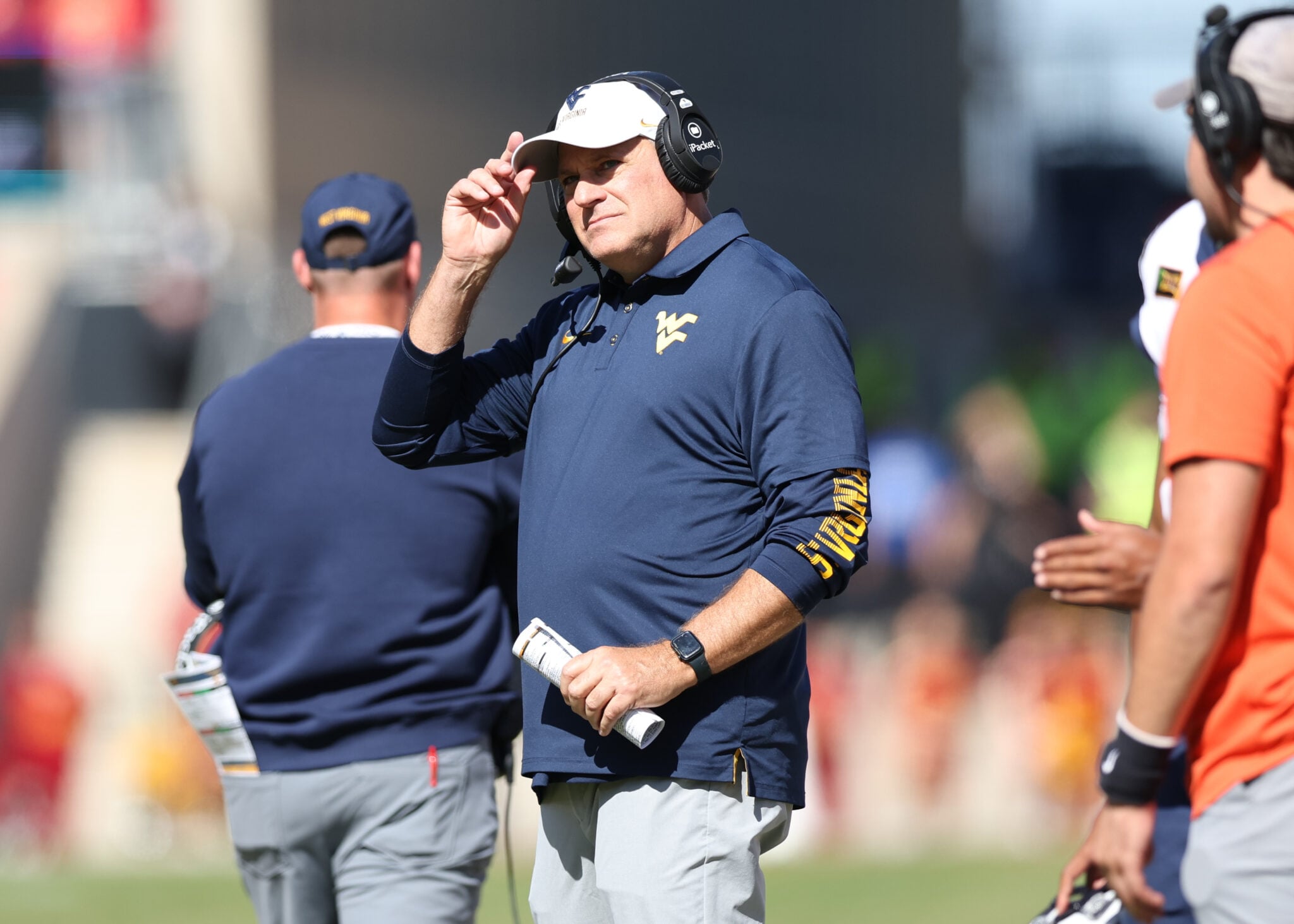
MORGANTOWN, W.Va. — West Virginia has yet to prove it can come remotely close to slowing down a Big 12 opponent through two conference games.
The challenge hardly gets any easier at noon Saturday when the Mountaineers welcome Arizona and quarterback Noah Fifita, one of college football’s most productive and experienced signal-callers.
Inside the Milan Puskar Team Center, the hope this week is that less becomes more for a unit that’s allowed 86 points and 1,186 yards over consecutive losses to Oklahoma State and Iowa State.
“We have to cut it down and make sure that we can at least line up and fit inside zone,” WVU defensive coordinator Zac Alley said.
That poses an interesting dynamic for Alley, who has sometimes looked to exotic schemes, alignments and blitz packages to create confusion for opposing offenses.
“I think we’re the worst defense in college football,” Alley said. “It’s pretty simple to say it ain’t f***ing worked. Doing the same thing over and over again seems like insanity, so we’ll cut it down and make sure they can execute.”
Not the worst, but certainly among them.
WVU ranks 110th among 138 FBS teams and 15th out of 16 Big 12 teams in scoring defense at 28.8 points, though that average jumps to 34.2 in four matchups against FBS-level opponents.
Stanford, Ball State, Marshall, Colorado State and Louisiana-Monroe are the only FBS squads allowing more yardage on average than the 456.6 surrenders — and that figure is 55 more than the next closest Big 12 team. In losses to the Cowboys and Cyclones, the Mountaineers allowed 485 rushing yards and an additional 701 through the air.
The pass defense was a sore spot at times in non-conference play, though WVU often made opponents one-dimensional by limiting the run game — a strength that hasn’t been displayed in either Big 12 contest.
One week after Oklahoma State tailback Caleb Hawkins totaled 180 yards on 31 carries, Iowa State tailback Aiden Flora was even better with 212 yards and three touchdowns on 22 rushes in addition to his two touchdown passes on trick plays.
“We have to stop the run first,” Alley said. “Misfit gaps, not reading our guys, just the basic things that we worked on through fall camp and have to translate to the games, and obviously they’re not right now. But if you let them run the ball on you, you have no shot of stopping anything else.”
A multitude of issues surfaced throughout the 45-42 setback at Jack Trice Stadium, including a coverage bust on the Cyclones’ first touchdown when quarterback Jaylen Raynor found Omar Hayes for an uncontested 20-yard touchdown pass on second-and-goal.
“Anytime you have a simple missed assignment or simple mistake, you have to look at the overall picture,” WVU head coach Rich Rodriguez said. “How can we just let a guy go free? If he has that guy and doesn’t take that guy, he’s not doing it on purpose, right? So what’s clouding his judgment or decision-making as a player?
“Players don’t watch as much film as coaches, but I really think they’re pretty conscientious and all that, so you have to dial it back to clear his mind a little bit, so we don’t make the glaring mistake, because they’re thinking too much. That’s always hard, because it’s like, you have to do this to stop it, but yet, sometimes you make the problem tougher trying to do too much to stop it as opposed to dialing it back. That’s not the only thing we’re talking about, but it’s part of our conversation.”
The Mountaineers ultimately rallied from a 28-14 third-quarter deficit and held separate four-point leads in the fourth quarter of their most recent contest, but surrendered touchdowns on both occasions after going in front down the stretch.
“We have to try to find the right position to put them in more consistently,” Rodriguez said. “By now, we should have a pretty good idea of what our players’ strengths and weaknesses are, so we can plan accordingly as far as what their responsibilities are on the field. It’s frustrating, because our guys are all working hard and we just haven’t had the results and played like we need to and the way we should be playing on defense. It’s not like it’s a shock to anybody. Everybody realizes it in the program and we’re working to fix it as we speak.”