

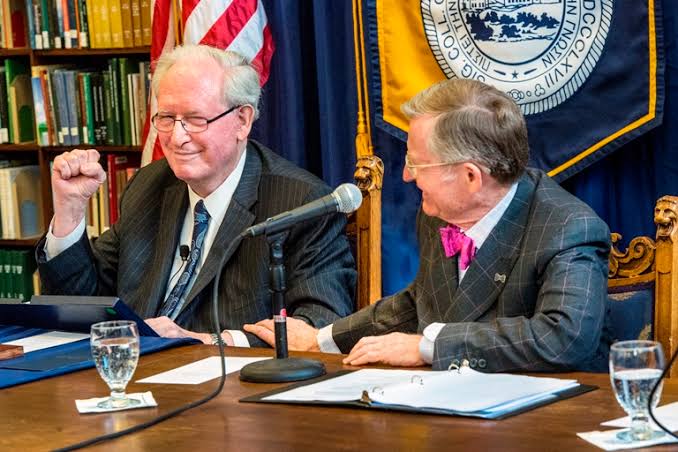
Former governor and longtime U.S. Senator Jay Rockefeller has died at age 89 surrounded by family at his home, according to a source close to the family.
He served as a United States senator from West Virginia from 1985 to 2015 and previously as governor of West Virginia from 1977 to 1985.
Born into the prominent Rockefeller family in New York City, Rockefeller moved in 1964 to Emmons, an unincorporated community along the Big Coal River in both Boone County and Kanawha County, to serve as a Volunteers in Service to America (VISTA) worker.
He became entrenched in West Virginia politics in an era when the state was dominated by Democrats. Rockefeller made a lasting mark in economic development, leveraging long-cultivated relationships in Asia to help draw investment by companies like Toyota to West Virginia.
At the national level, he became a leading advocate for healthcare reform.
He authored the Children’s Health Insurance Program, commonly called CHIP, that has provided health care coverage for millions of poor children. And he played a pivotal role in the passage of the Affordable Care Act of 2010, advocating for a public insurance option.
Rockefeller became the West Virginia’s senior U.S. senator when the long-serving Senator Robert Byrd died in June 2010.Rockefeller did not seek reelection in 2014 and was succeeded by Republican Shelley Moore Capito, who had been in the U.S. House of Representatives.
“Deeply saddened by the passing of former Senator and Governor Jay Rockefeller. Jay dedicated his life to serving West Virginia and our nation, leaving a lasting legacy. He was always a true gentleman who treated me with respect, kindness, and encouragement,” Capito said.
“Over the years, we developed a wonderful friendship that transcended politics, and I will always be grateful for that.”
As governor, Rockefeller was both preceded by and succeeded by Capito’s father, Republican Arch Moore.
The political rivalry between Moore and Rockefeller defined West Virginia gubernatorial politics in the 1970s, featuring two high-profile matchups in 1972 and 1980.
In 1972, Moore defeated Rockefeller by 73,355 votes. Rockefeller campaigned as a “new school” reformer focused on environmental protection and anti-corruption, notably calling for restrictions or an end to strip mining. Moore framed Rockefeller’s environmental stance as a direct threat to coal miners’ jobs and the state’s economy, while labeling him a wealthy outsider.
Rockefeller’s campaign spent more than $1.5 million, which was a record at the time, while Moore spent about $696,000.
Rockefeller was elected governor of West Virginia in 1976, defeating the venerable Republican nominee Cecil Underwood.
In 1980, the slogan “Make Him Spend It All, Arch” became a memorable bumper sticker campaign used by Moore’s supporters in the rematch. Rockefeller’s supporters fired back with their own bumper stickers that said “Spend It, Jay. It’s Yours.”
After the 1972 loss, Rockefeller spent time as president of West Virginia Wesleyan College and moderated his stance on coal and strip mining, earning more trust from labor and miners.
Rockefeller became the first Democratic governor of West Virginia to win re-election to a consecutive term, winning with 401,863 votes to Moore’s 337,240 votes.
Rockefeller served as governor when manufacturing plants and coal mines were closing as the national recession of the early 1980s hit West Virginia particularly hard. Between 1982 and 1984, West Virginia’s unemployment rate hovered between 15 and 20 percent.
“West Virginia has lost a man who devoted much of his life to serving our state and its people. Jay Rockefeller’s remarkable career in public service spanned nearly five decades, including two terms as governor and 30 years representing West Virginia in the United States Senate,” said current Gov. Patrick Morrisey, a Republican.
“From his early work in some of our state’s most disadvantaged communities to his efforts to strengthen healthcare, protect coal miners and their families, and support our veterans, Senator Rockefeller demonstrated a deep commitment to the people of West Virginia. His work helped shape our state and left a lasting mark on the lives of generations of West Virginians.”
In 1984, Rockefeller was elected to the U.S. Senate to a seat formerly held by Jennings Randolph. He narrowly defeated businessman John Raese, chairman of WVRC Media, which runs West Virginia MetroNews. Rockefeller spent more than $12 million to win a Senate seat. He was re-elected in 1990, 1996, 2002 and 2008 by big margins.
This story will be updated.