

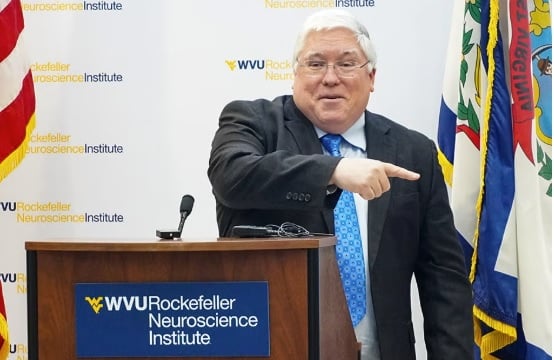
MORGANTOWN, W.Va. — Gov. Patrick Morrisey delivered grants totaling more than $9.3 million to the WVU Rockefeller Neuroscience Institute and the WVU Innovation Corporation through the West Virginia Rural Health Transformation Fund during a Thursday announcement in Morgantown.
The grants will support improvements in treatment, transportation, and research related to substance use disorders and recovery.
The funding will support the delivery of high-technology care, peer recovery coaches, advanced research and economic development.
One $3 million grant will expand RNI’s Human Operating System, which uses smartphone technology, wearable sensors, and medical records to monitor patients for signs of a potential relapse. When an alert is generated, a notification is sent to recovery coordinators or peer recovery specialists who can intervene before someone in recovery returns to substance use.
A patient and peer recovery specialist from the RNI shared their experiences during the event.
The RNI will receive more than $6.3 million through the West Virginia Rural Health Transformation Program (WV RHTP), while the WVUIC will receive a $3 million Economic Enhancement Grant to develop shared laboratory space for startups.

Morrisey said the grants will support a Recovery Access Coordination Hub, additional peer specialists, transportation personnel and other resources to ensure people receiving treatment have the support they need to access care.
“All of us have periods in our life where we could get that little bit of a boost or a push up. It can make all the difference in the world, and you see that with these folks here today,” Morrisey said.
Over the next 12 months, the WVU Innovation Corporation will be transformed into a validation and verification facility for low-intensity focused ultrasound treatments, according to Dr. Ali Rezai, Executive Chair and Director of the Rockefeller Neuroscience Institute (RNI) and Associate Dean of Neuroscience at West Virginia University.
Other companies are expected to show interest in advancing ultrasound technology that originated at RNI and is now being used in locations around the world.
“Many of these companies need to come in and look at the different doses, the different parameters, and different configurations,” Dr. Rezai said. “So we will test the different doses there.”
Other medical technology companies, as well as businesses involved in high-technology or advanced manufacturing, would also be welcome at the innovation center as the facility continues to develop. The center could become a “sandbox” for developing the next generation of medical treatments and other high-technology ventures.
“It’s not just ultrasound, it’s other areas,” Rezai said. “These labs will allow other technologies to come in, and as the medical center grows, people will want to come here from other companies to learn from us. Also, if they know this is here, they can build here.”
Governor Morrisey believes the Monongalia County area could become a center for medical device development, testing, and manufacturing. As the industry grows, it could bring jobs of all types to the region and potentially establish the area as a major economic engine while benefiting the people of West Virginia.
“Once you show the technology works, we know that technology can be monetized to the benefit of our citizens,” Morrisey said. “Can you imagine what would happen if we can really build a burgeoning medical device industry here while we’re helping folks and we build West Virginia as a centerpiece?”
Jonathan Board, Executive Director of the West Virginia First Foundation, the organization established to distribute opioid settlement funds, said the foundation’s board of directors has supported RNI in the past and is excited to see the continued development of the technology.
“When you’re talking about taking from our side dollars that are blood money that has to go back to not just healing in the moment, but healing in perpetuity, changing and breaking generational cycles, and this is where it happens,” Board said.