

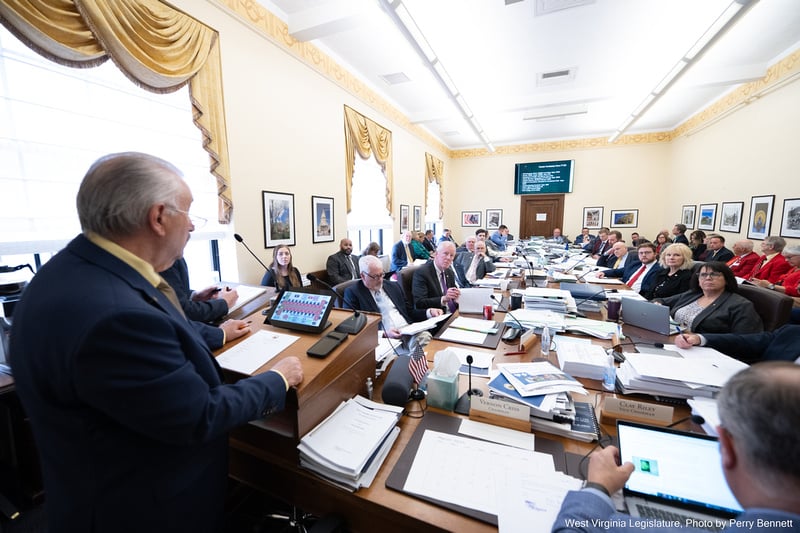
The House of Delegates has introduced a budget bill that is structurally different from one introduced for the governor a few weeks ago.
This is not likely to be the final version of the budget. It’s a starting point for a process that will kick back and forth from the House to the Senate and back over the next couple of weeks.
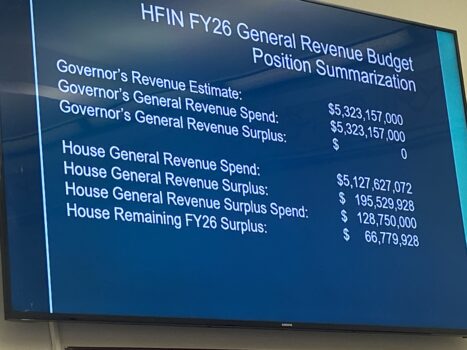
When the regular legislative session began, Gov. Patrick Morrisey and his representatives provided a revenue estimate for the coming fiscal year of $5.323 billion and proposed a general revenue budget that spent that same amount.
The House Finance Committee on Monday introduced its own version that proposes base spending $5.127 billion along with the possibility of an additional $128.75 million in surplus spending if the money is there at the conclusion of the current fiscal year.
The budget proposal from House Finance would leave $66.7 million unspent — in case the money is needed in a pinch.

In a discussion with reporters after the budget bill was passed by committee, House Finance Chairman Vernon Criss said this version of the budget just represents a different perspective from what the governor’s staff produced.
Criss, R-Wood, emphasized the need to differentiate between required spending, which he referred to as the front of the budget, and spending that could be beneficial, which he called the back of the budget.
On the base spending, lawmakers have emphasized in recent years trying to hold down growth.
“If you would look at the last seven years that we have done budgets, this is the way we have approached the budget. We have started with the operating budget. We have tried very hard to stay as close to zero as possible on our growth because we knew that the dollars are there.
“And over the last seven years, as the migration on the on the total budget has been less than inflation considerably, we’ve been able to make that work. And then we’ve had dollars available to take care of wants, which is the back of the budget, versus the needs, which were in the front of the budget.”
He also made a point of saying there should still be money left on the table, in this case the $66.7 million.
“You should never, never spend to zero. You always need a cushion. And the governor made a brutal mistake in his budget by spending every damn dollar, and I don’t mind if you quote me,” Criss said.
The House version of the budget restores $90 million in earlier cuts to the Department of Human Services. It increases the employer share for the Public Employees Insurance Agency by $40 million. It increases funding to the Division of Corrections by $30 million. It provides an additional $7 million to West Virginia’s birth to three program.
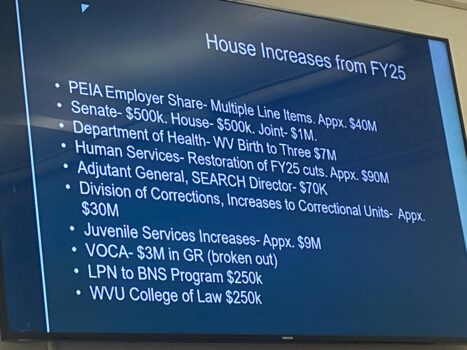
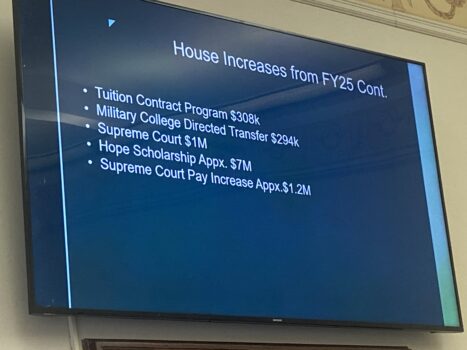
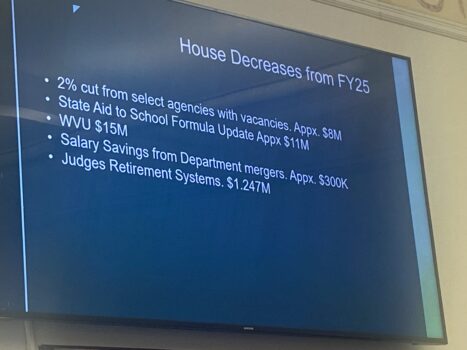
There are some cuts in the House budget too: about $8 million from some state agencies with vacancies, about $11 million from state dollars to the school aid formula, $15 million from West Virginia University and more.
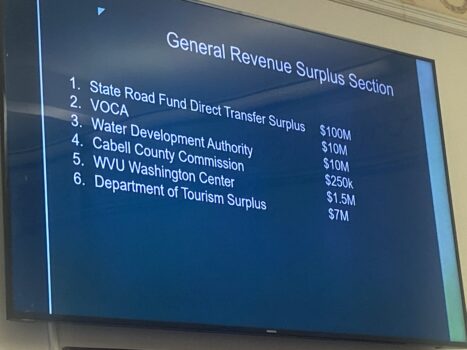
The section of the bill that would dedicate more spending if the state ends the year with a financial surplus is typically ordered by priority.
“The number one slot in the back of the budget is $100 million for highways. We know that we have had a bad winter,” Criss said.
From here, the budget will go back and forth through the remainder of the legislative session, which concludes April 12.
“Today was the first day for our opinion on the budget. It’s a committee process,” Criss said.
The budget bill next goes to the full House of Delegates. By Friday it could be up for a passage vote, and Criss will do much of the speaking on the floor that day.
Meanwhile, the state Senate is also working on its version of budget priorities.
“So then the Senate will receive ours. There will be a compromise between us and the Senate, and we’ll put they’ll put that in the House bill and send it back, and then sometime late next week, Thursday or Friday, or even maybe Saturday — I mean, last year, it was Saturday night at 10:30 before we got the budget done — but sometime in the last two or three days there, we will then take up the budget as a compromise and agree to the to the compromise on this bill once it comes back over from the Senate.”