

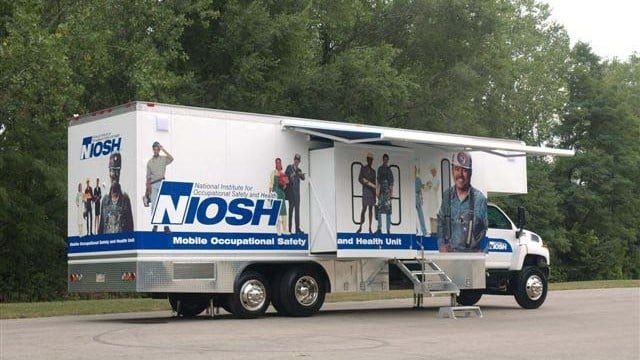
Senator Shelley Moore Capito has written a formal letter asking for a reversal of cuts to the National Institute for Occupational Safety and Health, which runs a coal mine lung disease screening program required under federal law.
The union that represents workers at the Morgantown facility expressed appreciation for the senator’s support while also saying NIOSH faces “an unprecedented challenge.”
Meanwhile, a federal judge in Charleston has set a hearing for 10 a.m. May 7 for a lawsuit filed against U.S. Health and Human Services Secretary Robert F. Kennedy Jr. over the cuts at NIOSH affecting black lung screening.
These are the events so far this week involving the reduction in force at the agency that conducts research and makes recommendations about preventing work-related injuries and illnesses.

“This is more than a staffing issue — it’s a public health emergency,” said said Cathy Tinney-Zara, president of American Federation of Government Employees Local 3430, which represents workers at NIOSH in Morgantown.
“We must act swiftly to restore these positions and ensure that NIOSH can continue its invaluable work for generations to come.”
NIOSH cuts
Hundreds of workers at the Morgantown facility learned a a little less than a month ago that they would lose their jobs.

Kennedy’s Health and Human Services agency announced on March 27 a restructuring in line with the administration’s Department of Government Efficiency initiatives.
“Over time, bureaucracies like HHS become wasteful and inefficient even when most of their staff are dedicated and competent civil servants,” Kennedy said at the time.
Congress funds the National Institute for Occupational Safety and Health through the appropriations process. Specifically, Congress allocates funding for NIOSH in the Labor, Health and Human Services Appropriations Bill.
Capito is chairwoman of the Senate Appropriations Subcommittee on Labor, Health and Human Services, Education, and Related Agencies.
Capito, who voted to confirm Kennedy and the rest of the Trump cabinet, said early this month that she has been on multiple calls with the Health and Human Services secretary to emphasize the importance of the work at NIOSH.
This week, she made her point in a letter.
“I believe in the President’s vision to right size our government, but I do not think eliminating the NIOSH coal programs and research will accomplish that goal. The mission and work conducted by the specially trained NIOSH employees is not duplicative of any other government program,” wrote Capito, R-W.Va.
“I am concerned that the RIFs at NIOSH will undermine the vital health programs important to so many West Virginians. I urge you to bring back the NIOSH employees immediately so they can continue to support our nation’s coal industry.”
Advocates call for immediate reversal
The local union representing federal government workers expressed appreciation for Capito’s efforts.
“We are encouraged and grateful to see Senator Capito taking a strong stand in support of the critical work carried out by NIOSH,” Tinney-Zara said.
Advocates called for the immediate reversal of the reduction in force and the reinstatement of the affected NIOSH personnel. Union members and supporters of the facility’s work plan a rally from 11 a.m. to 2 p.m. Wednesday at the intersection of Willowdale Road and Route 705 in Morgantown.
“The research and services provided by NIOSH are not only essential to protecting the health and safety of workers across the nation,” Tinney-Zara said, “they are truly unique, with no equivalent elsewhere in the federal government.”
The NIOSH Division of Safety Research in Morgantown focuses on preventing occupational injuries through preventing falls, encouraging motor vehicle safety and preventing violence in the workplace.
The Respiratory Health Division focuses on preventing work-related respiratory diseases and improving worker health. The Coal Workers Health Surveillance Program studies respiratory disease in miners and provides health screenings and information, particularly about black lung.

Anita Wolfe retired in 2020 as program coordinator for the Coal Workers Health Surveillance Program. She spoke with Capito on Tuesday and hopes the senator can generate momentum to restore the program and the workers.
“She is very adamant that, especially, that program, has to be reversed,” said Wolfe, who described the importance of returning people to work before their job losses lock in as permanent.
“If we can get it stopped and get Secretary Kennedy to just stop it and say the RIF was a mistake — you know, ‘We’re just stopping it; people go back to work’ — that would be the best of all worlds because they would never come off the roles, they wouldn’t lose their health insurance and all.”
After that, even if the program is reinstated, the workers could have to reapply for their old positions.
Those workers have expertise in their fields, Wolfe said. Without them, the work of screening for occupational health risks like black lung has come to a halt.
“We have clinics that are holding X-rays that are ready to come to us,” Wolfe said, “and some of them they know from looking at the X-rays day in and day out themselves are miners that are eligible for Part 90 transfer probably, and those aren’t getting processed.
“So that means those miners already have disease and because they’re being held, they’re still being exposed to that same disease.”
Lawsuit over black lung screening
A Kanawha County coal miner named Harry Wiley filed federal suit on April 7 on behalf of himself and others potentially affected by the loss of the Coal Workers Health Surveillance Program.
Wiley learned he developed black lung in 2024, according to the lawsuit filed in U.S. District Court for the Southern District of West Virginia.
“Coal miners face some of the greatest hazards of all American workers, including a recent epidemic of advanced coal mine dust lung disease as miners cut sandstone to reach the heavily depleted thin-seam coal reserves that remain after a hundred years of mining in Appalachia,” said an amended complaint in the case.
“In order to prevent black lung from developing into totally-disabling progressive massive fibrosis, the federal mine safety statutes since 1969 have afforded American coal miners a medical screening and epidemiological surveillance program, along with a unique right to transfer to a non-dusty job if they begin developing early signs of occupational lung disease.”
The lawsuit notes that on April 1, the U.S. human services agency fired top employees including the chief medical officer overseeing the coal mine dust lung disease screening program “thus jeopardizing miners — like the Plaintiff, Mr. Wiley — who seek to utilize these critical and time-sensitive protections from continued dust exposure and debilitating disease.”
The suit contends that Wiley took an initial step last fall to apply for transfer under federal law to a non-dusty job, mailed a form and radiographic image of his chest last Nov. 8 to the lab in Morgantown — yet has received no response. So he remains actively employed in underground mines.
The lawsuit filed in U.S. District Court for the Southern District of West Virginia seeks a declaration for the federal government to comply with its statutory duties by restoring all personnel in NIOSH’s Respiratory Health Division.
Wiley’s lawyers asked for a preliminary injunction.
“The fact that Mr. Wiley must continue to work in unsafe conditions — facing the certainty of further dust exposure and worsening his existing lung disease — is purely the result of the decisions of Robert F. Kennedy Jr. and the Department of Health and Human Services,” his lawyers wrote.

U.S. District Judge Irene Berger is overseeing the case and ordered that the defendants — Kennedy and DHS — file a response to the motion for preliminary injunction by May 1.
Berger ordered a hearing at 10 a.m. May 7 in Charleston.