


CHARLESTON, W.Va. — The Emergency Medical Service industry is making some changes to its operational framework.
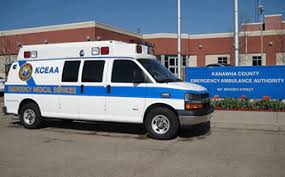
A spokesman with the Kanawha County Emergency Ambulance Authority, Tom Susman says changes happening across the scope of the emergency dispatch service industry is prompting the organization to rework some things within their own operation.
Susman recently made an appearance on 580 Live and said what has happened over a period of time is that the delivery of ambulance services has changed within the EMS industry as well as the business model.

As a result, he said the Kanawha County Emergency Ambulance Authority (KCEAA) is having to make their own alterations in order to navigate the changing industry.
“How do we redesign Kanawha County Ambulance to meet the needs, not only financially, but more importantly, quality-wise in the coming years,” Susman said.
On top of the overall industry changes, Susman said KCEAA is also having to maneuver around a $4 million dollar deficit and workforce shortage issues of their own.
Susman said one of the major changes that has really affected them and their revenue stream is that hospitals are now doing their own inner-facility transports that ambulance services like KCEAA used to do.
“We used to have a model where the emergency ambulance providers, for the most part, did the non-emergency transports as well as the emergency transports, well, now you have third party companies that are providing that, and so that revenue stream has moved away,” he said.
However, in order to mitigate the gap in revenue as well as address workforce issues, Susman said the Kanawha County Ambulance Authority plans to implement a new ambulance dispatch system called tiered response.
He said under this system, only the most appropriate medical personnel will be sent out for each specific call rather than the old way of dispatching the nearest ambulance.
Susman said this system will more efficiently allocate the proper ambulance to the proper call.
“Say I sprain my ankle and I have no other way to get to the hospital, it’s a problem, but for the most part it’s not life threatening, so that would be a basic life support ambulance,” he said.
However, he said with bigger emergencies such as cardiac arrest situations, an advanced life support ambulance would be called.
Susman said KCEAA is working with Kanawha County Metro 911 to implement this new tiered response model.
 He added that 30 to 40 years ago, this system wouldn’t have necessarily been possible due to the sole reliance on radios in ambulances alone, but new and developing technology is giving them the ability through telemedicine to communicate with hospital medical personnel remotely and in real time.
Susman said another way KCEAA is trying to specifically address the workforce shortage is through a new training program they have implemented that provides the tools for people to become paramedics and EMTs quicker.
He said he believes this workforce shortage in the industry in West Virginia is a result of limited employee pay compared to what EMTs make in surrounding states.
“Based on some statistics from the West Virginia EMS Coalition, it’s kind of like the Hospital Association but for EMS providers, in Maryland they’re paying a minimum mean hourly wage of $29.96 an hour, in West Virginia it’s $21.55, Ohio is $22.50, we’re $21.55, Pennsylvania is $25.51, West Virginia is $21.55,” he said.
Susman said in West Virginia, a major issue is that about 71% of the pay for EMS comes from Medicaid, Medicare, and PEIA and about 30% or less is coming from private corporations.
However, he said in other states, Medicare, Medicaid, and PEIA pay is about 40% and private is about 60%.
Susman said they hope this tiered response model can help to better address all of these issues they’re currently faced with.
“How do we do it better, how do we make it more efficient and maintain quality.”