

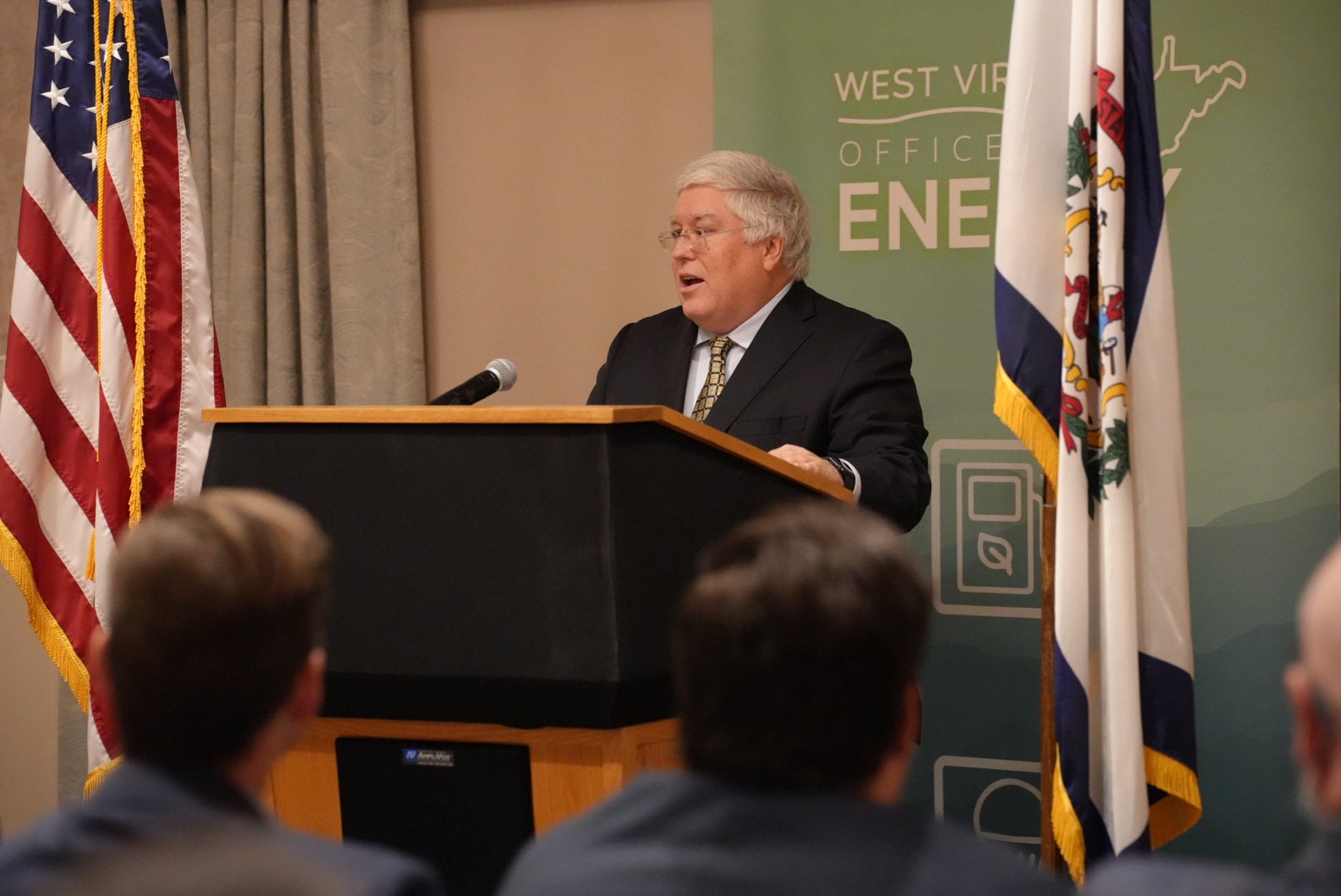
WHEELING, W.Va. –Gov. Patrick Morrisey says the state’s first comprehensive energy policy will help West Virginia achieve energy dominance.
Morrisey appeared at the West Virginia Educational Forum and Tour at Oglebay Resort in Wheeling on Wednesday evening to announce the state’s new energy policy and outline its key components.
During his speech, he focused on PJM, the nation’s largest Regional Transmission Organization, which coordinates the generation and flow of electricity to 13 states and 67 million people, from Chicago to New Jersey to New York.
He said he was told that by 2045, peak load within PJM territory is expected to increase by 70 gigawatts, and by 2030, approximately 40 gigawatts of PJM’s generating capacity could be retired.
Morrisey said that’s why he created this 25-year plan, to help West Virginia get in front of that and ensure we can help.
He highlighted three general principles guiding the policy. The first is duration,25 years, because a short-term policy would be too reactive. The second principle is that the policy will be grounded in both science and common sense. The third is location.
Morrisey said that this effort is going to have to be collaborative between everyone in the state.
“We want to get input from the legislature, we need to get input from the industry, we want to get input from consumers and all those effected, the manufacturers, people that rely on the important power that gets produced, and we want to do that so we can pursue that a balanced energy mix fueled by West Virginia’s natural resources,” he said.
He explained that currently West Virginia has approximately 15 GW of generating capacity, that needs to be to 50 GW by 2050.
To help WV get there, he announced the foundation of the policy, The Generation Plan.
“We need to focus on our baseload generation and be very focused about it, we need to make sure that through the resources I’ve talked about we have a stable backbone to the grid, and we have to ensure there’s always a dependable supply of electricity,” Morrisey said.
The baseload generation he was referring to was coal, natural gas, and nuclear.
Along with the plan he also announced how they were going to ensure the state gets to “50 (GW) by 50”.
He outlined three key components of the policy: first, focusing on existing generation by upgrading the power plants already in operation; second, embracing new generation by pursuing additional coal-fired facilities; and third, growing supply chains to address shortages of transformers, turbines, switchgear, and breakers—delays that are currently hindering new energy projects in the state.
Out of those three parts, he focused on making new generation.
He said they have met with the U.S. Department of Energy and its national labs in order to come up with a plan to create that new generation.
“We need to create a lot of different scenarios of how the new generation should be developed, looking at factors such as changes in commodity prices, changes in generation technologies, changes in regulations and quite frankly changes in consumer demand,” Morrisey said.
He also said that they are implementing a 25 year “Strategic Development Plan” for each of the energy sources, including coal, natural gas, and nuclear.
Morrisey stated this plan will help the state in the long run, no matter how long it takes.
“By developing individualized strategic policies, I think that’s going to be very beneficial, it’s going to take some time and it’s going to take input from a lot of people in this room, lot of citizens from across the state, but we got to make it happen,” he said.
He said that this plan is going to be ambitious and difficult, but they’re going to make it happen.
“We’re going to overcome our nay-sayers, a lot of people will say this can’t be done, we have no choice if we want to succeed in the modern economy,” Morrisey said.
He said they will also focus on security with their new Energy Security Plan, that will aim to inventory infrastructure, conduct risk and vulnerability analysis, identify emergency response protocols, address physical and cyber-attacks, and maintain continuity.
A full video of his full address can be found here.