

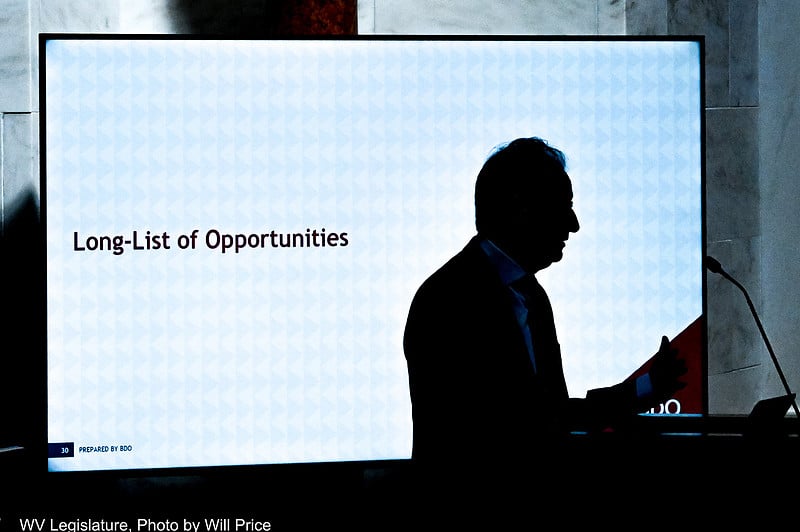
Matthew Rohrbach, the deputy speaker in the House of Delegates, said state officials will benefit from outside advice about the finances of the Public Employees Insurance Agency.
Lawmakers got a first glance of that advice yesterday but have not yet decided what recommendations to act upon.
“Now I think we were going to try to distill it down to what we can do to improve PEIA. We want a quality plan for our employees, and we want a plan that is fiscally sound,” Rohrbach said on MetroNews Talkline.
Members of the Joint Standing Committee on PEIA this week heard a detailed presentation prepared by the national advisory company BDO USA, which gave lawmakers an extensive list of choices that could improve the finances of the Public Employees Insurance Agency.
The result could be annual savings of about $55 million if the options were successfully implemented, the consultant said. That represents about 5% of PEIA’s total annual cost of about a billion dollars.
The recommendation with the highest likelihood of savings, BDO said, would be to institute a total family income rate tiering structure. The consultant estimated that could result in $20 million in savings for PEIA itself.

Rohrbach, R-Cabell, said lawmakers have looked at that possibility in the past, “and it didn’t go anywhere then and it’s going to be a pretty tough lift, politically.”
Another suggestion by the consultant was to reduce non-state employee eligibility for PEIA. County governments and municipalities can currently opt into the plan, but their payment structure is different. About 15,000 workers are covered this way and might be affected.
As an alternative to eliminating eligibility for non-state employees, BDO also suggested ensuring that non-state employees are required to pay the same 20% cost share as their state worker counterparts, helping to support administrative costs for the agency.
“That’s one of the things we need to look at,” Rohrbach said of the second option. “I think if we’re going to continue to stay in the insurance business for non-state employee entities then we need them to pitch in part of the administrative costs.”
One of PEIA’s biggest cost drivers is specialty drugs, especially G1Ps that are prescribed for diabetes and popular for weight loss. The consultant proposed a few possibilities for trying to better control those costs, including hiring a dedicated staff member to focus on more efficiency.
The consultant also discussed greater efforts to import drugs at lower costs from countries like Canada.
“If we can’t get a handle on prescription drugs, I’m afraid at the rate they have been increasing we’re doomed to just see higher and higher costs for PEIA,” Rohrbach said.
Rohrbach was one of the delegates who asked the most questions at the conclusion of the consultant’s report at legislative interim meetings this week.

Another delegate who asked several questions was Shawn Fluharty, a Democrat from Ohio County. He asked, for example, if the consultant had completed a cost-benefit analysis of the suggestions for curtailing the prices of specialty drugs.
The answer was no because the problem of the cost of those drugs is relatively new and any potential approach would be somewhat experimental.
Fluharty also asked about the proposal to bump non-state employees from eligibility. He drew out that the math on that proposal is tricky: The overall savings is estimated to be $189 million. But those workers contribute premiums, which would be lost.
So the net is a modest $1 million reduction.
“A million doesn’t seem like a large number give the numbers we’re working with here,” Fluharty said, adding that the potential exodus of members would be several thousand. “Would that run the risk of de-stabilizing the risk pool?”
The response was that the overall pool of workers would, naturally, be smaller under this scenario. So factors like whether the group is younger or older, healthier or sicker could be magnified.
Fluharty then asked about the proposal to tie cost shares to total family income. He wondered about verification standards and whether privacy concerns would exist.
Finally, Fluharty wanted to know about state employees getting walloped by high premium increases after years of low or no increases. “Are there guardrails we could put in place that we’re not doing currently?” Fluharty asked, “so we’re not hitting members with these catch up years?”
The report concluded that PEIA’s recent and anticipated annual premium increases of about 14% premium increases are justified given that costs were frozen for people in the program between 2018 and 2022.
“If you have a 0% increase, you have to catch up, just by math,” responded Ben Lewis, BDO’s managing director of strategy and innovation.