


On August 11, President Donald Trump declared a “crime emergency” for the District of Columbia, and five days later Gov. Patrick Morrisey deployed members of the West Virginia National Guard for support.
The president’s emergency declaration, which placed the Metropolitan Police Department under federal direction, expired after 30 days, Sept. 10. Yet the West Virginia National Guard deployment remains active and could be in effect through the end of November or beyond.
A court case in Kanawha County has challenged the governor’s power to deploy the West Virginia National Guard to the streets of America’s capital. Judge Richard Lindsay heard about an hour of argument Oct. 24 and then stopped because he wants to more thoroughly explore a central question.
As Lindsay phrased it before telling the lawyers to submit written briefs, “The central issue to this court is whether or not what the governor did is in compliance with West Virginia law.”
The case before Judge Lindsay is set to resume on Monday morning, and weighing the question at the heart of it relies on a cross section of state and federal law.
Some of the factors to be considered include the hybrid nature of the state-federal deployment, whether federal laws forbidding the use of military personnel for policing should apply, whether there’s an exception because the Guard is under the oversight of the governor — or whether the governor’s authority has been stretched to overreach.
Federal callups
The governor’s original announcement noted that the mission would be funded at the federal level. That’s a Title 32 order, typically for natural disasters, where the National Guard remains under the control of the state’s governor but receives pay and benefits from the federal government for federal missions.
This federal law permits a member of the National Guard to be ordered to perform training or other duty that may include support of operations or missions undertaken by the member’s unit at the request of the President or Secretary of Defense.
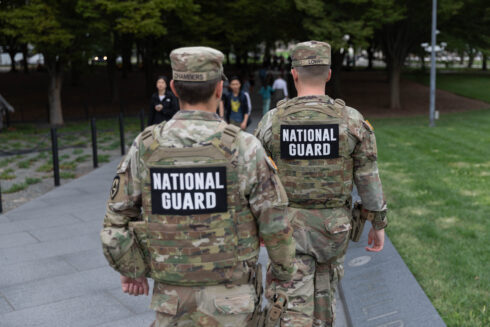
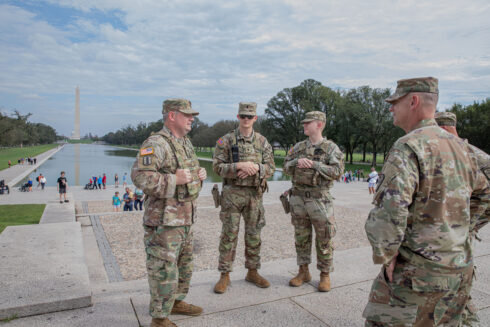
The 300 to 400 members of the West Virginia National Guard who have been deployed to Washington, D.C., have been operating under Joint Task Force-DC, which says the mission will continue “until law and order is restored.”
The landing page for the Joint Task Force-DC describes some of the duties as beautification, including graffiti removal and trash cleanup, support of Metropolitan Police in high-traffic areas and increased presence at Metro public transit stations along with assistance to U.S. Park Police.
The Joint Task Force-DC cites authority under Title 32 “to perform law enforcement activities” under D.C. code, as an exception to the Posse Comitatus Act. That is a federal law that restricts the use of the military for domestic policing.
The Posse Comitatus Act consists of just one sentence:
“Whoever, except in cases and under circumstances expressly authorized by the Constitution or Act of Congress, willfully uses any part of the Army, the Navy, the Marine Corps, the Air Force, or the Space Force as a posse comitatus or otherwise to execute the laws shall be fined under this title or imprisoned not more than two years, or both.”
Members of the National Guard are rarely covered by the Posse Comitatus Act because they usually report to their state’s governor.
That means they are free to participate in law enforcement if doing so is consistent with state law. However, when Guard personnel are called into federal service, or “federalized,” they become part of the federal armed forces, which means they are bound by the Posse Comitatus Act until they are returned to state control.
That raises a couple of questions about the West Virginia National Guard deployment to Washington, D.C.
Whose authority are the Guard members acting under, and is the deployment consistent with West Virginia law?
The Title 32 status splits the authority, with Guard personnel paid through federal funds and performing a mission requested by the president — but still under state command and control.
As for West Virginia law, that again requires some deciphering.
Issues of West Virginia law
A couple of sections of West Virginia law seem to apply.
One outlines the authority of the governor to order the organized militia to active state service, including the ability to order the militia to serve outside the state for training, parades or other duties.
Another describes the governor’s powers to call out the West Virginia National Guard “into the active service of the state” in events like war, insurrection, riot, invasion or public disaster.
ACLU-West Virginia, the plaintiff in the court challenge, maintains that nothing matching those terms is happening for the Guard to be called up to state service.
“There has been no assertion that the activation of the West Virginia National Guard is based upon any such event, much less such an event occurring within the State of West Virginia,” wrote the lawyers challenging the deployment.
Lawyers representing the state contend governor was permitted to order the mobilization because the West Virginia National Guard was “called for active service of the United States.”
The lawyers from the state Attorney General’s Office wrote that “West Virginia law expressly permits the governor to order members of the WV National Guard out of state to perform military duties and independently to comply with a request to do so by the President of the United States.”
In this instance, they wrote, “Governor Morrisey acted well within his authority as Governor and Commander in Chief of West Virginia’s military when he ordered the WV National Guard to Washington, D.C. at the President’s request.”
In Washington, D.C., members of the National Guard were deputized by the U.S. Marshal Service. The deputation forms identified the troops as employees of the Department of Defense, not the State of West Virginia or the governor.
“Whether the government obeys the law matters. Where, when, and how West Virginia troops are deployed matters,” concluded the lawyers challenging the deployment.