

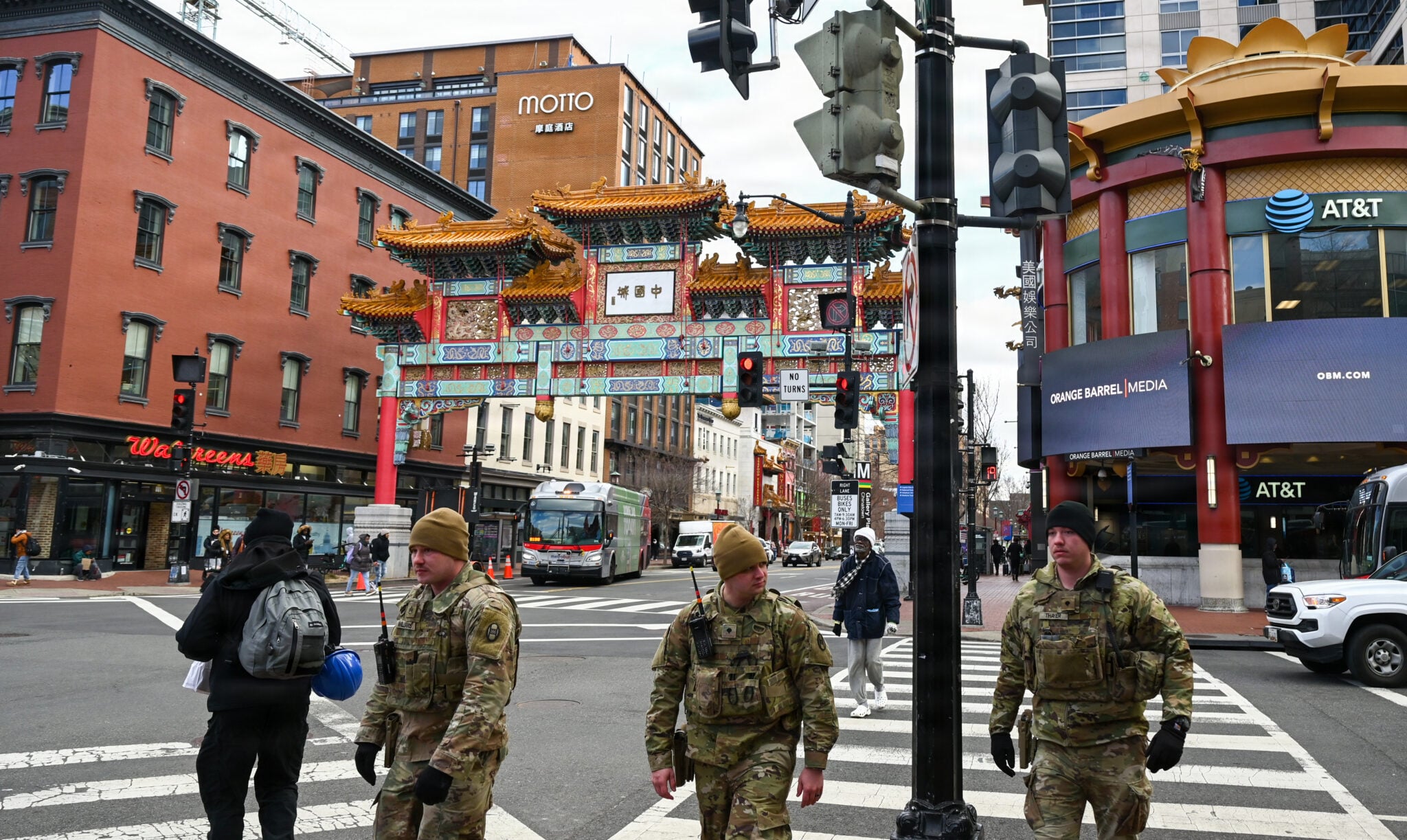
A circuit judge has submitted his written order upholding Gov. Patrick Morrisey’s authority to send members of the West Virginia National Guard to Washington, D.C., elaborating on an earlier verbal ruling with additional detail about the judge’s reasoning.

“Ultimately, he is responsible for this deployment and mission to Washington D.C. and therefore the safety and welfare of our guard members,” Kanawha Circuit Judge Richard Lindsay wrote of the governor.
This comes as about 175 members of the West Virginia National Guard are set to remain in Washington, D.C., until the end of February.
It also comes as the Trump administration is dropping the deployment of National Guard troops to Chicago, Los Angeles and Portland, Oregon, after challenges in federal court. The deployment to Washington, D.C., continues while under review by a federal appeals court.
West Virginia National Guard members Sarah Beckstrom, 20, and Andrew Wolfe, 24, were shot Nov. 26 at the corner of 17th and I Streets NW. Beckstrom died on Thanksgiving Day, and Wolfe continues to recover from serious injuries.
In a West Virginia state court case, Judge Lindsay ruled from the bench at November that the governor has been within his authority to deploy the West Virginia National Guard to patrol Washington, D.C.
Lindsay’s ruling weighed the unique federal oversight of the District of Columbia as a significant factor.
In the written version of his ruling, which was filed Dec. 30, Lindsay emphasized that while the governor cannot send troops to other states without their permission, the unique status of the nation’s capital allows for this discretionary military assistance.
“It is undisputed that Washington D.C. is not a state or sovereign, but a federal district subject to control by the federal government,” Lindsay wrote.
On August 11, President Donald Trump declared a “crime emergency” for the District of Columbia, and five days later Gov. Patrick Morrisey deployed 300 to 400 members of the West Virginia National Guard for support.
“The Governor’s fulfilment of the President’s request is permissive, not mandatory,” Lindsay wrote of the decision-making authority.
The governor’s original announcement noted that the mission would be funded at the federal level. That’s a Title 32 order, typically for natural disasters, where the National Guard remains under the control of the state’s governor but receives pay and benefits from the federal government for federal missions.
This federal law permits a member of the National Guard to be ordered to perform training or other duty that may include support of operations or missions undertaken by the member’s unit at the request of the President or Secretary of Defense.
The Title 32 status splits the authority, with Guard personnel paid through federal funds and performing a mission requested by the president — but still under state command and control.
“Significantly, the foregoing federal code section for ‘Title 32 Status’ deployment of the national guard is permissive and vague. It is entirely up to the requested governor — here Governor Morrisey — to choose whether to grant the President’s request. His decision to do so is not mandatory nor required. It’s his decision alone,” Lindsay wrote.
The president’s emergency declaration, which placed the Metropolitan Police Department under federal direction, expired after 30 days, Sept. 10. Yet the West Virginia National Guard deployment remains active, although the governor has shifted it to a voluntary basis.
In an update this week, the West Virginia National Guard’s public affairs office provided numbers for the mission through February.
“Approximately 175 volunteer WV National Guardsmen will remain on duty through the end of Feb 2026,” according to the update.
“The mission of the WV Guard members will remain the same: to contribute to the safety of the District by conducting static and roving presence patrols. They have not, nor will they be contributing to any type of beautification efforts.”