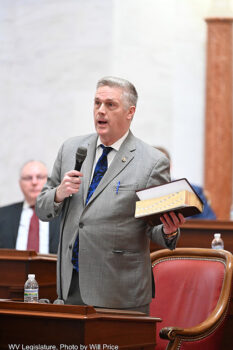
Senators argued over what kind of Bible should be made available to fourth, eighth and 10th grade social studies classrooms.
Senate Bill 388 would make the Aitken Bible available to classrooms for those age levels, with private donations being used to obtain them. Organizations like one called “The First American Bible Project” make such donations.
The Aitken Bible is the first complete English-language Bible printed in America, published in 1782 by Philadelphia printer Robert Aitken during the Revolutionary War. It is known as the “Bible of the Revolution.”
Senators sponsoring the bill say the Bible has particular historic value.

“So the significance of this particular Bible has to do with historical significance,” said Senate Education Chairwoman Amy Nichole Grady, the lead sponsor of the bill.
“It is not religion based, and it’s not saying the teacher has to use it to instruct from. It’s just making it available to students in the classroom as a resource because those contents are being taught,” referring to the social studies curriculum.

Senator Mike Woelfel, D-Cabell, offered an amendment to add the Catholic American Bible to what’s made available. The Catholic American Bible is an upcoming, updated English translation of the Bible approved by the U.S. Conference of Catholic Bishops.
His amendment was rejected, 8-25.
“I think this proposed amendment, adds a little balance to the bill. We certainly are leaving out lots of other religious views,” Woelfel said.
“It’s not my intention to today to try to dictate my sincerely held religious beliefs to you, but that’s exactly what the bill does.”

Senator Ryan Weld, R-Brooke, expressed support for the amendment.
“I think that it’s important from a historical context to also have the Catholic Bible, not just as a Catholic but as a historian as well, for students who are part of these classrooms,” Weld said.

Senator Kevan Bartlett, R-Kanawha, argued against the amendment. Bartlett is pastor of Maranatha Baptist Church in Charleston.
“We’re not talking about teaching theology. That’s another debate, another discussion and other pieces of legislation, but because of the historical significance that is embedded in the actual book itself, that’s the point,” Bartlett said.
The bill will be up for a passage vote in the Senate as soon as Thursday.
The Establishment Clause in the First Amendment of the U.S. Constitution prohibits the government from establishing an official religion, favoring one religion over another or preferring religion over non-religion, factors that were referenced several times during the Senate debate.

Late in Wednesday’s floor session, Senator Mike Azinger rose and announced the distribution of two-toned leather Bibles for legislators. Azinger went on to contend the United States was founded on biblical principles and disputed the basis of principles regarding the separation of church and state.
“The Bible is the foundation of Western civilization. Period,” Azinger said. “The Bible has been taught in public schools for 300 years until the upheavals of the 1965 sexual and cultural revolution. That’s our history.
“Church and state is a myth. There is no mention of church and state in any charter of the colonies, any constitution of the colonies, any founding document does not have church and state, it’s nowhere.”
Azinger continued, “Where’d we get our laws? Where’d our laws come from at the beginning? They came from the word of God. They came from the pulpit of America. That’s where our laws come from. The law comes from one of two places, the heart of man or the heart of God. You do not want to live in a nation with laws that come from the heart of man.”