


The state Senate passed a budget bill and an accompanying tax cut bill unusually early, on the 38th day of the annual 60-day session.
Yet there is still a long way to go toward resolving differences with the House of Delegates, getting the governor’s sign off and easing concerns among senators who found reason to disagree with the budget in its current form.
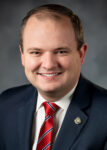
“What’s unique is we’re passing the budget out early. Also what’s unique is our members have rallied around our budget almost unanimously,” Senate Majority Whip Ben Queen, whose job is to assess vote counts, said after a floor session today. “But how can that negotiation happen? I think we’ll see.”
Queen observed, “We’re probably the farthest budget off from each respective house in my career of 10 years, but we also have 21 days to negotiate.”
Senators passed their budget bill, SB 250, on a 28-4 vote with two absences. The four no votes were Republicans Eric Tarr and Craig Hart and Democrats Mike Woelfel and Joey Garcia.
A separate tax bill, Senate Bill 392, passed by the same 28-4 margin. In this case, the no votes were Tarr, Woelfel, Garcia and Senator Amy Nichole Grady, R-Mason.
Senate Bill 392 represents the governor’s priority of cutting personal income taxes by 10% — which equates to about $250 million in state revenue. The bill partially offsets that by increasing vape taxes for an estimated $22 million additional revenue.

After the vote, Grady said she was a no because West Virginia already has a plan to cut income taxes via a trigger if the state hits particular economic conditions. She voted yes for the budget, knowing it’s unlikely to be the final product.
“A couple of years ago, we worked really, really hard on putting those triggers in place, and this would undo all that before we know how that’s working. So we haven’t given that time, and taking something we’ve worked on as a legislature and changing it immediately right after, I felt like it’s not the right time to do that,” she said.
Grady added, “I don’t have very many constituents who come to me and say ‘Hey, thank you for that income tax cut,’ but I have a lot of constituents who come to me say ‘We need more funding for roads and other things.’ I’m for a tax cut; I just don’t think we should go to 10 percent just yet.”
The Senate’s budget bill does include the 10% tax cut while the House bill up for passage next week does not.
Both versions include average 3% pay raises for public employees.
The Hope Scholarship to support the educational expenses of families opting out of public schools is an expense that grows and grows, and in the Senate budget that’s more than $300 million for the next fiscal year — a point that was an ongoing subject of debate in the Senate.

The prior Senate Finance chairman, Eric Tarr of Putnam County, said he could not vote for the budget bill or the tax bill because the state would be on course to spend more money while reducing revenue to pay for all that.
“Compared to last year’s spending, at a base level — anything we are obligating the state to forward, that’s likely to be a recurring expense — how much of an increase in spending does this budget represent compared to last year?” Tarr asked during discussion on the floor.
The current Senate Finance chairman, Jason Barrett of Berkeley County, said he could offer the base spend increase for this year’s proposed budget: $386 million.
Last year’s general revenue budget was about $5.3 billion.
This year it’s $5.7 billion in base spending, Barrett said.
Tarr said the current trajectory could mean in a few years having to raise taxes or making deep cuts. He made similar remarks about the separate tax cut bill.
“We just passed almost 5% increased spending in a budget,” he said. “And now we’re going to go through and say ‘OK, not only are we not holding it flat, we’re going to go and exceptionally reduce the revenue that comes to the state that pays for our sewer, our water, our road repair.'”

Barrett, talking to reporters after the floor session, said the budgeting situation is different this year. He noted further developments in the process will inevitably change the budget before it’s final.
“I’ve been dealt a different hand than last year, and we’re taking a different approach than last year,” said Barrett, a Republican.
“We’re passing it out very early to begin negotiations with the House to see if we can come up with some other offsets for the tax plan, which will increase those revenue estimates that he’s concerned about and ultimately be able to pay for not only some of the spending but also the tax cut.”

Senate Minority Leader Mike Woelfel, another of the no votes, said the state has unmet needs like support for childcare and for the public education system. “I think our priorities are mixed up,” he said.
Woelfel, D-Cabell, also said the state is not adequately preparing for a wide range of anticipated disruptions to federal dollars. “A hard rain’s gonna fall,” he said.
Finally, Woelfel said the tax cut bill goes way too far and the state is unprepared financially. “I’m surrounded by, I think, 33 fiscal conservatives,” he said. “And if you look in your heart of hearts, this is not a fiscally conservative bill.”