

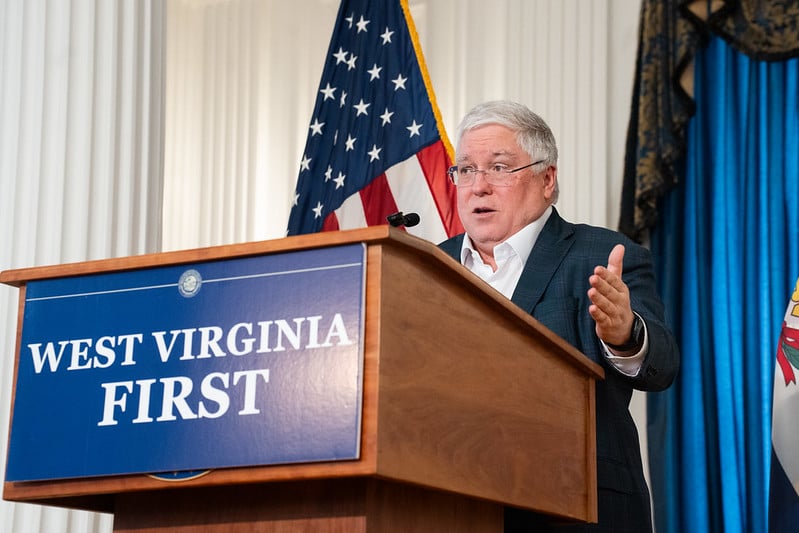
Gov. Patrick Morrisey says he’s ready to collaborate with the Legislature on a budget, but he believes his administration’s approach has been the most fiscally sound so far.

“We’re really eager to work and collaborate with the House and Senate, but also we have a very fiscally responsible budget, and I think that there’s an opportunity to help collaborate together to get everyone to be singing the same tune,” Morrisey said today.
A House of Delegates budget proposal is set up for passage as soon as Wednesday. The state Senate passed its proposed budget last Friday. There are major differences between those, as well as with the governor’s proposal.
The governor highlighted his willingness to work with lawmakers during a press conference today at the state Capitol. Morrisey has had several recent social media posts expressing differences.
“New spending bills that pass in the WV Legislature should be offset and accounted for. We cannot sacrifice our future for the wild spending of today,” Morrisey posted Monday night.
“I will fight against the Legislature chewing up all of the resources we need to provide West Virginians with the across the board income tax reductions they deserve.”
Last week he posted, “Tax cuts and school choice used to be page one of the Republican platform— guess House Finance Chair Vernon Criss hasn’t gotten that far.”
Morrisey’s budget proposal included a 5% personal income tax cut that amounts to $125 million in state revenue. The governor aspires to cutting a full 10% — which would be another $125 million.
The Senate’s budget bill does include the 10% tax cut while the House bill up for passage next week does not have the 5 or the 10.
“Now I know the Senate put that in and they have some offset. I think there’s a way to get to 10 percent. What I’m telling people is we want to collaborate and work. We know that we at least have the 5% in there. Let’s work together to make all that happen and not put the lines in the sand,” Morrisey said today.
The Hope Scholarship to support the educational expenses of families opting out of public schools is an expense that grows and grows. In the Senate budget that’s more than $300 million for the next fiscal year, but it’s generally from surplus funding — meaning money that could be on hand if the state brings in more revenue than anticipated.
The House is considering a bill that would trim Hope Scholarship expenses by capping the amount to families and refining allowable expenses.
Morrisey today described Hope as an entitlement that must be fully funded if the state is going to offer it.
“I was not supportive of what the House Finance did,” he said. “I deal with things that are in front of me, and so I’m not supportive of that. And I think obviously there’s been a lot of pushback on that, but I do believe that we should keep Hope intact and be very strong.”
It’s still early in the 60-day session, Day 42, but the competing visions of state finances are about to collide.

Senator Eric Tarr, a former finance committee chairman, voted no on the Senate’s budget last week. He contended that the state can’t yet afford to embrace another tax cut.
“We increased spending and then gave a revenue reduction that was just didn’t match up,” Tarr, R-Putnam, said on MetroNews Talkline.
He added, “If we take this thing right now as a Senate passed it, we’re going to have a huge budget hole coming up in the next few years, and that gets really painful. It gets painful for the people of West Virginia, and that’s what I don’t want to see.”
The state cut income taxes by about 27 percent over the past few years and has a trigger system in place to cut more if economic conditions are met.
Tarr suggested the state could move in advance of that trigger if officials have the discipline to hold spending flat for a year.
“You can’t spend more than you make,” he said. “It means it’s simple family economics.”