

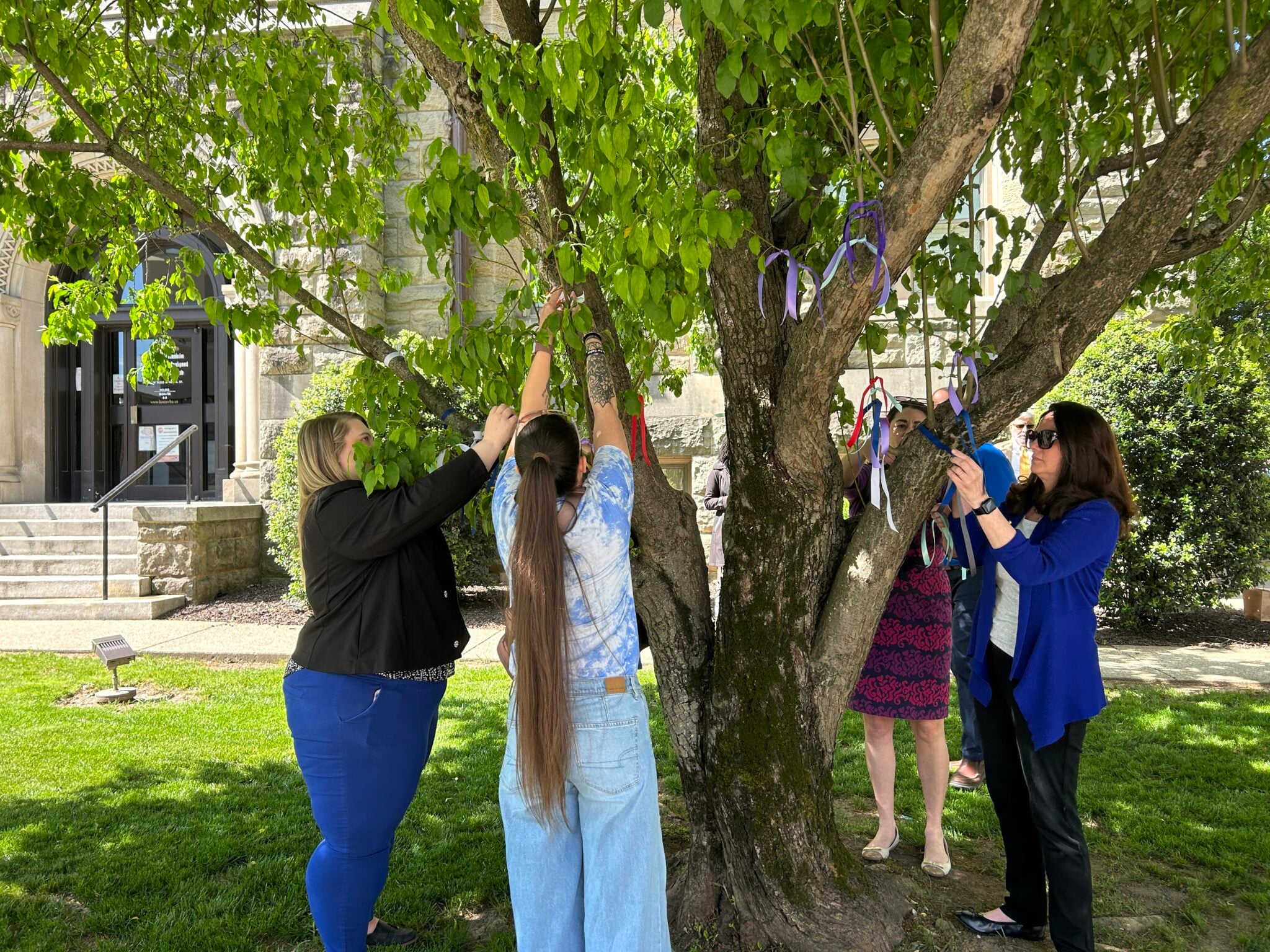
CHARLESTON, W.Va. — The U.S. Attorney’s office, law enforcement, crime victims, and crime victim advocates gathered Tuesday morning in the Capital City to recognize National Crime Victims’ Rights Week.
A Ribbon Tree ceremony was held in front of the Kanawha County Courthouse where victims and advocates could place ribbons on a tree.
National Crime Victims’ Rights Week dates back to 1981.
U.S. Attorney for the Southern District of West Virginia Moore Capito said the event signals a shift in mentality towards victims.

“Today’s not just a ceremony, it’s a time to remember, to honor, and obviously, to act,” Capito said. “As prosecutors, we always say that it’s our job to carry out justice, to ensure that those that perpetrate crimes on our communities are accountable for those crimes, and that they do their time. But for a long, long time, that was all that happened in the justice system. It was sort of, ‘here was the perpetrator, here was the prosecutor’ and the victim was kind of over here as a convenience to an end. We realized that we needed more than just awareness, we needed action.”
Capito credited his mother-in-law, longtime crime-victim advocate Carol Vittert, for her work over the years. Vittert founded Aid to Victims of Crime in St. Louis, Mo. back in 1972, recognized by many as the United States’ first nonprofit victim-services agency. Vittert was in attendance Tuesday in Charleston, nearly 54 years after beginning the nonprofit organization.
“[She] realized that we needed more than just awareness; we needed action,” Capito said. “That victims have rights, and those rights need to be recognized in the system, and throughout the process. It doesn’t end at the end of a trial or at the end of a deal, it is a lifetime commitment. I’m proud to say the person that started the movement that we all recognize today, is here with us today. I have the honor of calling her my mother-in-law, but all of us are grateful to you, Carol Vittert.”
Brittany Leavitt, Victim Witness Specialist at U.S. Attorney’s Office, said Tuesday’s ribbons were color-coded in relation to the crimes that victims suffered.
“We probably see more purple than most other colors, that represents domestic violence,” Leavitt said. “That is the most prevalent of all violent crimes across the country. And often what comes along with the purple ribbons come others as well. If there’s domestic violence in the home, there’s often child abuse in the home. And then we have the white represent homicide, gray for human trafficking. The blue is for child abuse. There’s quite a few teal, as well, and that represents sexual assault. The red represents victims of drunk driving, and then we have yellow that represents assault and battery. Yellow has been the traditional color to represent victims for many years, which is why we have the yellow ribbon on today.”
Leavitt said that it was a team effort to put together the event.
“We reached out to the community and had multiple people here from different advocate groups that are here to help, and victims, law enforcement, prosecutors, just to have a moment to show some remembrance for them, just as a reminder that victims do have rights now. They haven’t always, but victims do have some level of rights, and the main thing is we want victims to know that they never have to go through any of this alone.”
A handful of law enforcement officers were in attendance, and Capito noted their work.
“Thank you for everything that you do every day, and the situations that you don’t ask for, but we ask of you,” Capito said. “You do it bravely and proudly. So today, and every day, we thank you for your service.”
“Most importantly, we want to thank all the victims that are here with us today,” Capito continued. “And those who we don’t often speak about, the families of those victims that are here today, who I’ve had a chance to meet with, some of, but who we want to hear from all of.”
Leavitt said those who speak up for crime victims play a key role.
“Advocates in the court system, especially with law enforcement and working in the courts, they carry a lot of weight,” Leavitt said. “They are a very crucial process to the system. They help give that support and aid to the victims and being with them in their time of need. They’re also the mediary; they help connect them with the resources that are available throughout the community.”
There are resources in place to help people suffering in a bad situation, Leavitt said.
“If you are the person who is hurting and you need someone, and you’re looking for safety, there will be someone there for you,” Leavitt said. “You do not have to do it alone. It’s a long road, but you don’t have to do it alone. If you know of someone, and you’re trying to help them, you have to be ready when they are ready, forcing them to get help won’t work. Always telling them that you’re there for them, and you don’t judge them, and you’re just there when they’re ready to get help.”
For more information about victim and witness resources in the Southern District of West Virginia, visit here.
The Southern District of West Virginia Victim Witness Program phone number is (304) 345-2200.
The National Domestic Violence Hotline is (800) 799-SAFE.