

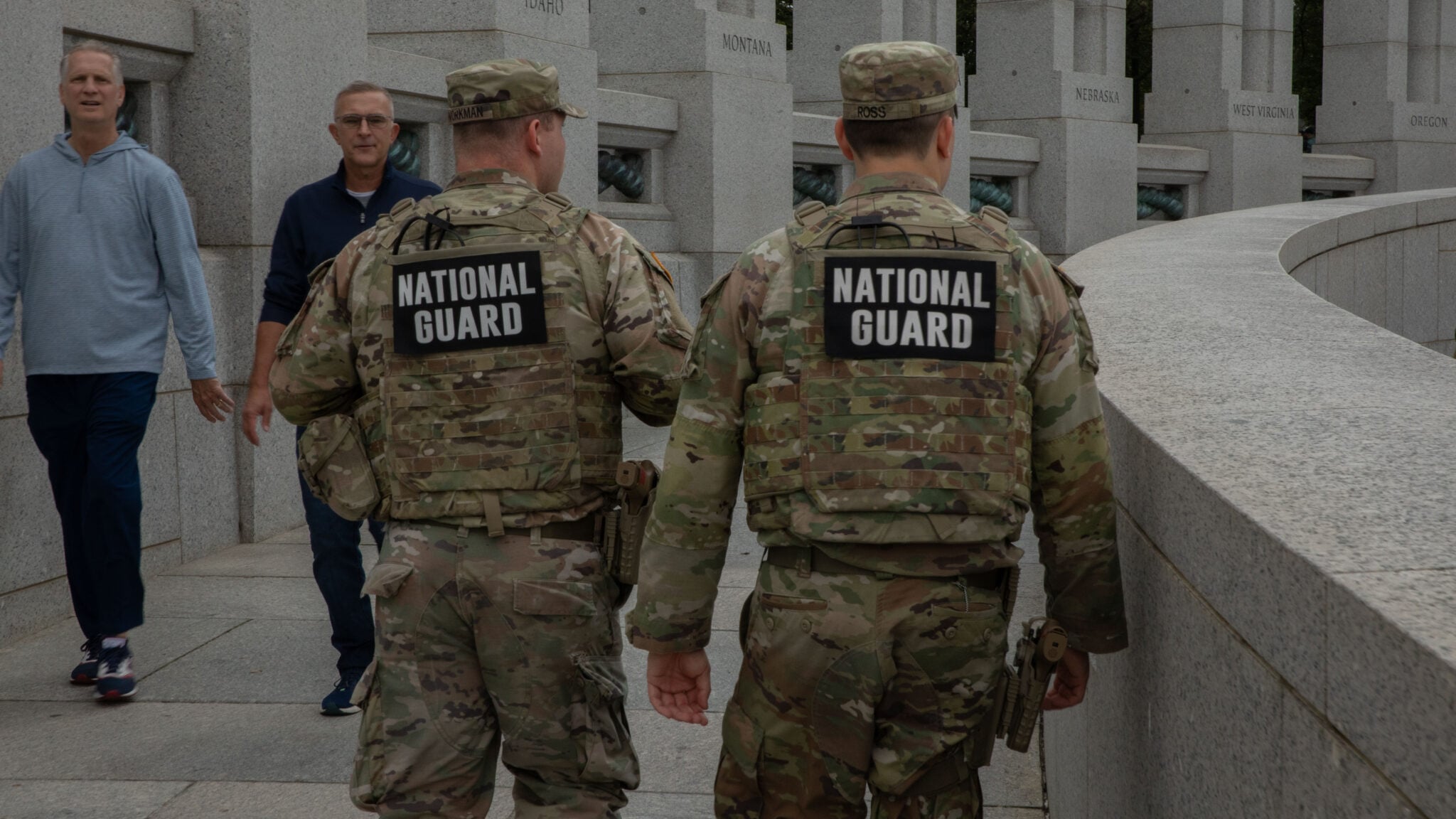
The State of West Virginia led more than two dozen states in a legal filing this month in support of a continued presence of the National Guard in Washington, D.C.
“The President as both commander-in-chief and chief executive has determined that the only way to defend the capital and take care that the laws are faithfully executed is to call up the National Guard to support the D.C. police in quelling the crime wave,” wrote attorneys for the states that support the policy.
About 2,000 members of the National Guard, overall, have been deployed to Washington, D.C., to patrol on the National Mall, in Metro public transportation stations and across D.C. neighborhoods.
West Virginia has an estimated 160 to 170 National Guard members who have remained in Washington, D.C., in a response to a call from the governor for volunteers.
Two members of the West Virginia National Guard were shot last year while on duty near a Metro public transportation stop. West Virginia National Guard Specialist Sarah Beckstrom, 20, died of her injuries. U.S. Air Force Staff Sgt. Andrew Wolfe, 24, has been recovering from serious injuries.
Less than a week before the attack on the Guard members, a federal judge ruled that deployment of the National Guard from several states, including West Virginia, to Washington, D.C., has been unlawful.
That ruling has been appealed to the D.C. Circuit, where it’s before a panel that includes federal judges Patricia Millett, who is an Obama appointee, and Gregory Katsas and Neomi Rao, who were appointed during the first Trump term.
The appeals case has had a flurry of briefs from a range of organizations stating positions about the deployment to Washington, D.C.
Authorities from states like West Virginia filed a brief late last year to support a stay of the district court ruling.
Their latest, broader brief filed on April 8 supports now vacating the lower court ruling. The brief argues that the president has both constitutional and statutory authority to ensure federal law is enforced and to protect the seat of federal government from a significant crime surge.
The brief was signed by Michael Williams, solicitor general for the state of West Virginia, on behalf of Attorney General J.B. McCuskey’s office.
Legal authorities for the states maintain the District of Columbia lacks the legal standing to sue the federal government because it is a subordinate entity rather than a sovereign state.
The brief further contends that a preliminary injunction against the deployment should be vacated because the military presence has successfully reduced violent crime and restored safety for government officials and citizens.
Much of the brief’s focus is on crime in Washington, D.C., but the attorneys for the states maintain the consistent Guard presence is helping the nation’s capital in other ways as well.
For example, the brief notes, National Guard members have provided immediate aid in situations, such as stopping fights, including at least one incident near a Metro station, providing first aid to elderly residents and conducting search and rescue, such as aiding in the successful search for a missing child.
Officials with the West Virginia National Guard have consistently maintained members have not been participating in landscaping duties in Washington, D.C., but the brief praises those who have.
“As part of supporting law enforcement, troops have worked on beautification projects to clean up neighborhoods,” wrote attorneys in the brief for the states.
“In October, the National Guard reported clearing trash, spreading mulch, and removing plant waste. This type of work supports the efforts to prevent crime by ensuring that those neighborhoods are not ‘recognized as invitations to violent and property crimes.'”