

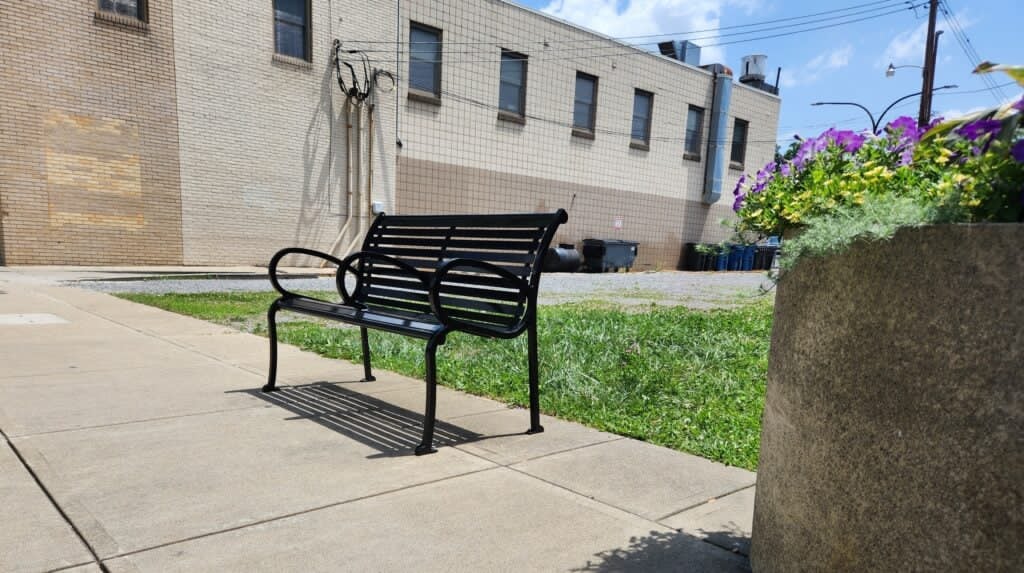
MORGANTOWN, W.Va. — The University City will move forward with an effort to remove infrastructure from municipal property that is deemed ‘hostile architecture’ towards residents and visitors.

Morgantown City Council approved a resolution Tuesday, 5-2, that bans the architecture and requires the making of an inventory and working toward removing city infrastructure that may restrict people from resting, sitting or other uses of benches. The resolution was approved about a week after the measure was placed on the agenda by the council during the monthly council workshop hosted in June.
According to the resolution, ‘hostile architecture’ entails an infrastructure that results in ‘discomfort, exclusion, or restriction rather than through legitimate safety, security, or operational necessity.’ Among the examples listed are ‘bench designs or bench-like structures with slanted or segmented surfaces intended to prevent sitting’ and ‘anti-sitting spikes, protrusions, rollers, or similar deterrent hardware installed on surfaces intended for human contact.’
Councilman Brian Butcher said the architecture is considered a hindrance for a fair number of residents.
“The reason for a resolution like this is for our public infrastructure to be more accommodating to everybody, that includes older people and people with disabilities,” Butcher said.
Examples of such infrastructure located within city limits, according to Butcher, include the public benches located in parts of downtown Morgantown near the Monongalia County Public Safety Building that include armrests segmented in the seating area to prevent people from lying down on them.
According to City Manager Jamie Miller, the city has approximately 15 city-owned benches that would be considered ‘hostile’, with additional infrastructure seen at Mountain Line bus stops as well as select BOPARC locations.

Councilwomen Louise ‘Wheez’ Michael and Jenny Selin each voted against the resolution. They said it either rushed or subjected to possible limitations on infrastructure development in the future. Selin said the decision could prompt the city to be forced to be limited on possible installations of benches as well as the removal of those located in parts of downtown Morgantown. While she wasn’t outright opposing the measure, Selin did affirm that a more wide-scale approach that would include replacements of infrastructure to benefit the city.
“I’d like to know what we have and develop something around it that was in favor of benches versus this framing of it as being hostile,” said Selin. “That’s just one person’s opinion.”
With the resolution passed, city staff will inventory existing public infrastructure suspected to include ‘hostile architecture’ within 180 days.
Some council members said they see this as an opportunity.
“Consideration of the types of seating, the types of furniture, and the types of infrastructure that go where – I would love to see us be more thoughtful about that,” Councilwoman Jodi Hollingshead said. “I think this is a jumping-off point for that.”